The ‘Double Glue’ Method for Stairs That Won’t Creak
I spent three days grinding concrete on a job last month just so the floor wouldn’t click like a castanet. Most guys skip the leveling compound. They think the underlayment will hide the dip. It won’t. If you want a floor that stays silent, you have to do the work that nobody sees. That smell of oak dust and WD-40 on my hands is a reminder of the thousands of treads I have set over the last twenty five years. Stairs are the most high-stress part of any flooring project. They take the full weight of a human body concentrated on a small surface area multiple times a day. If there is even a millimeter of space between the tread and the stringer, you get a squeak. That sound is the death knell of a professional reputation.
The physics of the silent staircase
A silent staircase requires the complete elimination of air gaps and mechanical friction between the tread, riser, and stringer. By using a double glue method involving moisture-cured polyurethane and high-strength construction adhesive, you create a monolithic bond that prevents wood-on-wood rubbing. This method treats the stair assembly as a single structural unit rather than a collection of loose components.
When you walk up a flight of stairs, the weight of your body causes the wood to deflect. In a standard installation where only nails or staples are used, those fasteners eventually pull away from the wood fibers by microscopic amounts. This creates a tiny pocket. When the wood moves, it rubs against the shank of the nail. That high-pitched chirp you hear is literally the sound of metal scraping against dried cellular walls of timber. To stop this, we turn to chemistry. We need an adhesive that has enough elasticity to move with the house but enough sheer strength to hold the tread in place under hundreds of pounds of pressure. This is where the double glue method enters the picture. It is not just about slapping some liquid nails on a board. It is about layering different types of chemical bonds to ensure the assembly never shifts. We are looking for a Shore A Hardness rating that balances rigidity with vibration dampening.
Why mechanical fasteners surrender to gravity
Mechanical fasteners like nails and screws fail over time because wood is a dynamic biological material that expands and contracts with seasonal humidity changes. As the wood fibers shrink, the grip on the nail shank weakens, allowing for the micro-movements that produce audible creaks and groans.
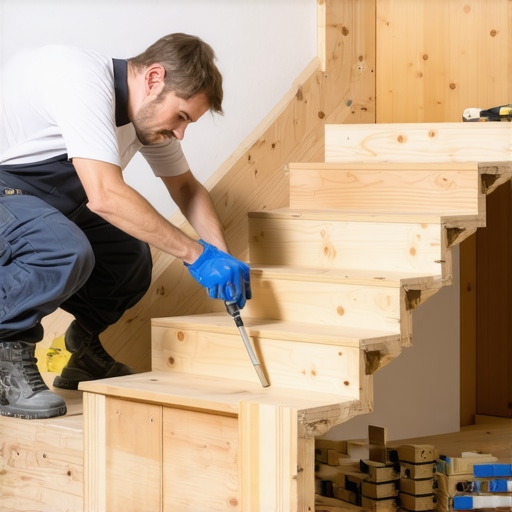
Think about the anatomy of a stair stringer. It is usually a 2×12 piece of Southern Yellow Pine or Douglas Fir cut into a saw-tooth pattern. These materials are notorious for having high moisture content when they leave the lumber yard. As they dry out in the conditioned space of a home, they twist. A nail that was tight in July will be loose in January. If you rely solely on screws, you might think you are safe. However, even screws can snap if the house settles or if the tread is wide-plank hardwood like White Oak or Hickory which exerts massive force when it moves. The double glue method solves this by providing a continuous bond across the entire surface area of the stringer. Instead of three or four points of contact provided by nails, you have hundreds of square inches of adhesive contact.
“A floor is only as good as the subfloor beneath it; deflection is the enemy of every joint.” – Master Flooring Axiom
Molecular reality of silane modified polymers
Silane modified polymers represent the pinnacle of flooring adhesive technology because they provide high green grab and permanent elasticity without the use of solvents or isocyanates. These adhesives cure by reacting with the moisture in the air and the subfloor, creating a cross-linked bond that is virtually indestructible.
When we talk about double gluing, we are often talking about using a primary structural adhesive on the stringers and a secondary, thinner spread of specialized flooring glue on the back of the tread itself. The primary adhesive fills the gaps. If your stringer is not perfectly flat, and let us be honest, they never are, the thick bead of polyurethane acts as a shim. It fills the voids where air would otherwise trapped. The secondary glue ensures that there is no skinning over. When the two adhesive layers meet, they fuse at a molecular level. This is why we avoid water-based glues for this application. Water-based adhesives can cause the wood to swell, leading to cupping or warping before the glue even has a chance to set. You want something that is moisture-cured. It actually gets stronger in the presence of humidity. This is the same technology used to bond windshields into cars or panels onto skyscrapers. It is designed to handle the shear forces of someone running up the stairs.
The 1/8 inch dip that ruins the tread
Precision in floor leveling is the difference between a high-end architectural finish and a DIY disaster that will fail within the first year. Any deviation greater than 1/8 inch over a ten foot span will cause laminate or hardwood to flex, eventually snapping the locking mechanisms or breaking the adhesive bond.
Before you even touch a tube of glue, you must address the subfloor and the stringers. If I am installing laminate or engineered wood on the landings between stairs, I am looking for perfection. I use a long straightedge to find the low spots. If I find a dip, I am not just filling it with cardboard or extra underlayment. I am using a high-flow, cementitious leveling compound. I want the surface to be like glass. On the stairs themselves, the stringers must be planed down if they are high or shimmed with marine-grade plywood if they are low. The double glue method is powerful, but it cannot fix a structural slope that is outside of the tolerance of the wood itself. If the tread is not sitting flat, the glue will be unevenly distributed, leading to some areas that are over-stressed and others that are under-supported.
The checklist for a permanent bond
To ensure your stairs remain silent for the next thirty years, follow this technical protocol. Skipping even one of these steps introduces a point of failure into the system.
- Acclimate all wood materials to the home environment for at least 72 hours until moisture content is within 2 percent of the subfloor.
- Clean all surfaces with a vacuum and a tack cloth to remove every grain of sawdust that could interfere with the adhesive bond.
- Apply a 1/4 inch V-notch bead of moisture-cured polyurethane to the top of the stringer.
- Back-butter the tread with a thin layer of the same adhesive or a compatible silane-modified polymer.
- Set the tread into place with a slight sliding motion to collapse the glue ridges and ensure full coverage.
- Secure the tread with 15-gauge finish nails or screws in hidden locations to hold it under tension while the glue cures.
- Wipe away any squeeze-out immediately using a manufacturer-recommended cleaner like mineral spirits.
Comparative analysis of stair bonding materials
The choice of adhesive depends on the material of the tread and the condition of the stringers. Not all glues are created equal in the world of stair geometry.
| Adhesive Type | Bond Strength (PSI) | Elasticity | Best Use Case |
|---|---|---|---|
| Polyurethane | 350 – 500 | High | Solid Hardwood Treads |
| Silane Modified | 250 – 400 | Very High | Engineered Wood & Laminate |
| PVA (Wood Glue) | 3000+ | None | Joint Assembly only |
| Construction Glue | 150 – 300 | Low | General Framing |
As you can see, the bond strength of PVA wood glue is massive, but its elasticity is zero. If you use standard wood glue on a stair tread, the first time the wood expands, the bond will brittle and snap. This is why we use polyurethane or silane-modified polymers. They allow for the dance of the seasons. The wood can breathe, but it stays anchored to the structure. This is also why we don’t use