The ‘Cardboard Trick’ for protecting your new laminate during a move
Moving furniture across a new laminate floor is a recipe for structural failure if you treat the surface like a piece of indestructible plastic. Most guys skip the leveling compound. They think the underlayment will hide the dip. It won’t. I spent three days grinding concrete on a job last month just so the floor wouldn’t click like a castanet. That experience taught me that the surface is only as strong as the preparation below it. When you move heavy appliances or oak dressers, the pressure is not just on the wear layer. It is on the locking mechanisms and the subfloor integrity. If you have a 1/8 inch dip in your slab that you did not level, a heavy refrigerator leg will snap the tongue and groove joint of your laminate the moment it rolls over that void. I have seen fifteen thousand dollar floors ruined by a single sofa leg because the homeowner did not understand the physics of point-load pressure.
The strategic utility of corrugated cardboard for impact resistance
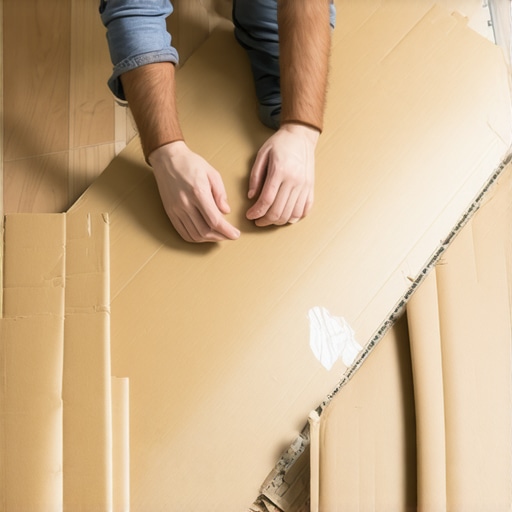
Corrugated cardboard provides a sacrificial compression layer that distributes the point load of heavy furniture across a wider surface area of the laminate. This prevents the high-density fiberboard core from fracturing under sudden weight. By using double-walled cardboard, you create a buffer that absorbs friction and prevents surface scratching during transit. When you slide a heavy object, the friction generates heat and micro-abrasions. Laminate is essentially a photograph of wood glued to a pulped wood core and topped with a clear layer of aluminum oxide. While aluminum oxide is incredibly hard, it is brittle. A grain of sand trapped under a moving box acts like a diamond tipped glass cutter. Cardboard acts as a trap for these particulates, embedding them into the soft cellulose fibers of the paper rather than allowing them to grind against the melamine wear layer. This is why professional installers keep stacks of clean, dry boxes on hand during the final phase of any project.
“A floor is only as good as the subfloor beneath it; deflection is the enemy of every joint.” – Master Flooring Axiom
The physics of the subfloor and why leveling matters
Before you even lay down a single sheet of cardboard, you must understand what is happening beneath the planks. If your floor leveling was not performed to a tolerance of 3/16 of an inch over a 10 foot radius, your laminate is floating over air pockets. When you move a heavy dresser, the laminate flexes into these pockets. This is called vertical deflection. Over time, this movement fatigues the locking system. During a move, this fatigue is accelerated. I have walked into jobs where the laminate was cupping because the installer ignored the moisture in the crawlspace or failed to use a proper vapor barrier. In high-humidity regions like Houston, the moisture makes the HDF core soft. In dry climates like Phoenix, the core becomes brittle. Both conditions make the floor more susceptible to damage during a move. If you are moving over a carpet install that transitions into laminate, the height difference creates a trip hazard for your dollies. You must ramp these transitions with extra layers of cardboard to avoid chipping the edges of the laminate planks.
Selecting the right materials for floor protection
Not all cardboard is equal. You want to avoid the thin, single-wall boxes found at grocery stores. These collapse under the weight of a washing machine. You need heavy-duty, double-wall corrugated sheets. I prefer the boxes used for shipping large appliances or specialized floor protection rolls like Ram Board. The corrugation is the key. The arches inside the cardboard provide vertical strength while the liners provide lateral stability. If you are moving through wet areas like showers or kitchens, the cardboard must remain dry. Wet cardboard loses its structural integrity and can actually trap moisture against the laminate, causing the seams to swell. This is known as peaking. Once the edges of laminate peak, they never go back down. You are looking at a full replacement of the affected area. Always use blue painter tape to secure the cardboard. Never use duct tape or packing tape directly on the floor. The adhesive in duct tape can chemically bond with the wear layer and leave a permanent residue or even pull the finish off if left too long.
| Protection Material | Impact Resistance | Moisture Sensitivity | Recommended Use |
|---|---|---|---|
| Single-Wall Cardboard | Low | High | Light boxes and foot traffic |
| Double-Wall Corrugated | Medium | Medium | Furniture and heavy appliances |
| Masonite Sheets | High | Low | Heavy dollies and refrigerators |
| Plastic Film | Zero | Low | Dust protection only |
The danger of heavy point loads on floating systems
Laminate is a floating floor system. It is not nailed or glued to the subfloor. It needs to move as a single unit as temperature and humidity change. This is why we leave expansion gaps at the perimeter. If you place a massive kitchen island or a heavy pool table on the floor, you effectively pin it to the subfloor. This prevents the floor from breathing. During a move, if you stack all your heavy boxes in one corner, you are doing the same thing. The floor will try to expand in the other direction and you will get buckling in the center of the room. I always tell clients to spread the weight out. If you must move a heavy object, use the cardboard trick to create a path. This path should be wide enough to accommodate the footprint of the object and the person moving it. The cardboard should be clean. If you use dirty cardboard from a garage, you are just introducing grit that will act like sandpaper under the weight of your furniture.
Step by step guide to the cardboard overlay strategy
- Sweep the floor three times to ensure zero particulates are present.
- Inspect the laminate for any existing peaks or gaps in the locking joints.
- Lay the first layer of double-walled cardboard with the corrugation running perpendicular to the direction of the move.
- Overlap the edges of the cardboard by at least three inches to prevent the sheets from sliding apart.
- Taping the seams of the cardboard to each other, not the floor, to create a monolithic protective mat.
- Place Masonite or plywood on top of the cardboard for extremely heavy items like pianos or safes.
- Check the cardboard periodically for tears or dampness and replace sections as needed.
The relationship between wear layers and impact
Laminate floors are rated by the AC system, which stands for Abrasion Criteria. Most residential floors are AC3. Commercial floors are AC4 or AC5. These ratings tell you how well the floor resists wear from walking, but they do not tell you how well the floor resists impact. A heavy hammer dropped on an AC5 floor will still dent the HDF core. This is why the cardboard trick is non-negotiable. The aluminum oxide top coat is hard, but the core is still just compressed wood fiber. If the core is crushed, the visual layer is compromised. The cardboard acts as an external shock absorber. It takes the initial energy of the impact and dissipates it. Think of it like a helmet for your floor. You wouldn’t go into a construction zone without a hard hat. Do not go into a move without a cardboard barrier.
“Deflection is the silent killer of click-lock flooring systems; a flat subfloor is a permanent floor.” – TCNA Installation Manual Reference
Environmental factors and laminate stability
The climate inside your home during the move is just as important as the protection on top of the floor. If the HVAC system is turned off during the move, the humidity will spike. Laminate absorbs moisture from the air. The planks will grow. If they hit the wall because the installer didn’t leave a big enough gap, the floor will lift. Moving heavy furniture across a floor that is already under stress from expansion is a disaster. You will hear the joints popping. This is the sound of the locking mechanism shearing off. Keep the air conditioning running. Keep the humidity between thirty and fifty percent. If you are moving in a rainy region, use a walk-off mat before people step onto the cardboard. If the cardboard gets wet, it becomes a sponge that holds water against the HDF seams, leading to irreversible swelling and mold growth in the underlayment. Professionalism in flooring is about controlling every variable, from the moisture in the concrete to the grit on the bottom of a mover’s shoe.