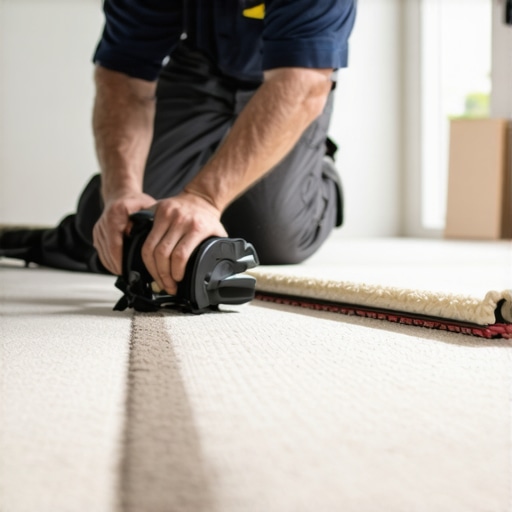
How to Stretch a Carpet That Was Cut Slightly Too Narrow
I have spent twenty five years on my knees with a moisture meter and a level. My knees click like a ratchet every time I stand up, and my hands smell permanently of oak dust and floor wax. I have seen every shortcut in the book. Most guys think a floor is just something pretty you walk on, but to me, it is a structural engineering challenge. If you ignore the physics of the subfloor, you are building on a foundation of lies. I spent three days grinding concrete on a job last month just so the floor would not click like a castanet because the previous guy thought leveling compound was optional. It was not. That same level of precision applies to carpet. When a carpet is cut too narrow, most installers panic or try to kick it into place with a knee kicker. That is a amateur move that leads to ripples and failed seams within six months.
The structural disaster of a short cut
Stretching a short carpet requires a power stretcher to exert over four hundred pounds of force on the backing to achieve the necessary elongation for a proper tuck. You cannot solve a narrow cut with a knee kicker alone. The knee kicker is a tool for positioning, not for the primary stretch. When you are dealing with a shortage of a half inch or even an inch across a room, you are fighting the molecular structure of the carpet backing. Most modern carpets use a dual-backing system. The primary backing holds the yarn tufts, while the secondary backing, usually made of a woven polypropylene known as ActionBac, provides the dimensional stability. To get that extra inch, you have to physically deform that secondary backing without snapping the thermoplastic resins that hold the whole thing together. It is a game of tension and heat. If the room is cold, the latex in the backing is brittle. It will snap before it stretches. You need the room at seventy degrees Fahrenheit for at least forty eight hours before you even think about putting a stretcher on it. This is why acclimation is not a suggestion; it is a law of physics in the flooring world.
“A floor is only as good as the subfloor beneath it; deflection is the enemy of every joint.” – Master Flooring Axiom
The physics of the power stretcher head
A power stretcher works by using leverage to create linear tension across the entire width of the carpet roll to bridge gaps. You set the foot of the stretcher against the baseboard on the opposite wall, usually using a piece of scrap lumber to spread the load and prevent punching a hole through the drywall. The head of the stretcher has teeth that bite deep into the primary backing. When you push that lever down, you are not just moving carpet. You are expanding the weave. In a narrow-cut situation, you have to overstretch. This means pulling the carpet until it is actually a quarter inch past the tack strip. You then use a stay-nail to hold that tension in the middle of the room while you work the edges. This is high-stakes work. If the tack strip is not nailed into the subfloor with hardened steel ring-shank nails, the tension will rip the strip right off the floor. I have seen guys lose an eye when a tack strip flew up like a piece of shrapnel because they tried to stretch a short carpet on a rotted subfloor.
Why humidity determines your stretching limit
Humidity levels in the home act as a lubricant for the synthetic fibers in a carpet backing which allows for more aggressive stretching. If you are in a dry climate like Phoenix, the polypropylene fibers are stiff. They have no give. In a high-humidity environment like Houston, the fibers are more relaxed, but they also have a higher risk of “creep,” which is the tendency of a material to move back to its original shape over time. When fixing a narrow cut, you must account for the ambient moisture. I always check the subfloor moisture content even for carpet. If the plywood is at fifteen percent, that moisture is going to migrate into the carpet backing. If you stretch it tight while it is damp and then the house dries out, that carpet is going to shrink and pull right off the tack strips. You will be left with a gap at the baseboard that looks like a mistake from a budget motel. You want the carpet to be at equilibrium with the room’s long-term climate before you apply the final tension.
| Backing Type | Stretch Coefficient | Standard Tension (lbs) | Maximum Elongation (%) |
|---|---|---|---|
| Jute Backing | High | 350 | 2.0 |
| ActionBac (Poly) | Medium | 450 | 1.5 |
| SoftBac | Low | 300 | 1.0 |
| Unitary Backing | None | 150 | 0.5 |
The chemistry of the thermoplastic seam
Fixing a narrow carpet cut often involves adding a sliver of material via a heat-welded seam using high-solids thermoplastic adhesive tape. Sometimes the stretch just is not there. The physics of the material reach a breaking point. In those cases, you have to perform a “fill.” You take a remnant piece, matching the pile direction perfectly. You cannot just tape it. You have to use a premium seaming tape with a high adhesive count. When the iron melts that glue, it has to penetrate both the backing of the main carpet and the backing of the filler strip. I prefer a four-inch wide tape for these repairs instead of the standard three-inch. It gives more surface area for the bond. You also have to use a seam sealer on the cut edges. If you do not seal the edges, the yarn will unravel at the molecular level, and within a year, the seam will look like a frayed piece of rope. I have seen $50-a-yard wool carpet ruined because some installer forgot a five-dollar bottle of sealer.
The invisible geometry of tack strip spacing
Tack strip placement must be exactly one half of the thickness of the carpet away from the baseboard to facilitate a proper tuck. If the carpet is cut narrow, your margin for error on the gully disappears. Normally, you have a little bit of slack to play with. On a short cut, you have nothing. I often have to double-up the tack strips. I will install a second row of strips right behind the first one. This gives the carpet twice as many pins to grab onto. It distributes the tension. Instead of all four hundred pounds of pull hitting one row of pins, it is spread across two. This prevents the pins from tearing through the backing. It is a trick I learned from an old-timer in Jersey who used to do custom installs for mansions. He always said that if you can see the pins, you have already lost the battle. The tuck must be deep and firm.
“Consistency in the gully is the hallmark of a master; a wandering line is the mark of a tired mind.” – Master Flooring Axiom
Essential toolkit for narrow carpet correction
- Power stretcher with at least four extension poles to reach across the room.
- Stay-nails or a carpet spreader to maintain tension during the tuck.
- High-temp seaming iron with a shielded base to prevent scorching.
- Dual-row tack strips for high-tension perimeters.
- Latex-based seam sealer to prevent edge fraying at the transition.
- Crain 505 or similar heavy-duty knee kicker for fine-tuning the corners.
How to manipulate the secondary backing
Manipulating the secondary backing involves using localized heat to soften the polypropylene weave to allow for mechanical expansion. If I have a spot that is just a quarter inch too short, I will sometimes use a steamer. You have to be careful not to delaminate the carpet. Too much heat will cause the primary and secondary backings to separate, which is a total failure. But a little bit of steam makes the plastic more pliable. You steam it, you hook the power stretcher, and you pull. As it cools under tension, it sets in that new, elongated position. It is basically the same principle as heat-setting plastic in a factory. You are re-engineering the carpet on-site. Most people think I am just kicking a tool, but I am actually managing the thermal properties of synthetic polymers. It is about understanding that the carpet is a living thing that reacts to the environment. If you treat it like a static object, it will fail you every time. You have to respect the material, or the material will humiliate you in front of the homeowner.