Why Your New Carpet Has a Strange Pattern in the Middle
The ghost in the subfloor
Most guys skip the leveling compound. They think the underlayment will hide the dip. It won’t. I spent three days grinding concrete on a job last month just so the floor wouldn’t click like a castanet. When you see a strange pattern appearing in the middle of your carpet install, you are likely looking at telegraphing from a subfloor that was never properly prepped. Subfloor prep and floor leveling are the invisible foundations of a quality carpet installation that lasts for decades rather than months.
You walk into the room and notice a shadow. It looks like a grid. Or maybe it looks like a long, straight line that does not match the furniture layout. I have seen this a thousand times. The homeowner thinks the carpet is defective. The retailer blames the mill. But I know better. I have spent twenty-five years on my knees with a straightedge. That pattern is the ghost of the floor underneath. If you have plywood seams that were not sanded flat, they will show. If you have a concrete slab with a 1/8 inch dip, the carpet pad will compress into that dip, and the light will hit the fibers at a different angle. This is the physics of light and density. It is not a manufacturing error. It is a failure of the carpet install process. We live in an era where speed is prioritized over craft. Builders throw down a subfloor and expect the carpet guy to fix it with a thick pad. It does not work that way. A thick pad actually makes the problem worse. It allows more movement, which creates more friction, which leads to shading or pooling.
“A floor is only as good as the subfloor beneath it; deflection is the enemy of every joint.” – Master Flooring Axiom
Why your subfloor is lying to you
Subfloor flatness is defined by the Industry Standards as a deviation of no more than 3/16 inch over 10 feet or 1/8 inch over 6 feet. When these tolerances are ignored, the carpet fibers will eventually crush or lean in a way that creates a permanent visual pattern known as telegraphing. If the subfloor is uneven, the cushion cannot support the carpet backing evenly.
Let’s talk about the chemistry of the slab. Concrete is a sponge. It looks solid, but it is a network of capillaries. In high humidity regions like Houston or New Orleans, that slab is constantly exhaling moisture. If the installer did not use a moisture barrier, that vapor hits the SBR latex in the carpet backing. This causes the backing to swell and shrink. Over time, the carpet loses its tension. When a carpet is loose, the pile begins to fall over in different directions. This creates what we call shading. It looks like a water stain, but it is just light reflecting off the side of the fiber instead of the tip. This is particularly common near showers or bathrooms where the humidity is higher. I have seen laminate floors buckle for the same reason. People think laminate is bulletproof, but it is just sawdust and glue. It needs an expansion gap. Carpet needs tension. Without tension, you get patterns.
| Metric | Standard Requirement | Impact of Failure |
|---|---|---|
| Subfloor Flatness | 1/8 inch per 6 feet | Visible telegraphing and shadowing |
| Moisture Content | <3 lbs per 1,000 sq ft | Latex breakdown and delamination |
| Tensioning | 1% stretch in both directions | Rippling and accelerated wear |
| Cushion Density | Minimum 6 lbs per cubic foot | Premature pile crush |
The 1/8 inch that ruins everything
Precision leveling is the only way to prevent telegraphing of subfloor imperfections through the carpet and padding. If a subfloor has a dip deeper than 1/8 inch, the carpet cushion will bridge the gap initially but will eventually collapse into the void. This collapse changes the pile height relative to the rest of the floor, creating a visual anomaly.
I carry a 10 foot box beam level on every job. If I see a gap, I reach for the self-leveling underlayment. I am talking about a high-flow, calcium aluminate based cement. This stuff has a compressive strength of over 4,000 PSI. You pour it, and it finds the low spots. But most guys are too cheap. They want to get in and out in four hours. They skip the primer. They skip the leveler. Then the homeowner calls me six months later asking why there is a strange pattern in their new carpet. It is because the installer did not understand the molecular bond required for a subfloor to remain stable. When you are near showers, the alkalinity of the concrete can even react with the carpet adhesive if it was a glue-down job. This creates a soapy film that lets the carpet move. Movement is the enemy. Stability is the goal. I tell my apprentices that we are not just laying carpet. We are engineering a walking surface. If the subfloor is not flat, the carpet is just a $3,000 blanket draped over a pile of rocks.
“The carpet must be tensioned to a minimum of one percent in both width and length to prevent rippling.” – Flooring Industry Standard
The chemistry of failure
Latex delamination occurs when the secondary backing of the carpet separates from the primary backing due to moisture or mechanical stress. This separation creates a void that appears as a bubble or pattern on the surface of the floor. Poorly executed carpet install routines often lead to this structural failure within the first two years.
Look at the mil-thickness of the wear layer on a piece of laminate. It is rigid. It bridges small gaps. Carpet is the opposite. It is a high-definition map of the floor underneath. If you have floor leveling issues, the carpet will find them. I once saw a floor where you could see every single screw head in the plywood. The guy didn’t countersink them. He thought the pad would hide them. It didn’t. Within three months, the carpet fibers over those screws had worn down to the backing. It looked like the floor had the chickenpox. This is why a checklist is mandatory for any pro installer.
- Check subfloor moisture with a calcium chloride test
- Grind down high spots in the concrete slab
- Fill low spots with a high-strength leveling compound
- Ensure all plywood seams are sanded and countersunk
- Use a power stretcher for every room, no exceptions
- Verify cushion density matches the carpet manufacturer specs
Physics of the power stretcher
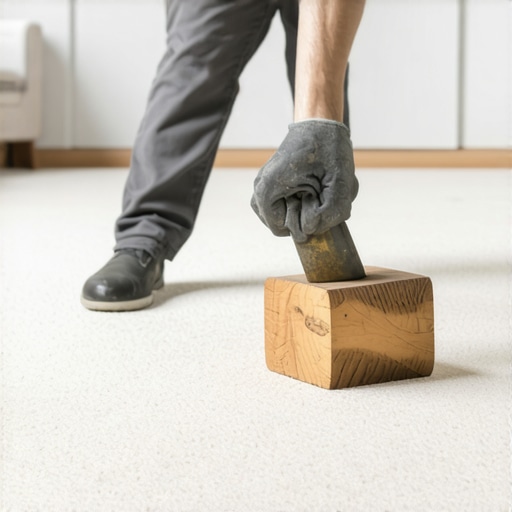
Power stretching is a mandatory requirement for a carpet install to ensure the textile remains under constant tension across the entire room. A knee kicker is only for positioning, but a power stretcher uses mechanical leverage to pull the carpet backing to its limit of elasticity. Without this tension, the carpet will ripple and create irregular patterns.
When I see strange patterns, I often check the perimeter. If the carpet is not tucked tightly into the gully between the tack strip and the baseboard, it will shift. That shift creates stress lines. Think of it like a drumhead. If one side is loose, the middle will sag. That sag creates a shadow. And because carpet is usually nylon or polyester, these fibers have a memory. Once they are bent out of shape by a ripple or a dip, they do not like to stand back up. You can steam them. You can rake them. But the pattern will return. It is a structural memory issue. This is why I am so obsessed with floor leveling. You have to get it right before the carpet even leaves the warehouse. If you are installing near showers, you also have to worry about wicking. Moisture gets under the baseboard, travels through the cushion, and pulls dirt to the surface of the carpet. This creates a dark pattern around the edges. It is not dirt from your feet. It is dirt from the subfloor being pulled up by evaporation.