The reason your shower niche is always wet
I spent three days grinding concrete on a job last month just so the floor wouldn’t click like a castanet. Most guys skip the leveling compound because they think the underlayment will hide the dip. It won’t. That same lazy logic is why your shower niche is currently a breeding ground for mold and standing water. I have seen million-dollar mansions with master baths that smell like a swamp because a tile setter forgot that gravity is not a suggestion. When I walk onto a job site, I smell the oak dust and the WD-40 on my tools, and I know exactly where the shortcut was taken. A shower niche is not a bookshelf. It is a hydraulic catch-basin that must be engineered to shed every single molecule of water back toward the primary drain system. If your niche is wet, you are looking at a failure of structural physics and chemical bonding.
The geometry of standing water
Standing water in a shower niche usually stems from a lack of positive pitch on the bottom sill. If the horizontal surface of the niche is perfectly level or sloped backward, capillary action and surface tension will trap moisture against the grout lines and waterproofing membrane indefinitely.
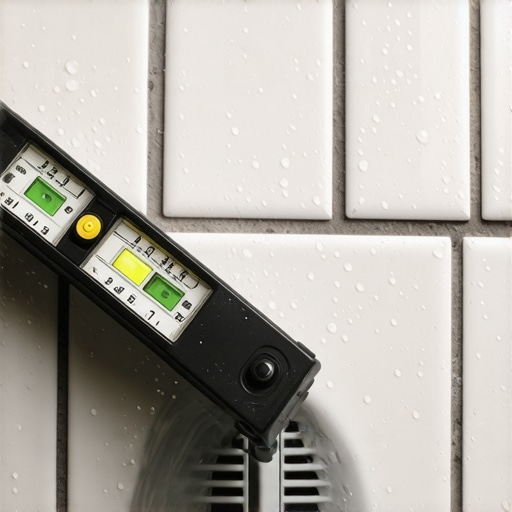
You have to understand the way water behaves on a molecular level. Water molecules have a high degree of cohesion. They want to stick together. If you provide a flat surface, they will pool. If you provide a backward slope, they will migrate into the wall cavity. The Tile Council of North America is very clear about this. You need a slope. It does not have to be visible to the naked eye, but it must be functional. When I install a niche, I use a digital level to ensure I have at least a 1/16 to 1/8 inch pitch toward the shower floor. Without that pitch, the water just sits there. It saturates the grout. Once the grout is saturated, the water begins to work on the thin-set. Standard thin-set is porous. It acts like a wick. If your installer used a cheap, non-modified mortar, that water is traveling straight to the studs.
“A floor is only as good as the subfloor beneath it; deflection is the enemy of every joint.” – Master Flooring Axiom
The myth of the waterproof grout
Grout is not waterproof and should never be used as the primary moisture barrier in a shower install or tile project. Most cementitious grout is highly porous and will absorb liquid water through capillary suction, leading to saturated sub-structures and potential mold growth behind the tile face.
I see it every week. A homeowner tells me they don’t need a full waterproofing system because they used “expensive grout.” That is a lie. Grout is just sand and cement with some pigment. It is a filter. Water passes through it. The real work happens behind the tile. If your niche is wet, the water might be trapped between the tile and the membrane. This is called a sandwich failure. If the installer applied a liquid membrane like RedGard or Hydro Ban but didn’t let it cure, or if they applied it over a dusty substrate, the bond fails. The water gets behind the tile, hits the membrane, and has nowhere to go because the niche is level. It sits there and rots the thin-set. It turns into a gray, slimy sludge. This is why I prefer pre-formed high-density polystyrene niches. They are manufactured with the pitch already built into the frame. You can’t mess it up unless you install the whole thing upside down.
The 1/8 inch that ruins everything
A deviation of 1/8 inch in floor leveling or niche placement can cause hydrostatic pressure to build up in shower systems. This structural inaccuracy leads to joint failure, cracked tiles, and water infiltration that bypasses the flashing and integrated membranes.
Think about the precision required for a carpet install or a laminate floor. If the subfloor has a hump, the laminate will bounce and eventually the tongue-and-groove locking system will snap. In a shower, the stakes are higher. If the niche sill is not perfectly flat across its width but sloped correctly toward the front, you get a birdbath effect. I have seen niches where the middle of the tile was slightly lower than the edges. The water pools in the center. It never dries. The homeowner wipes it down, but the moisture is already deep in the micro-fissures of the grout. Eventually, the efflorescence starts. Those white, crusty salts appearing on your tile? That is the sound of your shower dying. It is the mineral deposits left behind as the trapped water tries to evaporate through the face of the stone.
| Material System | Moisture Resistance | Typical Pitch Required | Failure Point |
|---|---|---|---|
| Pre-formed Foam | High | Built-in 1/8 inch | Improper Flashing |
| Custom Framed | Variable | Manual 1/8 inch | Structural Sag |
| Liquid Membrane | High | Depends on Substrate | Pinholes/Thinning |
| Sheet Membrane | Superior | Depends on Substrate | Corner Folds |
The chemistry of modified thin set
Polymer-modified thin-set uses latex or acrylic additives to increase bond strength and flexibility in wet environments. This chemical composition allows the mortar to resist water immersion and thermal expansion better than standard dry-set mortars used in basic flooring.
When you are dealing with a niche, you are dealing with multiple planes meeting at 90-degree angles. These are stress points. Every house shifts. If you used a cheap, brittle mortar, those internal corners in the niche will crack. Once they crack, the water has a highway to the wood. I always tell my guys to use the highest grade of modified thin-set. It costs more, but it has the flexibility to handle the expansion and contraction of the house. You want a bond that is stronger than the tile itself. If you are doing a carpet install, you might get away with cheap tack strips. If you are doing a shower, you don’t cut corners on the chemistry. You need those polymers to bridge the microscopic gaps between the waterproofing and the tile back.
“The TCNA Handbook emphasizes that all shower receptors must be sloped to the drain, and this includes all horizontal surfaces such as seats and niches.” – Master Flooring Axiom
The subfloor secret to dry walls
A stable subfloor is the foundation of a dry shower niche because deflection in the floor joists causes wall movement. If the floor leveling was not completed to L/360 standards, the lateral stress will tear the waterproofing seals inside the shower wall cavities.
It sounds crazy, but your wet niche might be caused by a bouncy floor ten feet away. If the bathroom floor is not rigid, the walls will move. Even a millimeter of movement is enough to break a silicone bead or a grout joint. This is why I am a stickler for floor leveling. I don’t care if you are putting down laminate or expensive marble. You start with the structure. If I find a dip in the subfloor, I fix it with self-leveling underlayment or I sister the joists. You cannot build a waterproof box on a moving base. It will fail. The niche is the weakest point because it has the most joints. It is the first place to show the signs of a failing structure.
- Use a digital level to verify 1/8 inch pitch on the sill.
- Apply two coats of liquid membrane beyond the manufacturer’s suggested thickness.
- Ensure 100 percent silicone is used in all change-of-plane joints.
- Check for subfloor deflection before starting the tile work.
- Acclimate all materials to the room’s humidity for 48 hours.
The reason your niche is wet is likely a combination of poor pitch and porous materials. It will buckle if the moisture reaches the wood. You need to treat your bathroom like an engine. Every part has a tolerance. If you exceed that tolerance, the system fails. Stop looking at the color of the tile and start looking at the angle of the shelf. That is where the professional separates himself from the amateur. I have spent 25 years looking at these failures. Don’t be the next homeowner calling me to tear out a moldy wall because you thought a level shelf looked better than a sloped one.