The ‘Double-Cut’ Trick for Invisible Carpet Seams in Large Rooms
I spent three days grinding concrete on a job last month just so the floor wouldn’t click like a castanet. That is the reality of this trade. Most guys skip the leveling compound. They think the underlayment will hide the dip. It won’t. I was in a massive custom build last year where the homeowner spent forty thousand on high-end wool. The previous crew had left a seam right in the middle of the transition from the master suite to the sitting room. It looked like a topographical map of the Andes. I had to rip it all out and start with the subfloor. If the substrate is not within one eighth of an inch over a ten foot radius, your carpet seam is destined to fail. Carpet is a textile, but it behaves like a structural membrane when stretched to its limit.
The physics of the double-cut method for perfect joins
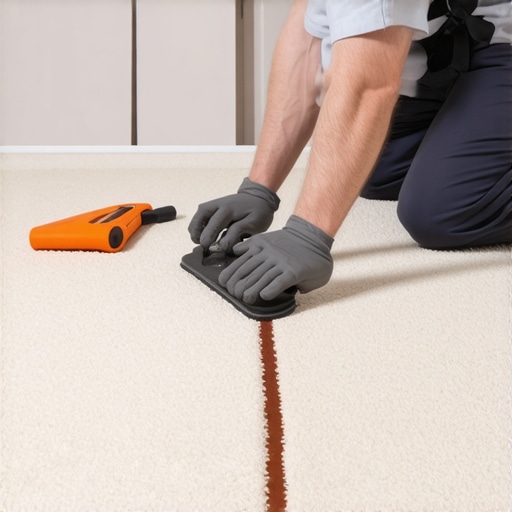
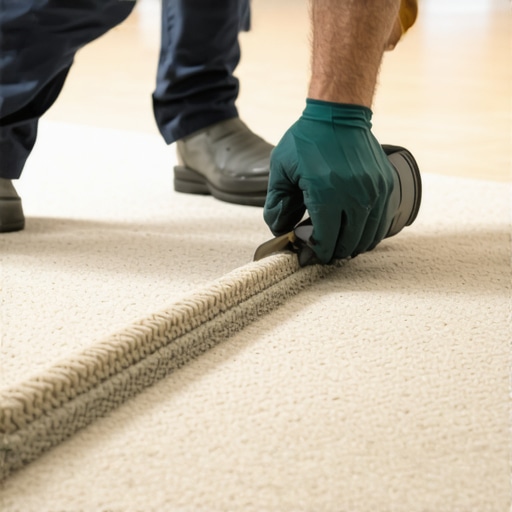
The double-cut trick involves overlapping two pieces of carpet by roughly three inches and cutting through both layers simultaneously with a specialized wall trimmer or a sharp utility blade. This technique ensures that the edges are exact mirror images of one another, eliminating gaps or overlaps that occur with standard row-cutting. By slicing through the primary and secondary backings in one motion, you create a microscopic interlocking fit that prevents the common ‘peaking’ seen in amateur installs.
“A floor is only as good as the subfloor beneath it; deflection is the enemy of every joint.” – Master Flooring Axiom
Why your subfloor is lying to you
Subfloors are often the primary reason for seam visibility in large residential spaces. Even if the carpet is cut perfectly, a dip in the plywood or a high spot in the concrete slab will cause the fibers to splay outward or compress together unnaturally. This creates a shadow line that people mistake for a bad seam. You must use a straightedge to identify these variances before the first tack strip is nailed down. Floor leveling is not optional. If you are working over a crawlspace, you must verify that the moisture content of the wood is within two percent of the indoor environment. Excess moisture will cause the jute or synthetic backing to swell, which puts immense pressure on the seam sealer and eventually leads to delamination.
The chemistry of thermoplastic adhesive and seam integrity
Most installers treat seam tape as a simple sticker. In reality, the bond is a chemical reaction between the hot melt glue and the polypropylene secondary backing of the carpet. The iron must be set to the specific melting point of the adhesive, usually around three hundred and fifty degrees Fahrenheit. If the iron is too hot, you risk ‘smoking’ the carpet fibers or melting the yarn. If it is too cold, the glue will not penetrate the weave. You need to move the iron at a pace of approximately two feet per minute to allow the heat to radiate into the backing without burning the nap.
The 1/8 inch that ruins everything
Precision in flooring is measured in fractions of an inch. When you perform a double-cut, the angle of your blade is the difference between a hidden seam and a disaster. If the blade is tilted even five degrees, you create a beveled edge. When those two beveled edges meet, they form a V-shape. This V-shape allows the carpet pile to fall into the gap, creating a dark line. You must keep the blade perfectly perpendicular to the floor. Use a fresh blade every ten feet. Steel dulls faster than you think when it is rubbing against the abrasive silica found in many carpet backings.
Tools every professional must carry
To execute an invisible seam, you need more than just a knife. You need a suite of tools designed to manage the tension of the textile.
- Power stretcher for uniform tension across the room
- Row spreader to separate the fibers before cutting
- Seam iron with a heat shield
- Seam tractor with star rollers to press the backing into the glue
- Stay-tacks to hold the carpet in place during the cooling phase
Managing carpet pile and row direction
Every carpet has a ‘grain’ or a pile direction. If you flip one piece of carpet one hundred and eighty degrees, the light will hit the fibers differently, making the two pieces look like different colors. This is called ‘shading’ or ‘pooling.’ Before you even think about the double-cut, you must verify the ‘run’ of the carpet. In large rooms, this means planning your cuts so that all seams run parallel to the primary light source, such as a large window or sliding glass door. A seam that runs perpendicular to the light will always cast a shadow, no matter how well it is cut.
Comparison of seam tape performance
| Tape Type | Strength Rating | Best Use Case |
|---|---|---|
| Paper Backed | Low | Low traffic bedrooms |
| Silicone Shielded | High | High traffic hallways |
| Reinforced Mesh | Highest | Commercial heavy-duty areas |
The ghost in the expansion gap
Expansion gaps are not just for hardwood or laminate. Even carpet requires a tiny amount of breathing room at the perimeter. If you stretch the carpet too tight against a wall without a proper tuck, you create a ‘tented’ effect. This tension pulls at the seams in the center of the room. Over time, the constant stress will snap the thermoplastic bond. This is why you see seams opening up after three or four years. It is not the glue failing; it is the installation geometry being incorrect from day one.
“The durability of a textile installation is inversely proportional to the amount of deflection in the subfloor.” – Master Flooring Axiom
How regional humidity ruins your carpet tension
In high humidity environments like Houston or Miami, the fibers of a carpet will naturally relax as they absorb moisture from the air. If you install a carpet on a dry day and don’t account for this, the floor will become wavy within a month. Conversely, in the dry desert of Phoenix, the backing can become brittle. You must acclimate the carpet to the room for at least forty-eight hours. This allows the molecular structure of the backing to stabilize. If you are doing a shower remodel nearby or have open floor leveling compounds drying, the humidity will spike. Do not seam the carpet until the wet trades are finished and the HVAC system has been running for two full days.
The mechanics of the star roller and seam cooling
Once the seam iron has passed and the glue is molten, you have a window of about sixty seconds to set the seam. This is where the seam tractor comes in. The star rollers are designed to knit the fibers together while simultaneously pushing the backing into the glue. You must apply consistent downward pressure. Do not ‘scrub’ the seam. Use a smooth, forward motion. After tractoring, place a heavy seaming weight or a piece of smooth wood over the area. This prevents the heat from escaping too quickly, which can cause the glue to become brittle. A slow cool ensures a flexible, permanent bond.