The ‘Dime Test’ for Measuring Proper Carpet Stretch
The 1/8 inch that ruins everything
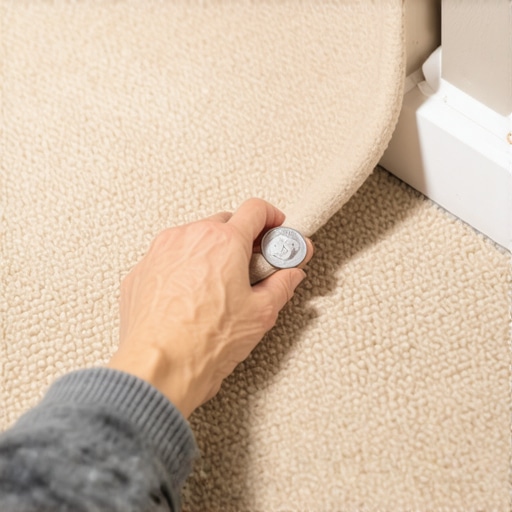
Measuring carpet stretch with the dime test involves lifting the carpet in the center of a room to see if a dime can fit under the ripple before it snaps back. If the carpet lifts high enough to accommodate the coin without immediate tension, the installation lacks the required 1 to 1.5 percent stretch. This failure leads to permanent wrinkles and premature backing delamination within months of traffic.
Most guys skip the leveling compound. They think the underlayment will hide the dip. It won’t. I spent three days grinding concrete on a job last month just so the floor wouldn’t click like a castanet. That job was supposed to be a quick carpet install, but you cannot put a quality product over a subfloor that looks like the rolling hills of Kentucky. I walked into that house and the homeowner was already complaining about the previous laminate job. The planks were separating because the installer ignored a massive dip in the slab. I told them straight. I am not laying a single yard of fiber until this floor is flat. We used a self-leveling underlayment with a high compressive strength, ensuring a base that would not deflect under the weight of furniture. Carpet needs a flat stage just as much as hardwood or tile. Without it, the tension on the tack strips is uneven. You get peaks. You get valleys. Eventually, you get a floor that looks like a crumpled bag of chips.
The physics of synthetic latex backing
The chemistry of a modern carpet is more complex than most people realize. It is not just fluff and some mesh. You have a primary backing, usually a woven polypropylene, where the yarn is tufted. Then you have a secondary backing. These two layers are fused together with a thick coating of SBR latex. This latex is filled with calcium carbonate to give it weight and stability. When I talk about stretching a carpet, I am talking about putting that SBR latex under a specific amount of tension. If you under-stretch, the latex remains relaxed. As people walk on it, the mechanical action of footsteps creates waves. If you over-stretch, you risk shearing the bond between the primary and secondary backing. This is called delamination. Once that bond breaks, the carpet is garbage. The dime test is the field-grade method for ensuring you hit that sweet spot of tension without crossing into the danger zone of structural failure. It is about the resistance of the SBR bond against the force of the power stretcher.
“A floor is only as good as the subfloor beneath it; deflection is the enemy of every joint.” – Master Flooring Axiom
The truth about power stretching versus knee kicking
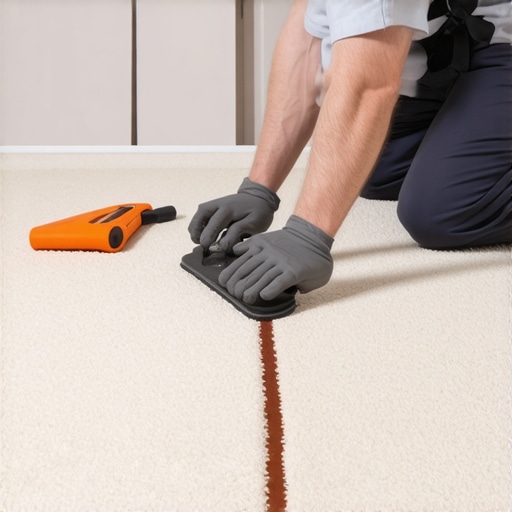
A power stretcher is a mechanical tool that uses a lever system to apply hundreds of pounds of force across the carpet. It consists of a head with adjustable teeth, extension poles, and a tail block that pushes against the opposite wall. Professional standards dictate that a knee kicker is only for positioning or tucking, never for the primary stretch. The dime test proves this every time. I have seen installers try to kick in a 20-foot room. Their knees are bruised, and the carpet looks tight for a week. Then the first humid day hits. The fibers expand. The backing relaxes. Suddenly, there is a ripple big enough to trip a horse. The power stretcher allows for a uniform pull. We are looking for roughly 1 to 1.5 percent elongation in both directions. In a 15-foot room, that is nearly two inches of extra carpet you are pulling onto the tack strips. If you cannot pull that much, the carpet is not truly stretched. It is just lying there, waiting to fail.
| Metric | Residential Standard | Commercial Grade |
|---|---|---|
| Stretch Percentage | 1% to 1.5% | 1.5% to 2% |
| Tack Strip Width | 1 inch | 1.75 inch (Architectural) |
| Latex Bond Strength | 3.0 lbs/inch | 4.0 lbs/inch |
| Underlayment Density | 6 lbs to 8 lbs | 10 lbs to 12 lbs |
Why your subfloor is lying to you
Subfloor preparation is where the amateurs are separated from the mechanics. Whether you are prepping for carpet, laminate, or even showers, the substrate must be structural. A concrete slab may look flat, but it often holds hidden moisture. I never start a job without my moisture meter. If that slab is exhaling water vapor, your carpet backing will rot from the inside out. In the dry heat of Phoenix, the opposite happens. The subfloor can become so parched it sucks the moisture out of any adhesive or leveling compound too quickly, leading to a brittle bond. You have to prime the floor. You have to treat it like a canvas. For laminate jobs, floor leveling is even more critical. A 3/16 inch dip over ten feet will cause the tongue-and-groove locking mechanism to flex every time someone steps on it. Eventually, the plastic or HDF core will snap. You will hear a click. Then a pop. Then you are calling me to rip it out and do it right. The dime test for carpet is essentially the same principle as checking for deflection in a subfloor. It is a measurement of stability.
The ghost in the expansion gap
Expansion gaps are the lungs of a floor. If you do not leave room at the perimeter, the floor will choke. I have seen ‘waterproof’ LVP buckle because the installer pushed it tight against the baseboards. They thought they were being neat. They were actually building a time bomb. When the temperature changes, the floor expands. If it has nowhere to go, it goes up. I once saw a floor that had lifted four inches off the subfloor in the center of a room because it was locked in. The same applies to carpet. If the tack strips are placed too far from the wall, or if the gully is too wide, the carpet cannot be tucked properly. The tension of the stretch is lost. You need a consistent 1/4 inch gully between the tack strip and the baseboard. This allows the carpet to be trimmed and tucked, creating a structural anchor that maintains the tension you worked so hard to achieve with the power stretcher.
- Check subfloor for moisture and PH levels before installation.
- Ensure floor leveling compound has cured for at least 24 hours.
- Use a power stretcher with a tail block for all areas over 10 feet.
- Verify the dime test: lifting the carpet should require significant force.
- Trim the carpet so that exactly 3/8 inch remains for the tuck.
The chemistry of the tack strip bond
Tack strips are not just pieces of wood with nails. They are precision-engineered anchors. The pins are set at a 60-degree angle, designed to bite into the secondary backing of the carpet. When we use the power stretcher, we are forcing the backing over these pins. The pins then lean back, locking the carpet in place. If the subfloor is soft wood or crumbly concrete, those strips will pull right out of the floor. This is why I use architectural strips with three rows of pins for large rooms. More pins mean more surface area. More surface area means better distribution of the 400 pounds of force I am putting on that carpet. If the strip moves even a fraction of an inch, the dime test will fail. The carpet will feel soft. It will feel lazy. A lazy carpet is a dead carpet.
“Modern synthetic backings require mechanical tension to maintain their dimensional stability over time.” – CRI Installation Standards
The 10 cent insurance policy
The dime test is the simplest insurance policy in the industry. After the room is stretched and tucked, go to the center. Reach down and grab the carpet with your thumb and forefinger. Pull up. If you can easily slide a dime underneath the ripple you’ve created, you haven’t put enough muscle into the stretcher. A properly stretched carpet should be as tight as a drum head. It should resist your pull. This tension ensures that as the yarn wears down and the latex ages, the structural integrity of the floor remains. It prevents the carpet from sliding against the cushion. Sliding causes friction. Friction causes heat. Heat causes the cushion to disintegrate into a fine yellow powder. I have pulled up carpets where the cushion was completely gone in the walking paths, all because the installer was too lazy to use a power stretcher and verify his work with a simple coin. Don’t be that guy. Spend the time on your knees. Check the tension. Save the floor. “,