
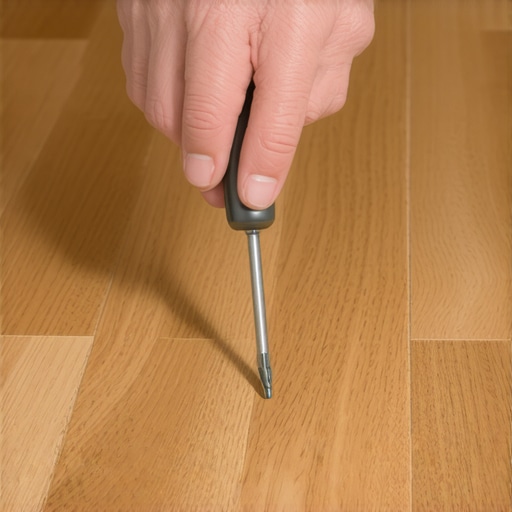
How to Stop Your Laminate Floors from Clicking Like a Typewriter
The hollow rhythm of a footstep on a floating floor tells me everything I need to know about what is happening underneath the planks. Most guys skip the leveling compound. They think the underlayment will hide the dip. It won’t. I spent three days grinding concrete on a job last month just so the floor wouldn’t click like a castanet. The dust was everywhere. It gets in your lungs and your coffee. But when we laid those planks, they felt like solid oak. That is the difference between a floor that functions and a floor that fails. You see, a clicking laminate floor is not just an annoyance. It is a structural cry for help. It means your locking mechanisms are rubbing against each other or the subfloor, grinding down the fragile HDF tongues until they eventually snap. Once they snap, you have a gap. Once you have a gap, you have a floor that needs to be replaced. I have seen fifteen thousand dollar wide-plank installations ruined because the installer was too lazy to check for a two millimeter dip in the plywood. If you want your floor to be silent, you have to respect the physics of the surface.
Why your subfloor is lying to you
Subfloor levelness determines the lifespan of a laminate floor because uneven spots create vertical movement that stresses the locking mechanisms. A subfloor must be flat within 3\/16 inch over a 10-foot radius or 1\/8 inch over 6 feet to prevent the dreaded clicking sound caused by friction and air gaps. When you walk over a low spot, the plank deflects. This downward pressure forces the tongue and groove to slide against one another. If there is even a microscopic layer of grit or sawdust in that joint, it will click. This is why floor leveling is not an optional step. It is the foundation of the entire architectural system. I have walked onto jobs where the builder-grade carpet was pulled up and the laminate was thrown right on top of the raw slab. That is a recipe for disaster. Concrete is never truly flat. It has waves and birdbaths. Without a self-leveling compound, your laminate floor is just a giant percussion instrument.
The physics of the hollow sound
The click-clack noise of laminate floors is caused by the air gap between the plank and the subfloor acting as a resonance chamber. This acoustic phenomenon is known as the drum effect, where the impact of a footstep vibrates through the rigid HDF core and reflects off the hard surface below. To stop the clicking, you must eliminate the void. This involves more than just buying a thick pad. It involves understanding the density of the underlayment. High-density underlayments, like those made from recycled rubber or heavy-duty felt, absorb the energy of the footstep rather than reflecting it. Cheap polyethylene foam pads are mostly air. They compress over time. When they compress, the air gap returns, and so does the noise. You want an underlayment with a high Delta IIC rating to ensure that sound transmission is neutralized at the source.
“A floor is only as good as the subfloor beneath it; deflection is the enemy of every joint.” – Master Flooring Axiom
The 1\/8 inch that ruins everything
Small variances in subfloor height create excessive vertical deflection that eventually causes the mechanical locking systems of laminate planks to fail. Even a 1\/8 inch dip is enough to allow the plank to move significantly under the weight of a grown adult. This movement is the primary source of the clicking sound. When the floor moves down, the tongue of one plank rubs against the groove of the neighbor. This creates a friction-based noise. Over time, this friction heat can actually warp the melamine resin coating on the joint. You must use a straightedge. Not a small level, but a full 10-foot aluminum screed. You mark the dips with a pencil and fill them with a high-compressive strength patch. If you skip this, no amount of expensive underlayment will save your ears from the constant clicking.
| Underlayment Material | Density (lb\/ft³) | Compression Resistance | Sound Dampening |
|---|---|---|---|
| Standard PE Foam | 2.0 | Low | Poor |
| EVA High Density | 4.5 | Medium | Good |
| Recycled Rubber | 25.0 | High | Excellent |
| Natural Cork | 12.0 | High | Very Good |
Chemistry of the underlayment bond
Modern underlayments use cross-linked cell structures to provide both moisture protection and acoustic insulation beneath floating laminate floors. The molecular makeup of these materials is designed to resist long-term compression set. This means the material bounces back after you walk on it. If you use a pad that is too soft, like some of the thick carpet install scraps I have seen people try to reuse, the floor will feel like a trampoline. This is bad. Too much cushion causes the locking mechanisms to pivot beyond their engineered limit. They will snap like dry twigs. You need a material with a high Shore A hardness but enough elasticity to bridge minor subfloor imperfections. This chemical balance is what separates a professional grade underlayment from the junk sold at big-box discount centers.
The ghost in the expansion gap
Expansion gaps at the perimeter of a room are vital because they allow the laminate floor to move as a single unit during humidity changes. Laminate is made of wood fibers. Wood fibers are hygroscopic. They absorb moisture from the air and grow. If you jam the planks tight against the wall or under a heavy kitchen island, the floor has nowhere to go. It will arch. This arching creates a massive air pocket underneath the floor. Every time you step on that arch, the floor slams down against the subfloor. That is the loudest click you will ever hear. It sounds like a gunshot. You must leave at least 3\/8 inch of space around the entire perimeter. Do not fill it with caulk. Do not pin the baseboards to the floor. The floor must be free to float. In areas like showers or bathrooms, you still need that gap, even if you seal the edge with a flexible silicone to prevent topical water from getting underneath.
“Floating floors require a minimum of 1\/4 inch expansion space at all vertical obstructions to prevent bucking and joint stress.” – NWFA Technical Guidelines
The ritual of the pre-install checklist
Before you even open a box of planks, you have to do the dirty work. I have a checklist that I follow on every job. It is not about being fast. It is about being right. Most installers want to get in and out in a day. They leave the homeowner with a floor that clicks for the next ten years. I would rather spend two days on prep and one day on the floor.
- Test concrete moisture using a calcium chloride kit to ensure levels are below 3 lbs per 1,000 square feet.
- Scrape the entire subfloor to remove drywall mud, paint, and wax that could cause friction.
- Use a diamond cup wheel on an angle grinder to take down high spots in the slab.
- Apply a primer to the subfloor before using self-leveling compound to ensure a permanent bond.
- Acclimate the laminate planks in the room for at least 48 hours to match the local humidity.
- Check the moisture content of the wood subfloor to ensure it is within 4 percent of the flooring material.
Molecular zooming into locking mechanisms
The engineering behind a click-lock joint is a marvel of modern manufacturing. These joints are cut with diamond-tipped router bits at speeds exceeding 10,000 RPM. The tolerances are measured in microns. When a floor clicks, you are often hearing the result of a manufacturing defect or, more likely, site-induced stress. If the tongue is too thin, it will vibrate within the groove. This is common in cheap laminate that is less than 8mm thick. I always recommend 12mm laminate. The extra mass of the HDF core provides a more stable joint. The heavier the core, the higher the density. A high-density core resists the moisture changes that lead to the expansion and contraction cycles which eventually loosen the joints and cause the typewriter sound. When you choose a floor, look at the weight of the box. A heavier box usually means a better core and a quieter floor.
Final thoughts on the silent floor
Stopping the clicking sound starts before the first plank is laid. It starts with the realization that the subfloor is the most important part of the installation. You can buy the most expensive laminate in the world, but if you put it on a wavy subfloor with a cheap foam pad, it will sound like junk. You have to be a stickler for the details. You have to grind the concrete. You have to fill the dips. You have to leave the expansion gaps. If you do those things, your floor will be as silent as a stone. If you don’t, you might as well be walking on a giant typewriter. This is the reality of flooring. It is a structural engineering challenge that requires patience and the right chemistry. Don’t let a 1\/8 inch dip ruin your home. Fix the subfloor and the silence will follow.