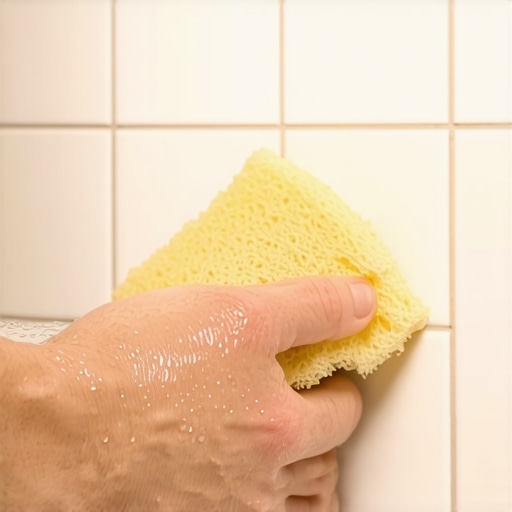
The ‘Wet Sponge’ Trick for Testing Your Shower Waterproofing Seal
Most guys skip the leveling compound. They think the underlayment will hide the dip. It won’t. I spent three days grinding concrete on a job last month just so the floor wouldn’t click like a castanet. That same laziness kills showers. I have spent twenty five years on my knees with a moisture meter and a level. I have seen fifteen thousand dollar wide plank walnut floors cup like potato chips because someone ignored the crawlspace humidity. Flooring is not a decoration. It is a structural engineering challenge. When we talk about showers, we are talking about a box designed to hold a tropical storm. If your waterproofing fails, the rot does not stay in the bathroom. It migrates. It eats your floor leveling. It buckles your laminate in the hallway. It turns your carpet install into a mold colony. You need to know if your seal is actually holding before you find out the hard way.
The one eighth inch that ruins everything
Shower waterproofing depends on the structural integrity of the subfloor and the precise application of topical or integrated membranes. If your subfloor has even a slight deflection, the grout joints will eventually crack. This allows water to bypass the tile and sit on the membrane. If that membrane has a pinhole, the water hits the wood. You need to verify that your surface tension is intact. The wet sponge trick provides a manual diagnostic for sealer saturation and membrane continuity. Most homeowners assume that because water runs down the drain, the system is working. That is a dangerous lie. Water is a solvent. It finds the path of least resistance through capillary action. If your sealer is worn out, the grout becomes a sponge rather than a shield. You can see this happening in real time if you know what to look for.
“A floor is only as good as the subfloor beneath it; deflection is the enemy of every joint.” – Master Flooring Axiom
Why your subfloor is lying to you
A subfloor may look flat to the naked eye but contains microscopic ridges and valleys that collect moisture and stress flooring materials. When I walk onto a job site, the first thing I smell is the concrete. Damp concrete has a specific, heavy scent that tells me the vapor drive is too high. If you are installing laminate or a carpet install over a slab, that moisture will eventually ruin the adhesive or the padding. In a shower, the subfloor must be perfectly sloped. If the floor leveling was done poorly, you get birdbaths. These are standing pools of water hidden beneath the tile. Over time, that water becomes stagnant. It breeds bacteria. It forces its way through the waterproofing seal through sheer hydrostatic pressure. You cannot trust a builder grade install. You have to verify the seal yourself.
| Material Type | Perm Rating | Acclimation Time | Failure Mode |
|---|---|---|---|
| Sheet Membrane | 0.5 or less | Zero | Puncture |
| Liquid Applied | 0.7 to 1.2 | 24 Hours | Thin Application |
| Traditional Mud Bed | Variable | 72 Hours | Structural Cracking |
The science of the wet sponge
The wet sponge trick relies on observing the absorption rate of the grout and tile surface to identify voids in the sealer. You take a standard yellow grout sponge. You saturate it with clean water. You press it firmly against a dry grout line for exactly ten seconds. When you pull the sponge away, the grout should look dark for a moment then quickly bead the water off. If the grout stays dark and looks wet for more than a minute, your sealer has failed. The chemistry here is simple. High quality sealers use fluoropolymers to lower the surface energy of the grout. This makes the water stay in a bead. When the sealer breaks down, the surface energy increases. The water is sucked into the pores of the cementitious grout. This is how moisture gets into the subfloor. This is how your hallway laminate starts to peak at the seams. Water travels through the joists.
The ghost in the expansion gap
Every floor needs room to breathe because humidity changes the physical dimensions of wood and stone. I see it all the time with LVP. People think it is waterproof so they do not leave a gap at the wall. Then the house settles or the humidity spikes and the floor buckles. In a shower, the expansion gap is usually filled with 100 percent silicone caulk. This is the weakest point of your waterproofing. If the caulk is peeling, the wet sponge trick will show you exactly where the water is disappearing. Use the sponge to flood the corner joint. Watch the water. If it vanishes into the gap, you have a leak. It does not matter how good your tile is. If the silicone is gone, the shower is a sieve. I have seen master bedrooms ruined because a three dollar bead of caulk failed in the en suite.
- Check for darkening grout lines during the sponge test.
- Inspect the transition between the floor and the wall for silicone gaps.
- Ensure the floor leveling compound is fully cured before any testing.
- Verify that the drain flange is flush with the waterproofing layer.
- Measure the moisture levels in the adjacent room floors.
Grout is not a raincoat
Cement based grout is naturally porous and serves as a filter rather than a waterproof barrier. This is the biggest misconception in the flooring world. People think tile is waterproof. It is not. Tile is the armor, but the membrane is the skin. The wet sponge trick tests the armor. If the armor is leaking, the skin has to work twice as hard. Eventually, the skin fails. This is especially true in areas with high mineral content in the water. Those minerals act like sandpaper. They grind away the sealer every time you clean the shower. If you have sawdust under your nails like I do, you know that maintenance is the only thing that stops a total tear out. You should be doing this sponge test every six months. If the wateraks in, you re-seal. It is a twenty minute job that saves you a ten thousand dollar floor install later.
“Standard thin-set is not a waterproofing agent; it is a structural bond meant to resist shear forces, not moisture migration.” – TCNA Technical Manual
Why laminate fails near bathrooms
Laminate flooring is essentially high density fiberboard which acts like a wick when it comes into contact with bathroom moisture. Even if your shower is not actively leaking onto the floor, the high humidity from a failing seal can cause issues. Vapor pressure moves from hot to cold. A hot shower creates a high pressure zone. If the waterproofing is weak, the vapor pushes through the walls into the subfloor. This vapor then travels under the transition strip and into your laminate. You will see the edges start to swell. This is called telegraphing. By the time you see it on the surface, the underside of the laminate is already ruined. The wet sponge trick helps you identify if the shower is the source of that high vapor drive before the laminate starts to look like a mountain range.