How to Clean Red Wine Stains from Carpet Using Only Cold Water
I once walked into a high end penthouse where the owner had just dumped a bottle of Cabernet on a custom white wool broadloom. They panicked. They grabbed a bottle of boiling water and a stiff brush, thinking heat would dissolve the pigment. By the time I arrived, they hadn’t just stained the floor, they had cooked the wine into the protein fibers of the wool. It was a fifteen thousand dollar mistake that could have been avoided with a simple gallon of cold water and a little understanding of fiber chemistry. Most people treat carpet like a rag, but it is a complex engineering system of primary backings, secondary backings, and twist locked yarns that react violently to the wrong thermal input.
The molecular physics of red wine pigments
To clean red wine stains from carpet using only cold water, you must utilize the principle of dilution without thermal fixation. Cold water prevents the wine tannins from bonding with the synthetic or natural dye sites in the carpet fiber. It maintains the surface tension necessary to lift pigments through capillary action into an absorbent medium. Red wine contains anthocyanins, which are the same pigments found in many natural dyes. When you introduce heat, you are essentially performing a hot dye bath in your living room. The heat provides the kinetic energy required for the pigment molecules to penetrate the amorphous regions of the carpet polymer. By using cold water, you keep these molecules in a suspended state. This allows for mechanical extraction rather than chemical bonding. You are fighting a war against the clock and the pore structure of the yarn. If you understand that nylon and wool have specific dye sites designed to hold color, you will realize that cold water is your only shield against making that red spot a permanent part of your home architecture.
Why cold water preserves the fiber twist
Cold water is the superior solvent for fresh wine spills because it does not trigger the relaxation of the heat set twist in the carpet yarn. Keeping the fiber structure tight prevents the wine from migrating deep into the yarn core where extraction is nearly impossible. When carpets are manufactured, the yarn is heat set to maintain its shape and resilience. Introducing hot water during a spot cleaning emergency can cause the fibers to bloom or untwist. Once the fiber blooms, it creates a visual shadow that looks like a stain even if the color is removed. This is a structural failure of the floor. Furthermore, cold water has a higher density and a different surface tension profile than hot water. It tends to sit on top of the factory applied stain resistance coatings rather than melting through them. I have seen countless carpet installs ruined because someone thought steam was a universal cleaner. In reality, steam is a catalyst for permanent pigment migration. You need to keep the liquid cool to keep the molecules slow. If the molecules stay slow, they stay on the surface of the fiber where your paper towels can actually reach them.
“A floor is only as good as the subfloor beneath it; deflection is the enemy of every joint.” – Master Flooring Axiom
The dangerous game of the wet carpet pad
The real danger of cleaning with any liquid is the risk of saturating the carpet pad and the subfloor beneath it. Cold water must be used sparingly to avoid triggering mold growth or structural rot in the wooden subfloor or the leveling compounds used during the initial carpet install. If you pour a gallon of water on a wine stain, you are just pushing the wine into the pad. The pad acts like a sponge. Once the wine is in the pad, it will continue to wick back up to the surface every time someone walks on it. This is why a stain seems to disappear and then reappears three days later. It is a hydraulic process. You need to use enough water to dilute the wine but not so much that it breaches the secondary backing of the carpet. If you have a basement with poor floor leveling, the water will find the low spots and pool there, leading to a lingering musty smell that no amount of surface cleaning can fix. You have to think like a drainage engineer. Control the flow, limit the depth, and ensure the moisture is removed vertically rather than spreading horizontally through the backing material.
| Fiber Type | Absorption Rate | Heat Sensitivity | Cold Water Success | |
|---|---|---|---|---|
| Nylon 6,6 | High | High | 85% | |
| Polyester | Low | Medium | 95% | |
| Wool | Very High | Critical | 60% | |
| Triexta | Low | Low | 98% |
The compression method for total extraction
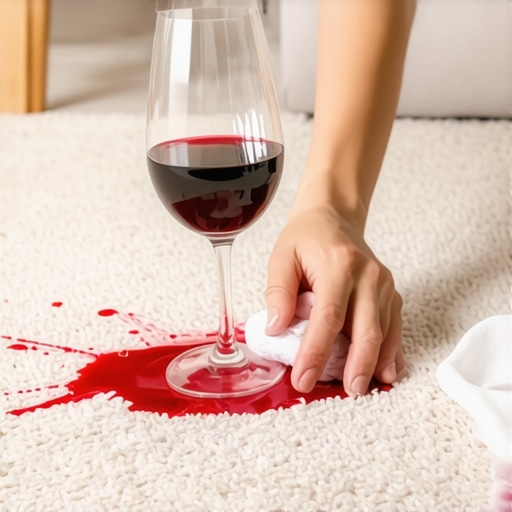
Effective wine removal depends on vertical extraction through high pressure blotting rather than horizontal scrubbing. Use heavy weights on top of white cotton towels to pull the diluted wine out of the pile through capillary action. Scrubbing is a crime against floor engineering. When you scrub, you are fraying the tips of the fibers and pushing the wine deeper into the backing. Instead, you should apply a small amount of cold water and then immediately cover it with a thick stack of white towels. Place a heavy object, like a five gallon bucket of floor leveling compound or a stack of books, on top of the towels. This creates a vacuum effect. As the towels absorb the water, they pull the wine with them. It is a slow process. You might need to change the towels five or six times. It requires patience that most homeowners simply do not have. They want a miracle in thirty seconds, but a proper extraction takes hours. You are essentially reverse-engineering the spill. Every ounce of water you put down must be recovered with twice the amount of dry towel capacity.
- Blot the excess wine immediately with a dry white cloth.
- Apply cold distilled water to the perimeter of the stain and work inward.
- Use a wet vacuum if available to pull liquid out of the backing.
- Never use a circular scrubbing motion.
- Weighted drying for at least twelve hours to prevent wicking.
Why scrubbing is a crime against floor engineering
Scrubbing a carpet during a spill cleanup causes permanent mechanical damage known as tip bloom which permanently alters the light refraction of the floor. This damage is irreversible and will always appear as a dark or fuzzy spot regardless of cleanliness. I see this all the time in high traffic areas and near showers where people try to scrub out small spots. The mechanical agitation breaks the chemical bonds of the fiber finish. It is like sanding a piece of finished hardwood with coarse sandpaper. You are destroying the sheen. In the context of a red wine stain, scrubbing also forces the organic pigments into the microscopic pits of the fiber. Carpet fibers are not smooth glass rods. Under a microscope, they have ridges and valleys. Scrubbing acts like a piston, driving the wine into those valleys. Once it is in there, cold water alone will have a hard time reaching it. You must be gentle. Treat the carpet like it is a delicate structural membrane. The goal is to lift, not to push. If you lose the twist of the yarn, you have lost the floor. No amount of cleaning will bring back the original texture once those fibers have been shredded by aggressive agitation.
“Excessive heat during the spot cleaning process can permanently alter the molecular orientation of synthetic fibers.” – Master Flooring Axiom
The 1/8 inch rule for moisture migration
Managing a liquid spill requires understanding that moisture will migrate at least 1/8 inch horizontally for every second it sits on the carpet backing. Rapid response with cold water containment is the only way to stop the spread. Most people don’t realize that the liquid isn’t just sitting where they see the color. It is spreading underneath. If you wait ten minutes to start the cold water process, a four inch stain on the surface has likely become a six inch stain on the pad. This is why your cleaning radius must always be larger than the visible stain. You need to create a cold water barrier around the spill to prevent it from moving further. Think of it like a fire break. By wetting the clean carpet around the wine, you saturate those fibers with clean water, making it harder for the wine to move into them. This is basic fluid dynamics. The wine will follow the path of least resistance. If the surrounding fibers are already full of cold water, the wine is forced to stay in the center where you can extract it. It is a strategic move that separates the professionals from the amateurs. You aren’t just cleaning a spot. You are managing a localized flood on a structural surface. Done correctly, the cold water method is the most effective and safest way to preserve your investment.