How to Get Rid of the ‘New Carpet Smell’ Without Opening Every Window
How to Get Rid of the New Carpet Smell Without Opening Every Window
I have spent twenty-five years on my knees with a power stretcher and a tucking tool. I have smelled every adhesive, every roll of padding, and every synthetic fiber known to the modern flooring industry. I once saw a family move into a basement with a fresh carpet install and no mechanical ventilation. Within forty-eight hours, the kids were wheezing because the installer used a cheap, petroleum-based pad that off-gassed like a chemical plant. Most homeowners think that distinct scent is just the smell of newness. It is not. It is the smell of 4-phenylcyclohexene, a byproduct of the styrene-butadiene rubber latex used to hold the carpet backing together. If you cannot open your windows because it is ten degrees outside or you live next to a noisy highway, you have to treat this as a chemical engineering problem rather than a housekeeping chore.
The invisible chemistry of off gassing
Removing the new carpet smell without ventilation requires a combination of high-efficiency particulate air filtration and activated carbon adsorption to capture volatile organic compounds. Chemical neutralizers that break down 4-phenylcyclohexene molecules are more effective than masking agents which simply add scents to the already contaminated indoor air environment. Most people do not realize that the synthetic latex used to bind the secondary backing of the carpet to the primary face fibers is the primary source of that pungent aroma. This latex is a mixture of styrene and butadiene. During the curing process at the factory, small amounts of 4-phenylcyclohexene are created. This molecule is detectable by the human nose at concentrations as low as 0.5 parts per billion. It is a persistent ghost that haunts a room long after the installers have packed up their saws and headed home. You are not just smelling the carpet. You are smelling the byproduct of a high-temperature manufacturing process that is finally reaching equilibrium in your living room.
The danger of trapped subfloor moisture
Floor leveling compounds that have not fully cured can trap moisture beneath a new carpet pad, creating a secondary odor profile that complicates the removal of factory scents. When moisture from a concrete slab or a leveling pour interacts with the antimicrobial treatments in the carpet, it can trigger a sour chemical reaction. I always tell my clients that the subfloor is a liar. It looks dry on the surface, but the moisture meter tells the truth. If you rushed the carpet install over a fresh layer of leveling compound, the moisture has nowhere to go. It gets trapped in the open-cell structure of the padding. This moisture then reacts with the VOCs in the carpet glue. It creates a humid micro-climate that prevents the chemical scents from dissipating. This is why some rooms smell like a mix of new carpet and a damp basement. You must ensure the slab is at a relative humidity of less than seventy-five percent before the pad even touches the floor. If you missed that window, you are now fighting a two-front war against chemistry and biology.
“A floor is only as good as the subfloor beneath it; deflection is the enemy of every joint.” – Master Flooring Axiom
The tactical use of air scrubbers
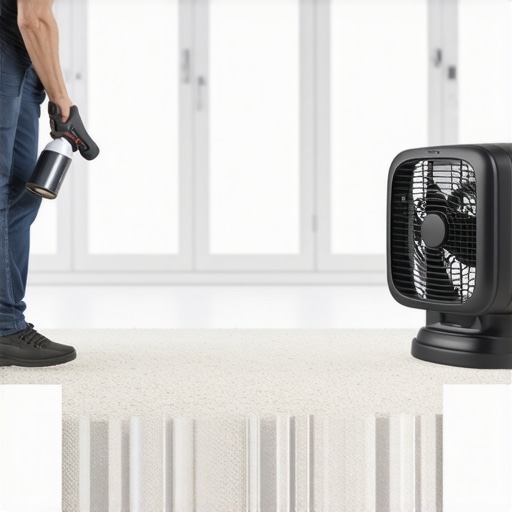
A professional-grade air scrubber equipped with a thick activated carbon filter is the only mechanical way to strip VOCs from an enclosed space without external air exchange. These machines cycle the entire volume of a room multiple times per hour, pulling air through a medium that chemically bonds to the odor molecules. Standard HEPA filters are great for dust and dander, but they are useless against gases. You need carbon. Activated carbon is treated with oxygen to open up millions of tiny pores between the carbon atoms. These pores act as a molecular trap. When the 4-phenylcyclohexene molecules pass through the filter, they get stuck in the carbon. This process is called adsorption. If you are dealing with a heavy scent, you need a scrubber that can handle at least five hundred cubic feet per minute. Put it in the center of the room. Turn it on high. It will be loud, but it will do in twenty-four hours what a box fan in a window would take a week to accomplish.
The science of the bake out method
The bake out method involves raising the indoor temperature to eighty-five degrees Fahrenheit for several hours to accelerate the off-gassing process before rapidly cooling the room to trap the remaining molecules. High heat increases the kinetic energy of the VOC molecules, forcing them out of the carpet fibers and into the air. This is a trick I learned from high-end commercial jobs where deadlines were tight. You turn the thermostat up as high as it will go. You leave the room empty. As the heat rises, the chemical bonds in the latex backing begin to vibrate and break. This forces the 4-PCH to enter the gas phase much faster than it would at seventy degrees. After about twelve hours of baking, you must use your air scrubber to capture the concentrated gases. If you do not have a scrubber, you are just making the room a toxic sauna. The heat moves the chemicals from the floor to the air. You then have to get them out of the air.
The relationship between showers and humidity
High humidity from master bathroom showers can migrate into bedroom carpets and re-hydrate the latex backing, causing a secondary wave of off-gassing. Controlling the indoor relative humidity to stay between thirty and fifty percent is essential for stabilizing new flooring materials and minimizing odor. I have seen jobs where the carpet smelled fine until the homeowner took a long, hot shower. The steam traveled into the bedroom and the carpet started reeking again. This happens because the moisture in the air softens the latex and the padding. It acts as a carrier for the VOCs. If you are trying to get rid of the smell, you need to run a dehumidifier. Keep the air dry. Dry air is hungry for moisture and will pull the remaining chemical scents out of the carpet more effectively than damp air. This is especially true if you have a laminate floor in the hallway that was recently installed. Laminate also off-gasses formaldehyde, and the combination of carpet and laminate scents in a humid environment is a recipe for a headache.
The tactical use of dry compounds
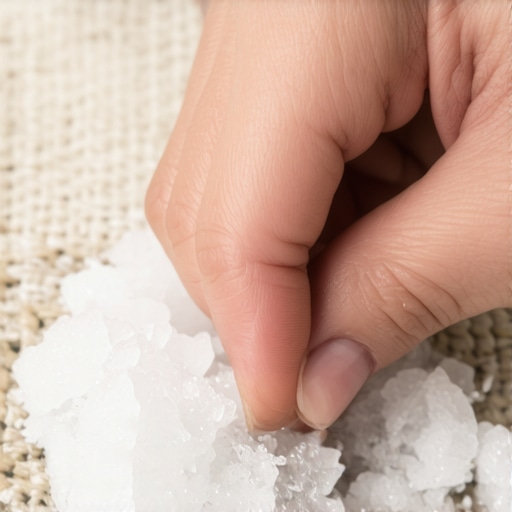
Dry carpet cleaning compounds containing natural minerals like zeolites or bentonite clay can be brushed into the pile to absorb odors at the source. These minerals have a crystalline structure that attracts and holds onto VOC molecules through ion exchange. Do not use wet shampoos. Adding water to a new carpet install is a disaster. It can cause the backing to delaminate and will certainly make the smell worse. Instead, use a dry powder. Sprinkle it liberally. Work it into the fibers with a stiff brush. Let it sit for twenty-four hours. The zeolites will act like tiny magnets for the chemical scents. When you vacuum the powder up with a HEPA-certified vacuum, the smell goes with it. This is a surgical strike against the odor. It focuses on the fibers themselves rather than just the air above them.
“Moisture is the primary catalyst for adhesive failure and the unwanted migration of chemical vapors in residential environments.” – TCNA Technical Bulletin
The manufacturing reality of cheap padding
Low-density rebond padding is often the primary source of the new carpet smell because it is made from recycled scrap foam held together with chemical adhesives. Upgrading to a high-density frothed polyurethane pad can significantly reduce the initial odor profile of a new installation. Everyone spends their money on the carpet and tries to save on the pad. That is a mistake. The pad is the lungs of the floor. When you walk on it, you are pumping air in and out of that foam. If the foam is cheap, every step you take pushes a puff of chemical scent into the room. Higher-end pads are made with fewer VOCs and often have a spill guard that helps seal in some of the odors from the subfloor. If you are already stuck with the smell, you have to realize that you are cleaning the pad through the carpet. This is why deep-cleaning with a HEPA vacuum is so important. You need the suction to reach down into the cells of the foam.
The final audit of indoor air quality
Continuous monitoring of indoor air quality using a VOC sensor can help you determine if your odor removal strategies are working or if the carpet is still off-gassing at an unhealthy rate. These sensors provide real-time data on the concentration of chemicals in the air. I always keep a sensor in my truck. If a client complains about a smell, I set it up. Usually, the levels spike right after the install and then drop off. If they stay high for more than a week, something is wrong. Maybe the carpet was stored in a damp warehouse. Maybe the subfloor was not dry. If the levels stay high and you cannot open the windows, you might have to look at an ultraviolet air purifier. UV-C light can break the molecular bonds of certain VOCs. It is a high-tech solution for a stubborn problem. Don’t just ignore the smell and hope it goes away. It will eventually, but your lungs will be the filter in the meantime.
Comparison of Carpet Materials and VOC Profiles
| Material Type | Initial VOC Emission | Primary Chemical Source | Persistence Level |
|---|---|---|---|
| Nylon with SBR Latex | High | 4-phenylcyclohexene | Moderate (4-7 days) |
| Wool (Untreated) | Very Low | Natural Lanolin | Short (1-2 days) |
| Polyester (PET) | Medium | Phthalates | Moderate (3-5 days) |
| Olefin (Polypropylene) | Low | Thermal Stabilizers | Short (2-3 days) |
Professional Odor Removal Checklist
- Deploy an air scrubber with a minimum of 10 lbs of activated carbon.
- Increase room temperature to 85 degrees for a 12-hour bake out period.
- Run a dehumidifier to keep relative humidity below 40 percent.
- Apply a zeolite-based dry mineral powder to the carpet pile.
- Vacuum three times daily using a HEPA-certified vacuum cleaner.
- Place charcoal bags in corners where air circulation is stagnant.
- Ensure all bathroom fans are running to pull air through the building.
The process of cleaning the air in a sealed room takes patience and the right tools. You are fighting a battle against industrial chemistry. The smell of a new carpet install is not a sign of quality. It is a sign of a manufacturing process that is still active in your home. By using heat, carbon, and dry minerals, you can reclaim your space without ever having to touch a window lock. It is about physics and chemistry. If you treat it like an engineering problem, you will win. If you treat it like a bad smell, you will just be masking the problem while the VOCs continue to circulate in your indoor environment.