Why Your Laminate Floor Looks Hazy Even After You Just Cleaned It
I have spent twenty-five years standing on these floorboards, smelling the heavy scent of floor wax and the sharp tang of freshly cut oak. My shop is filled with racks of premium inventory that big-box retailers wouldn’t even know how to handle. Every week, a homeowner walks through my door looking defeated because their high-end laminate looks like it was wiped with a greasy ham. They buy the fancy spray bottles and the expensive microfiber mops, yet the surface remains cloudy. I remember one specific job where a client had laid down a beautiful wide-plank laminate that looked like weathered barn wood. Within three months, it was so hazy you couldn’t see the grain. She thought the floor was failing. I took a white cloth and some distilled water, scrubbed a six-inch square, and showed her the truth. She didn’t have a floor problem; she had a chemistry problem. She had been using a cleaning product that promised a ‘mirror shine’ which was actually just a liquid plastic film that trapped every footprint and bit of dust. We spent the next two days stripping that gunk off. It was a lockdown on her floor’s ability to breathe and reflect light correctly. This is the reality of the laminate world. If you treat this material like it is indestructible, it will punish you with a dull, matte finish that makes your whole house look dirty. You have to understand the physics of the wear layer and the chemistry of the surfactants you are spreading around.
The phantom film on your planks
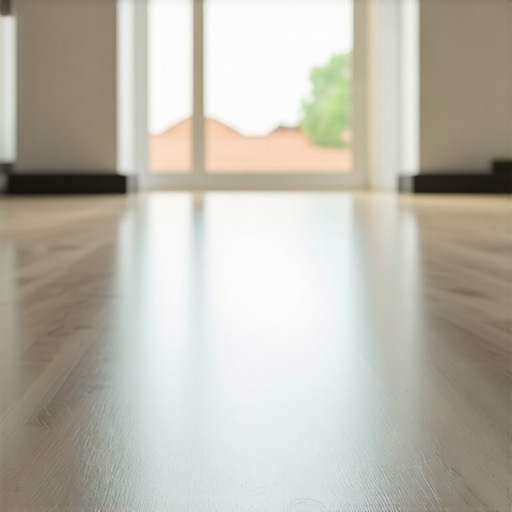
Laminate floor haziness is usually caused by residual surfactants, hard water minerals, or excessive cleaning product that has dried on the non-porous melamine resin surface. Unlike natural wood, laminate cannot absorb oils or waxes, so any cleaning agent left behind creates a microscopic film that refracts light unevenly, appearing as a cloudy haze to the human eye. This is not a defect in the material itself but a build-up of foreign substances that have bonded to the top wear layer. When you walk across this, the oils from your skin stick to that residue, making the problem look ten times worse in high-traffic areas. People often think the solution is to clean more, but that is exactly what makes the film thicker. You are essentially painting your floor with layers of soap. Most commercial cleaners are designed to smell good and look sudsy, but suds are the enemy of a clear finish. You want a cleaner that flashes off the surface almost instantly without leaving anything behind. If your floor feels even slightly tacky after you clean it, you have already failed. That tackiness is the sign of an active chemical bond that is waiting to grab onto the next piece of dust that floats by.
The chemistry of surfactants and detergent buildup
When we look at the molecular structure of a cleaning solution, we find molecules called surfactants which are designed to lower the surface tension of water. These molecules have a hydrophilic head and a hydrophobic tail. In a perfect world, they grab the dirt and get whisked away by your mop. However, if the solution is too concentrated, these molecules remain on the aluminum oxide wear layer of the laminate. Because laminate is compressed at such high pressures, reaching Janka hardness levels that rival domestic hardwoods, there are no pores for these molecules to hide in. They sit on top and crystallize as the water evaporates. This creates a refractive index shift. Light hits the floor, but instead of bouncing off the crisp photographic layer, it gets scattered by the dried chemical crystals. This is why the floor looks fine when it is wet but turns grey and dull the second it dries. You are essentially looking through a dirty window. To fix this, you have to break the ionic bond of those surfactants. Most people use more soap, which is like trying to put out a fire with gasoline. You need a neutral pH approach or a slight acidic lean to neutralize the alkaline salts found in most household detergents. If you live in a region with high humidity, like the coastal areas, this film stays moist longer, attracting even more airborne particulates before it sets.
Hard water and the microscopic mineral deposit
The mineral content in your tap water, specifically calcium carbonate and magnesium, creates a chalky residue known as limescale on the surface of your laminate. When you mop with tap water, the liquid evaporates and leaves these inorganic minerals behind in the micro-texture of the floor. This is particularly noticeable on darker laminate decors where the white minerals create a stark contrast. This is the same stuff that builds up in your showers on the glass doors. If it can etch glass, it can certainly dull a resin floor. Many homeowners make the mistake of using hot water, thinking it cleans better. While heat helps break down grease, it also speeds up the evaporation of the water, leaving the minerals behind before you can buff them dry. This is a physics problem. You are essentially performing a laboratory evaporation experiment on your living room floor. I always tell my customers to use distilled water if they have particularly hard well water. It is a small price to pay to avoid the mineral haze. The minerals also act as an abrasive. Every time you walk across a mineral-coated floor, you are essentially using a very fine sandpaper on the wear layer. Over time, this doesn’t just create a haze that you can wash off; it creates micro-scratches that permanently dull the factory finish. At that point, no amount of cleaning will bring back the shine.
The role of floor leveling in light reflection
A level subfloor is essential for a uniform light reflection, as any deflection or subfloor dipping creates shadows and uneven wear that mimics the appearance of a hazy surface. If your floor leveling was done poorly, the laminate planks will slightly