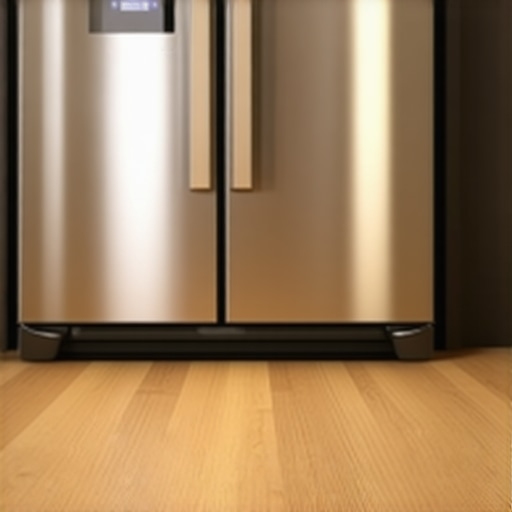
How to Stop Laminate Floors from Buckling Near the Fridge
I have spent twenty five years on my knees with a moisture meter and a level. I have seen every mistake a homeowner or a cut-rate contractor can make. Homeowners always ask why their waterproof vinyl or laminate is buckling. Usually, it is because they locked it under a heavy kitchen island or a massive refrigerator, killing the floor ability to breathe. I once walked into a house where the laminate was rising like a sourdough loaf right in front of a French-door fridge. The owner was baffled. I pointed at the 400 pound appliance sitting directly on a floating floor system and told him he had just anchored a ship in the middle of a moving river. The floor had nowhere to go, so it went up. This is the structural reality of laminate flooring. It is a living, breathing assembly of wood fibers and resins that expands and contracts with every shift in humidity. When you pin it down with a heavy appliance or fail to leave a proper gap, the physics of expansion will win every time.
The physics of the floating kitchen floor
Stopping laminate floors from buckling near the fridge requires maintaining a 3/8 inch expansion gap around all vertical obstructions and ensuring the appliance does not pin the planks. Laminate is a floating floor system. It must move as a single unit. When a refrigerator weight traps specific planks while others remain free, the internal tension forces the joints to peak or buckle. This is not a defect in the material. It is a failure of the installation geometry. The core of your laminate is likely high density fiberboard or HDF. This material is hygroscopic. It absorbs water vapor from the air and expands. If the fridge is sitting on the floor, the friction between the bottom of the plank and the underlayment becomes too great. The expansion force then redirects to the weakest point which is the click lock joint. You see a hump. I see a mechanical failure caused by a lack of planning. This often happens in kitchens where homeowners prioritize the look of the cabinets over the needs of the subfloor. If you are also dealing with floor leveling issues in other rooms, the stress on these joints increases exponentially. A dip in the subfloor near the fridge allows the heavy appliance to further compress the locking mechanism, leading to a permanent snap.
“A floor is only as good as the subfloor beneath it; deflection is the enemy of every joint.” – Master Flooring Axiom
The mechanical anchor of a heavy appliance
A standard refrigerator can weigh between 200 and 450 pounds and this concentrated load acts as a permanent anchor on a floating floor. To prevent buckling, you must ensure the floor can slide under the fridge or stop the floor at the fridge legs using a transition strip. Most installers run the floor all the way to the wall behind the fridge. This is fine if the floor is perfectly level. However, if there is a 1/8 inch deviation over 10 feet, the fridge will tilt. This tilt focuses all the weight on the front rollers. Those rollers dig into the wear layer and the HDF core. You have now created a fixed point. When the humidity in the kitchen rises because of the dishwasher or a boiling pot of pasta, the rest of the floor expands toward the fridge. It hits that fixed point and the planks have no choice but to lift. It is a simple matter of structural engineering. Unlike a carpet install where the material is stretched and tacked down, laminate needs to float. If you treat it like carpet, you will fail. I always tell my clients that a kitchen floor is a performance surface. It needs to handle the heat of the oven and the cold of the fridge without losing its structural integrity.
| Core Material | Expansion Rate | Recommended Gap | Moisture Resistance |
|---|---|---|---|
| Standard HDF | High | 3/8 inch | Moderate |
| Wax-Coated HDF | Medium | 3/8 inch | High |
| Stone Plastic Composite | Low | 1/4 inch | Extreme |
| Wood Plastic Composite | Medium | 5/16 inch | High |
The chemistry of the laminate core
The internal composition of laminate consists of melamine resin and wood fibers which react to the microclimate under your refrigerator. The area under a fridge is a unique ecosystem. The compressor generates heat. The coils release warm air. This creates a localized zone of low humidity and high temperature. Meanwhile, the rest of the kitchen might be cooler. This thermal gradient causes the planks to expand at different rates. The wood fibers inside the HDF core are held together by adhesives. When these fibers are subjected to constant thermal cycling, the internal bond can weaken. This is why you see peaking. Peaking is when the edges of the planks push against each other and rise. It looks like a small mountain range. If you do not have a 3/8 inch gap at the walls, there is no relief valve for this pressure. You must also consider the vapor transmission from the subfloor. If you are on a concrete slab, the heat from the fridge can pull moisture up through the concrete via capillary action. This moisture hits the bottom of the laminate and causes the core to swell. It is a silent killer of floors.
The expansion gap at the perimeter
Maintaining a consistent perimeter gap is the most effective way to prevent buckling near heavy appliances like refrigerators and stoves. I see it all the time. An installer gets to the end of the room and the last plank is a tight fit. Instead of ripping it down to leave a gap, they wedge it in. They think the baseboard will hide the mistake. It hides the gap, but it also hides the problem until the first humid day of summer. You need a minimum of 1/4 inch but I always recommend 3/8 inch for any run over 20 feet. This gap allows the entire floor to shift. When the fridge anchors the center, the floor can still expand outward toward the walls. If you have a kitchen that transitions into a dining room, you need an expansion joint in the doorway. Do not listen to the people who want a seamless look. A seamless look is a recipe for a buckled floor. Even in bathrooms near showers, the same rules apply. The humidity from the shower will travel through the air and find the weakest link in your laminate. If that link is pinned by a fridge or a vanity, you are going to have a bad day.
“Wood and wood-based products will always seek an equilibrium moisture content with their environment.” – NWFA Technical Manual
The subfloor leveling protocol
A subfloor that is not level within 3/16 of an inch over a 10 foot radius will cause the laminate to bounce and eventually buckle under a fridge. Before you even think about laying a plank, you need to get the floor flat. I am not talking about level. I am talking about flat. If there is a hump in the subfloor right where the fridge sits, the fridge will rock. This rocking motion acts like a hammer on the tongue and groove joints. Every time you open the fridge door, you are stressing the floor. I spend more time with a 10 foot straight edge and a bag of self-leveling compound than I do with the actual flooring. If you skip this step, no amount of expansion gaps will save you. The fridge weight will find the void in the subfloor and crush the locking system. Once those joints are snapped, the floor is toast. You cannot glue them back together. You have to tear it out and start over. I have seen guys try to hide dips with extra underlayment. That is a crime. Too much cushion under a floating floor is just as bad as no underlayment at all. It allows the floor to flex too much, which leads to joint fatigue and buckling.
The solution for peaked joints
If your floor is already buckling near the fridge, you must first check the expansion gaps at the nearest wall to ensure the floor is not bottomed out. The first thing I do on a repair job is pull the baseboards. Nine times out of ten, I find the floor is touching the drywall. I take my oscillating saw and I cut a 3/8 inch gap right there in place. Sometimes you hear the floor pop as the tension is released. It is like a literal weight being lifted off the floor’s shoulders. If the buckling is directly under the fridge, you might need to move the fridge and see if the planks have been damaged. If the tongues are still intact, you can sometimes massage the planks back into place. If they are snapped, you are looking at a board replacement. This involves cutting out the damaged planks and gluing in new ones with the tongues removed. It is a surgical procedure. It is much easier to just install the floor correctly the first time. Check your kitchen for any other fixed points. Is there a pipe for the ice maker coming through the floor? Is the hole tight? It shouldn’t be. You need a gap around that pipe too.
- Remove the baseboards to check for perimeter clearance
- Inspect the ice maker water line for a 1/4 inch gap around the pipe
- Ensure the refrigerator feet are not resting on a joint line
- Check for subfloor flatness using a 6 foot level or straight edge
- Verify that no cabinets or islands are bolted through the laminate
- Confirm that the underlayment is not doubled up in high pressure zones
The truth about waterproof ratings
Waterproof laminate does not mean the floor is immune to the physical laws of expansion and contraction caused by moisture and weight. Manufacturers love the word waterproof. It sells floors. But what they mean is the surface is waterproof for a certain amount of time. The core is still susceptible to humidity. If your fridge has a slow leak in the back, that water will sit on the subfloor. It will soak into the bottom of the laminate where there is no protective wear layer. The planks will swell. Because the fridge is sitting on top, the swelling can only go one way. Up. This is why I always recommend a moisture barrier on concrete slabs, even for waterproof products. You need to protect the floor from the bottom up. In areas with high humidity like the South, this is non-negotiable. If you are installing laminate in a basement or a kitchen, you want a 6 mil poly film at the very least. This prevents the hydrostatic pressure from the slab from reaching the HDF core. It is a five cent solution to a five thousand dollar problem. Don’t be the person who skips the vapor barrier because the box said the floor was waterproof. That is how you end up calling a guy like me to fix a mess that should never have happened.
{“@context”:”https://schema.org”,”@type”:”HowTo”,”name”:”Stop Laminate Floors from Buckling Near the Fridge”,”step”:[{“@type”:”HowToStep”,”text”:”Remove baseboards around the perimeter of the kitchen to check for a 3/8 inch expansion gap.”},{“@type”:”HowToStep”,”text”:”Move the refrigerator and inspect the planks for signs of pinning or mechanical damage.”},{“@type”:”HowToStep”,”text”:”Use an oscillating saw to trim back any planks that are touching walls or cabinets.”},{“@type”:”HowToStep”,”text”:”Check the subfloor for levelness using a straight edge and fill any dips with leveling compound.”},{“@type”:”HowToStep”,”text”:”Reinstall the refrigerator using furniture glides to distribute the weight evenly across multiple planks.”}]}