The ‘Feather Finish’ Secret for Hiding Subfloor Seams Under Laminate
Most guys skip the leveling compound. They think the underlayment will hide the dip. It won’t. I spent three days grinding concrete on a job last month just so the floor wouldn’t click like a castanet. That job was a wake up call for the homeowner who thought a thin piece of foam would solve a half inch deflection. It did not. I am standing here with sawdust in my pockets and a moisture meter in my hand because the structural integrity of your floor depends on what you cannot see. When you walk across a floor and hear that hollow thud or a rhythmic clicking, you are hearing the sound of a failed subfloor preparation. We are going to talk about the physics of the flat surface and why a cementitious bond is the only thing standing between you and a flooring disaster.
The microscopic failure of the click lock
Laminate flooring failure occurs when subfloor irregularities exceeding one eighth of an inch over ten feet cause the locking mechanisms to undergo cyclic loading. This mechanical stress eventually snaps the tongue and groove joints. This is not just an aesthetic issue. It is a structural engineering failure. When the joint breaks, the planks separate. This allows moisture to penetrate the HDF core. Once that core absorbs water, the floor is done. You cannot fix a swollen laminate board. You can only replace it.
“A floor is only as good as the subfloor beneath it; deflection is the enemy of every joint.” – Master Flooring Axiom
The chemistry of the bond
Feather finish compounds are specialized cementitious underlayments designed to provide high compressive strength at ultra thin layers. These products use polymer modification to ensure they stick to plywood, OSB, and concrete without cracking or delaminating. Most people think they can just throw some drywall mud or cheap wood filler into a seam. That is a mistake you will regret when the floor starts moving. Wood filler is brittle. It lacks the flexural strength to handle the foot traffic of a busy household. A proper feather finish product creates a bridge. It uses high alumina cement to reach a compressive strength of over 3,000 PSI in just a few hours. This is why we use it. It becomes part of the structure, not just a filler.
Why your subfloor is lying to you
Subfloor seams look flat to the naked eye but OSB swelling and plywood delamination create microscopic peaks that telegraph through thin laminate planks. You might think your subfloor is fine. Then you lay the first three rows and realize there is a hump at the joist. This happens because houses settle. Wood expands and contracts. The edges of your subfloor sheets are the most vulnerable to moisture during construction. They swell up. We call it edge flare. If you do not sand those edges down and then skim them with a feather finish, you are essentially laying your floor over a series of small speed bumps. Every time you step on that spot, the floor moves. Movement is the enemy of laminate.
| Property | Cementitious Patch | Gypsum-Based Patch | Wood Filler |
|---|---|---|---|
| Compression Strength | 4,000+ PSI | 2,500 PSI | 800 PSI |
| Drying Time | 20 Minutes | 90 Minutes | 4 Hours |
| Flexural Strength | Excellent | Poor | Very Poor |
| Moisture Resistance | High | Low | Medium |
The ghost in the expansion gap
Laminate expansion gaps are mandatory perimeter spaces of at least one quarter inch that allow the floating floor to move during seasonal humidity shifts. If you run your laminate tight against the wall, the floor will buckle. If you run it tight against a cabinet, it will buckle. I have seen floors lift three inches off the subfloor because a DIYer forgot to leave a gap at the door casing. You need to treat the floor like a living thing. It breathes. In the summer, the humidity goes up and the wood fibers expand. In the winter, the furnace kicks on and the air dries out. The floor shrinks. If the floor is locked in place by a heavy kitchen island or a lack of gaps, that energy has to go somewhere. Usually, it goes up. This is where the feather finish helps. It ensures that as the floor slides across the subfloor, it is sliding across a glassy, flat surface rather than snagging on a rough seam.
The 1/8 inch that ruins everything
Flatness tolerances for laminate flooring are typically three sixteenths of an inch over ten feet, which is a strict requirement for professional warranties. If you ignore this, you void your warranty. The manufacturer will send an inspector with a straightedge. If they find a dip, they will deny your claim. They do not care if you bought the most expensive floor in the world. A dip in the floor creates a void. When you step on the floor above that void, the plank bends. Laminate is made of high density fiberboard. It is stiff. It does not like to bend. When it bends, the friction in the locking system creates heat and wear. Eventually, the plastic or wood locking profile wears away. Now you have a floor that gaps.
Tools of the trade for a flat surface
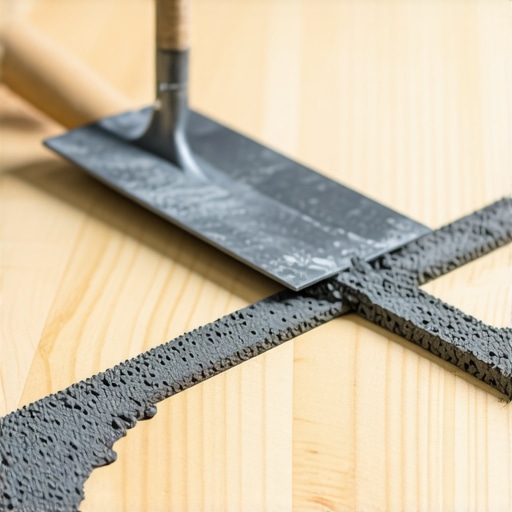
Floor leveling tools include ten foot straightedges, magnesium trowels, and low speed mixers to ensure the feather finish is applied without air inclusions. You cannot do this job with a six inch putty knife. You need a long trowel. You need to pull that material across the seam in a wide arc. You are not just filling a hole. You are creating a transition. I always tell my apprentices that if they can feel the seam with their eyes closed, it is not ready. You have to sand. You have to skim. You have to vacuum. Dust is the bond breaker. If you leave sawdust on the floor and put patch over it, the patch will pop off. Then you have loose rocks under your floor. That sounds like a gravel pit every time you walk on it.
- Sand all OSB or plywood seams with 40 grit sandpaper to remove edge flare.
- Vacuum the entire floor with a HEPA filter to remove fine particulates.
- Mix the feather finish in small batches because it sets in fifteen minutes.
- Apply the material with a flat trowel at a thirty degree angle.
- Check the work with a six foot level or straightedge immediately.
- Allow the patch to fully dry before installing the underlayment.
“A floor is only as good as the subfloor beneath it; deflection is the enemy of every joint.” – Master Flooring Axiom
Laminate versus moisture in the real world
Waterproof laminate is a marketing term that refers to the top surface protection and waxed joints, not the subfloor moisture levels. Do not think that because the box says waterproof you can skip the moisture barrier. If you are installing over concrete, you need a six mil poly film. Concrete is a sponge. It breathes moisture vapor. That vapor will get trapped under your laminate and rot the core from the bottom up. Even on wood subfloors, you need to check the moisture content. I never install unless the subfloor is within two percent of the flooring material. If the subfloor is wet, the feather finish will not cure properly. It will stay soft. Then it will crumble. You need a dry, stable environment before you even think about opening a box of planks.
The danger of too much cushion
While most people want the thickest underlayment, too much cushion actually causes the locking mechanisms on LVP or laminate to snap under pressure. This is the big lie in the flooring industry. People think a thick pad makes the floor feel soft. It does. But it also creates too much vertical movement. Imagine putting a piece of glass on a mattress and stepping on it. It breaks. Laminate joints are the same. They need a firm base. You want a high density underlayment that is thin. The goal is sound dampening and a minor thermal break, not a trampoline effect. If your subfloor is flat thanks to your feather finish work, you do not need a thick pad to hide sins. You have already fixed the sins with the trowel.