Why Your Laminate Planks are Separating at the Short Ends
The subfloor secret that ruins your investment
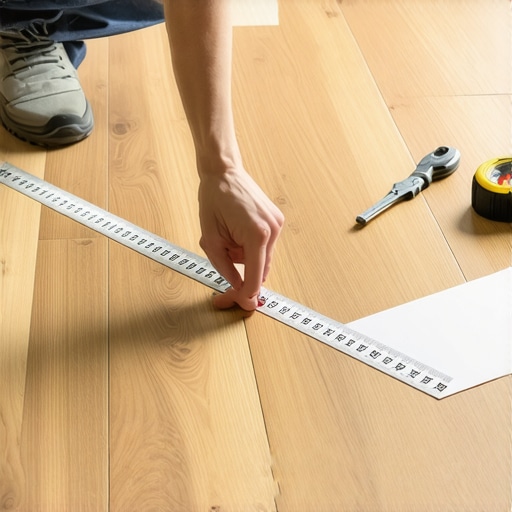
Laminate planks separate at the short ends because the underlying subfloor is uneven or the floor was installed without proper expansion gaps. When a floor is not flat within one eighth of an inch over ten feet, the locking mechanisms undergo constant mechanical stress, leading to joint failure. I spent three days grinding concrete on a job last month just so the floor would not click like a castanet. Most guys skip the leveling compound. They think the underlayment will hide the dip. It won’t. I have seen fifteen thousand dollar floors ruined because someone was too lazy to use a straightedge. You can buy the most expensive planks in the world, but if your subfloor has a valley, those short ends will walk apart. It is physics. When you step on a plank over a void, the board bends. This creates a lever action that pulls the tongue out of the groove. Over time, the friction wears down the fiberboard until it cannot hold. This is why floor leveling is the most important step in any laminate installation. [image]
The ghost in the expansion gap
Laminate flooring is a floating system that requires perimeter gaps to expand and contract with changes in humidity and temperature. If the floor is pinned against a wall or a heavy kitchen island, the pressure has nowhere to go except into the locking joints. This internal pressure causes the planks to buckle or pull apart at the weakest point, which is usually the short end butt joint. You need at least a quarter inch of space around every single vertical obstruction. This includes door frames, cabinets, and pipes. If you trap the floor, it will fight back. I have seen entire rooms shift because the installer did not leave room for the wood fibers to breathe. You cannot treat laminate like carpet install where everything is stretched tight. Laminate needs to move as a single monolithic slab. If one side is stuck, the rest of the floor will separate as it tries to shrink during the dry winter months.
“A floor is only as good as the subfloor beneath it; deflection is the enemy of every joint.” – Master Flooring Axiom
Why your subfloor is lying to you
Subfloors often appear flat to the naked eye but contain subtle waves that destroy the integrity of high density fiberboard cores. Using a moisture meter is not enough, you must use a ten foot aluminum straightedge to identify high spots and low valleys before the first plank touches the ground. If you find a dip deeper than three sixteenths of an inch, you must fill it with a high quality cementitious leveler. Do not rely on foam underlayment to bridge these gaps. In fact, using an underlayment that is too thick is a common mistake. While most people want the thickest underlayment, too much cushion actually causes the locking mechanisms on LVP and laminate to snap under pressure. The excessive vertical movement acts like a pair of scissors on the thin tongue of the plank. You want a high density underlayment with a low compression set. This provides a firm base that supports the joint instead of letting it sag every time someone walks across the room.
| Material Property | Requirement for Stability | Impact on Short Ends |
|---|---|---|
| Subfloor Flatness | 1/8 inch per 10 feet | Prevents vertical shearing |
| Moisture Content (Plywood) | Under 12 percent | Prevents core swelling |
| Expansion Gap | 1/4 inch minimum | Allows for seasonal movement |
| Underlayment Density | >20 lbs per cubic foot | Reduces joint deflection |
The chemistry of the clicking sound
The clicking sound you hear when walking on a separated floor is the sound of the locking profile rubbing against itself. Laminate cores are made of HDF, which is essentially compressed sawdust and resin, and this material has a finite limit for friction. Once the factory applied wax or lubricant wears off due to constant movement, the joint will eventually fail completely. This is especially true in areas near showers or high moisture zones where the humidity can soften the HDF core. When the core softens, it loses its grip. If you are installing in a basement or a humid climate, you must use a six mil poly vapor barrier over the concrete. This prevents the moisture from the slab from migrating into the plank and weakening the mechanical bond. A weak bond cannot resist the natural tension of the floor as it tries to shrink. It will pull apart. It will fail. You will be left with gaps that collect dirt and moisture, further accelerating the decay of the floor.
The checklist for a permanent bond
- Verify subfloor flatness using a 10 foot straightedge to ensure no dips exceed 1/8 inch.
- Maintain indoor relative humidity between 35 and 55 percent at all times.
- Acclimate the planks in the room for at least 48 hours prior to opening the boxes.
- Use a professional tapping block and a heavy pull bar to ensure every joint is fully seated.
- Leave a 1/4 inch to 3/8 inch expansion gap around the entire perimeter of the installation.
- Avoid placing heavy fixed objects like kitchen islands directly on top of the floating floor.
When the heavy furniture trap snaps the lock
Heavy furniture like pool tables or grand pianos can effectively pin a floating floor to the subfloor, preventing the necessary movement that laminate requires. When the floor tries to contract during the winter, the heavy object acts as an anchor, forcing the floor to pull apart at the nearest short joint. This is a common failure point that many homeowners do not anticipate when they choose a floating floor system. If you have extremely heavy furniture, you might need to consider a glue down engineered hardwood instead. Laminate is a magnificent product for many applications, but it is not a structural material. It is a system of interlocking parts that depends on the ability of the entire surface to shift slightly. If you lock one end down with a thousand pound cabinet and the other end is free to move, the middle will eventually give way. Usually, it is the short end of the plank that shows the first sign of distress.
“Standard subfloor deflection shall not exceed L over 360 to ensure the structural integrity of the finished floor surface.” – NWFA Technical Standards
Temperature swings and the molecular dance
Thermal expansion is a scientific reality that affects every building material including the wood fibers found in laminate flooring cores. In regions with extreme seasonal changes, the planks will physically grow in the summer and shrink in the winter. If the short ends are separating, it is often because the floor was installed during a high humidity period without accounting for the dry season shrinkage. Professional installers use spacers to maintain that crucial gap. We also use a drop of specialized PVA wood glue in the short joints of the last row or in high traffic areas to provide extra insurance against separation. This does not make the floor permanent, but it adds a layer of chemical bonding to the mechanical lock. You must be careful not to over glue, as this can prevent the floor from moving naturally, but a small amount on the short ends can often prevent the dreaded gap from appearing in the first place.
How to fix gaps without tearing up the floor
If you already have gaps at the short ends, you do not always have to rip the whole floor out and start over. You can often use a floor gap fixer tool, which is essentially a block with high quality adhesive tape that sticks to the plank. By hitting the block with a mallet, you can slide the plank back into its original position. Before you do this, you should vacuum the gap thoroughly to remove any debris that might prevent the joint from closing. Once the plank is back in place, you can apply a tiny amount of wood glue to the groove before sliding it shut to help keep it there. However, this is a bandage, not a cure. If the subfloor is the problem, the gap will eventually return. The only real way to stop a floor from separating is to address the root cause, which is almost always the prep work done before the first plank was ever laid. Do the work. Level the floor. Leave the gaps. Your floor will stay together for decades if you follow the physics.