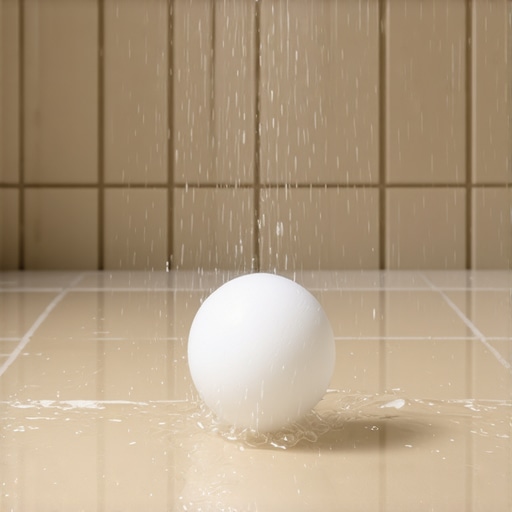
The ‘Ping Pong Ball’ Test for Checking Shower High Spots
Most guys skip the leveling compound. They think the underlayment will hide the dip. It won’t. I spent three days grinding concrete on a job last month just so the floor wouldn’t click like a castanet. If you walk into a bathroom and the tile sounds hollow, someone didn’t use their brain before they used their trowel. I’ve spent twenty-five years on my knees with a moisture meter and a level. I have seen fifteen thousand dollar wide-plank walnut floors turn into potato chips because the installer didn’t check the crawlspace humidity. Flooring is not a decoration, it is a structural engineering challenge. When we talk about showers, we are talking about fluid dynamics and substrate integrity. If you ignore the slope, you are essentially building a very expensive, very moldy pond in your house. The ping pong ball is your best friend on a job site because it never lies about gravity.
The gravity of the situation and shower drainage physics
Shower high spots and drainage slopes require a precise quarter-inch per foot fall toward the drain to ensure surface tension and hydrostatic pressure do not cause water to pool. A ping pong ball placed on the dried mortar bed or leveling compound will immediately roll toward the lowest point, revealing subfloor irregularities and high spots that a standard four-foot level might bridge over. This simple tool identifies where capillary action might trap moisture under your porcelain tile or stone floor. You cannot expect thin-set to fix a bad slope. It is a bonding agent, not a structural filler. When water finds a high spot, it stops. It sits. It eats away at the alkalinity of the grout. If you are doing a carpet install in the bedroom next door, that moisture will eventually wick through the transition strip and rot your padding. The chemistry of a shower floor starts with the TCNA Handbook standards for slope to drain and ends with the physical reality of how a plastic ball reacts to a curve.
“A floor is only as good as the subfloor beneath it; deflection is the enemy of every joint.” – Master Flooring Axiom
The 1/8 inch that ruins everything and substrate deflection
Substrate deflection and floor leveling are the most overlooked aspects of laminate and tile installation because installers want to rush to the finish line. If your subfloor moves more than 1/360th of the span, your grout lines will crack and your click-lock laminate tongues will snap off. Most homeowners think waterproof LVP means they can ignore the dip in the floor, but that is a lie. If the floor flexes, the locking mechanism is under constant stress. Over time, that stress leads to fatigue failure. I have seen laminate floors in Phoenix shrink until they show a gap because the dry heat pulled the moisture out of a subfloor that was never leveled properly. You need to use a straightedge. You need to check for the high spots. A shower floor requires even more care because the waterproofing membrane, whether it is a liquid-applied membrane or a sheet membrane, must adhere to a perfectly smooth surface. Any bump or ridge in the pre-slope becomes a point of failure where the membrane can stretch and tear during structural settling.
The chemistry of the bond and thin-set polymers
Polymer-modified thin-set and epoxy grouts create a chemical bond that relies on mechanical keys within the concrete slab or backer board. When you have a high spot, you end up with thin-set shrinkage. As the water evaporates from the mortar, it pulls the tile down. If the mortar is too thick in one spot to compensate for a dip, it will shrink more than the surrounding areas, leading to lippage. This is why I tell people that floor leveling is not optional. You are dealing with cementitious materials that follow the laws of thermodynamics. They expand and contract. If the thin-set is uneven, the expansion and contraction will be uneven. This leads to the hollow sound you hear when you walk across a cheap tile floor. In a shower, this hollow space becomes a reservoir for stagnant water. This is how you get mold and mildew smells that no amount of bleach can kill. The smell is coming from under the tile, where the ping pong ball would have shown you the high spot that trapped the water in the first place.
| Metric | Standard Requirement | Material Impact |
|---|---|---|
| Deflection Limit | L/360 for Tile | Prevents Grout Cracking |
| Shower Slope | 1/4 Inch per Foot | Ensures Gravity Drainage |
| LVP Wear Layer | 20 mil Minimum | Commercial Grade Durability |
| Subfloor Gap | 1/8 Inch at Perimeter | Expansion for Humidity |
| Concrete Moisture | <3 lbs per 1000 sq ft | Prevents Adhesive Failure |
The ghost in the expansion gap and structural movement
Expansion gaps and perimeter joints are the only things keeping your hardwood or laminate floor from exploding during a humidity spike. If you run your flooring tight against the wall, you are asking for buckling. I don’t care if the shoe molding is thin, you find a way to give that floor room to breathe. In showers, the expansion joint at the change of plane, where the wall meets the floor, must be 100 percent silicone caulk. Never use grout in a corner. The house moves. The floor moves. Grout does not move. If you use grout in a corner, it will crack within six months. That crack is a highway for water to reach your wall studs. I’ve seen carpet installs where the tack strip was rusted out because water was leaking from a shower floor with a high spot that pushed water toward the bathroom door instead of the drain. The physics of water is simple, it takes the path of least resistance. Your job as an architect of the floor is to make sure the path of least resistance leads to the plumbing, not the joists.
“Water doesn’t have a brain, it just follows the lowest point. If you don’t build the lowest point at the drain, the water will find its own low point in your subfloor.” – TCNA Installation Manual
- Check the subfloor for deflection before adding any weight.
- Use a ping pong ball to verify the slope of the shower pan pre-slope.
- Grind down concrete high spots instead of trying to fill around them.
- Verify that the drain flange is set at the correct height for the tile thickness.
- Always use a moisture barrier over concrete slabs before a laminate or carpet install.
The contrarian truth about thick underlayments
While most people want the thickest underlayment for their laminate or LVP, too much cushion actually causes the locking mechanisms to snap under pressure. A floor needs a firm substrate. If you put a squishy pad under a rigid core plank, every step you take puts vertical stress on the tongue and groove. It is like trying to build a bridge on a sponge. You want high-density foam or cork that offers sound dampening without compressive failure. The same logic applies to shower pans. You don’t want a mud bed that is soft or crumbly. You want fortified mortar that creates a monolithic structure. If you are leveling a floor for carpet, you can get away with a bit more padding, but even then, a high spot will cause the carpet fibers to wear down faster in that specific area. A flat floor is a long-lasting floor. Whether it is carpet, tile, or laminate, the subfloor is the soul of the room. Don’t let a one-eighth inch dip be the reason you have to rip out five thousand dollars of finish material in three years. Use the ping pong ball, check your moisture levels, and respect the chemistry of the adhesive.