Why Your Laminate Planks Are Separating at the End Joints
Why Your Laminate Planks Are Separating at the End Joints
Homeowners always ask why their waterproof vinyl or laminate is buckling. Usually, it is because they locked it under a heavy kitchen island, killing the floor’s ability to breathe. I once walked into a house where a five thousand dollar floor was literally pulling itself apart at the seams because the installer thought an expansion gap was a suggestion rather than a law of physics. The homeowner was distraught, blaming the product, but the product was just doing what physics demanded. It was trying to move, but it was pinned. When a floor is pinned, it does not just sit there. It builds up tension until the weakest point gives way. In most click-lock systems, that weakest point is the short end joint.
The 1/8 inch that ruins everything
Laminate planks separate at the end joints because of subfloor deflection, improper expansion gaps, or environmental fluctuations that exceed the material’s tolerance. When the subfloor is not flat within 3/16 of an inch over a 10 foot radius, the planks bridge over low spots. Every time you walk on that bridge, the locking mechanism flexes. Eventually, the thin profile of the tongue or the lip of the groove snaps. Once that physical bond is broken, the boards start to walk away from each other. You might try to tap them back together, but without a mechanical lock, they will just drift again under the pressure of foot traffic.
Why your subfloor is lying to you
Most installers think a subfloor is flat if it looks okay to the naked eye. It is not. I have spent three days grinding concrete on a single job just so the floor would not click like a castanet later. A subfloor is a structural foundation, not just a surface. If you have a dip in your plywood or a hump in your concrete slab, the laminate has to contour to that shape. Laminate is stiff. It is made of high-density fiberboard. It does not want to bend. When you force it to bend over a hump, you are putting incredible shear stress on the end joints. This is where the separation begins. You cannot hide a bad subfloor with a thick underlayment. In fact, using an underlayment that is too thick or too soft is a recipe for disaster. The extra cushion allows the floor to bounce too much, which acts like a lever on the click-joints, prying them apart with every step.
“A floor is only as good as the subfloor beneath it; deflection is the enemy of every joint.” – Master Flooring Axiom
The physics of the floating floor
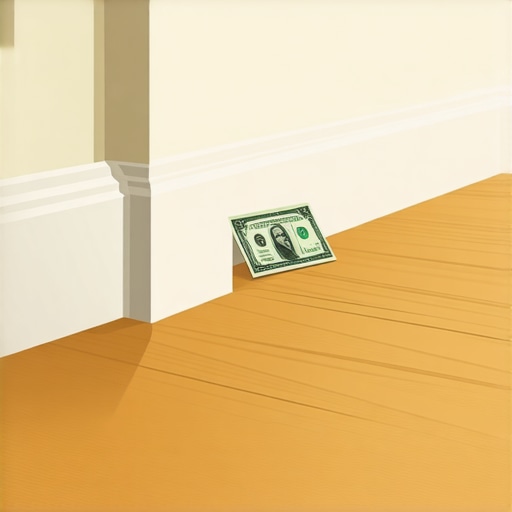
A floating floor is an island. It needs to move as a single unit. When the humidity in your home rises, the wood fibers in the core of the laminate absorb moisture and expand. When the air dries out, they shrink. This is a molecular reality. If you install your baseboards too tight against the floor, or if you run the flooring under a heavy cabinet, you have anchored the floor. Now, when the floor tries to shrink during the winter, it cannot pull inward from the edges. Instead, it pulls apart at the weakest link, which is almost always the end-joint transition. The separation you see is the floor literally tearing itself in two because it is anchored at the perimeter. This is why a 1/2 inch expansion gap is not a guideline, it is a requirement. If you fill that gap with caulk or tight trim, you are asking for the joints to fail.
Chemical composition and core density
The quality of the HDF core determines how well the locking mechanism holds up under stress. Cheap laminate uses a lower density core that is more susceptible to moisture and physical breakdown. High-quality laminate uses resins and wax-impregnated edges to resist swelling. If the core is weak, the intricate tongue and groove pattern will crumble under the weight of furniture or the vibration of walking. When we talk about floor leveling, we are talking about creating a plane where the core density can do its job. If the floor is level, the weight is distributed evenly across the entire surface of the plank rather than being concentrated on the tiny plastic or fiber lock.
| Core Material | Density (kg/m3) | Expansion Rate | Joint Strength |
|---|---|---|---|
| Low-Density Fiberboard | 600-700 | High | Low |
| Standard HDF | 800-850 | Moderate | Medium | Premium High-Density | 900+ | Low | High |
The danger of the tapping block
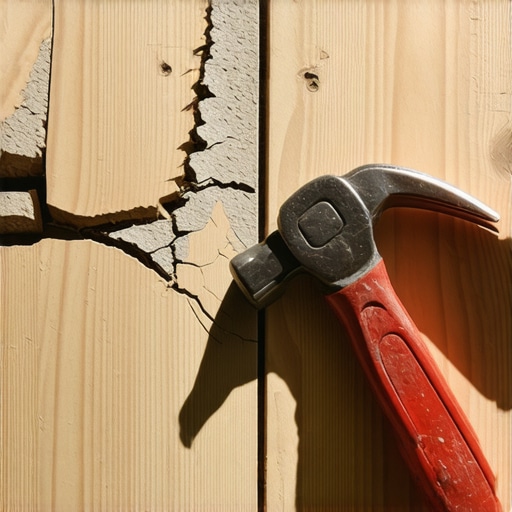
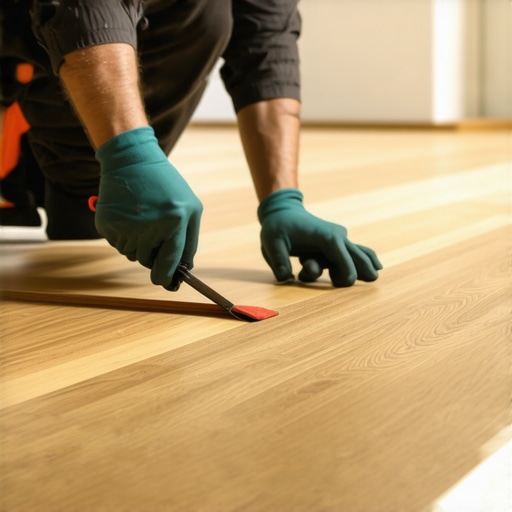
Sometimes the separation starts before the homeowner even moves in. If an installer is too aggressive with the tapping block during the carpet install or the laminate layout, they can create micro-fractures in the tongue. You won’t see these cracks immediately. However, after six months of expansion and contraction, those micro-fractures become full breaks. This is why I always use a professional-grade pull bar and a soft-faced mallet. You want to nudge the planks into place, not beat them into submission. If you hear a sharp crack during installation, you have probably already ruined that plank. Take it out and throw it away. It is not worth the callback six months later when the joint opens up a quarter of an inch.
The ghost in the expansion gap
In many modern homes, people want a continuous look from the kitchen through the living room. They hate T-moldings. They want the floor to flow through doorways without any breaks. This is a dangerous game. Most manufacturers specify a maximum run length, usually around 30 feet. If your floor run is 60 feet long without a transition, the cumulative expansion is massive. That entire mass of flooring is pushing and pulling. The force generated by sixty feet of expanding laminate is enough to buckle a wall or, more commonly, snap the end joints in the middle of the room. Transitions are there for a reason. They act as a pressure relief valve for your floor.
“Failure to provide adequate expansion space is the primary cause of flooring separation and buckling in residential installs.” – Master Flooring Axiom
Environmental acclimation protocols
You cannot bring laminate from a cold warehouse into a warm house and start clicking it together. The material needs to acclimate. I tell people to leave the boxes in the room for at least 48 hours. The boxes should be cross-stacked to allow air to circulate around them. If you skip this, the planks will acclimate after they are installed. If they shrink after they are locked together, you will get gaps. If they expand, you will get peaked joints. This is especially true in areas with high humidity variations like the Gulf Coast or the Pacific Northwest. Moisture is the enemy of any wood-based product. Even ‘waterproof’ laminate has a wood-based core that can react to atmospheric moisture.
- Check subfloor moisture levels with a pin-type meter.
- Ensure the room temperature stays between 65 and 75 degrees Fahrenheit.
- Verify the subfloor is flat within manufacturer specifications.
- Use a moisture barrier over concrete slabs even if the floor says it is waterproof.
- Maintain a 35 to 55 percent relative humidity in the home year-round.
Final assessment of joint failure
If you are already seeing gaps, you need to determine the cause before you try to fix it. Use a vacuum suction cup tool to try and slide the planks back together. If they move easily, you likely have a subfloor dip or an expansion gap issue. If they will not move, or if you see broken bits of the locking mechanism in the gap, the floor is structurally compromised. In those cases, the only real fix is to pull up the floor to the point of the failure, fix the subfloor, and replace the damaged planks. It is a lot of work, but it is the only way to ensure the floor performs the way it was engineered to. Flooring is a science of tolerances. When you ignore those tolerances, the floor will eventually remind you why they exist in the first place.