Why Your Carpet Is Bunched Up Near the Baseboards
The physics of the lateral stretch
Carpet bunching near baseboards is primarily caused by improper tensioning during the initial installation or the subsequent failure of the tack strip due to subfloor moisture. To fix this, a technician must use a power stretcher to achieve a one to one point five percent stretch across the secondary backing of the carpet. A simple knee kicker is insufficient for long term stability in residential settings. [IMAGE_PLACEHOLDER]
I spent three days grinding concrete on a job last month just so the floor wouldn’t click like a castanet. The homeowner wanted carpet over a slab that looked like the surface of the moon. They thought the padding would hide the dips. It never does. Most guys skip the floor leveling compound because it takes time and money. They roll out the pad, kick the carpet into place, and cash the check. Six months later, the carpet starts crawling toward the walls. It creates those ugly ridges that look like waves in a harbor. I see it every week. It is the result of laziness and a fundamental misunderstanding of structural mechanics. Carpet is a textile. Like any fabric under stress, it wants to return to its original shape. If you do not mechanically force it to a specific tension, the daily traffic of feet and vacuum cleaners will push the slack toward the perimeter. Once that slack hits the baseboards, it has nowhere to go but up.
The hidden failure of the tack strip
The tack strip is the mechanical anchor that holds several hundred pounds of lateral tension across a room. If the wood in that strip is soft from high humidity or if the pins are not set at a sixty degree angle toward the wall, the carpet will slip. This is common near the entryways of showers where moisture wicks into the subfloor and rots the plywood or softens the tack strip. High humidity environments cause the wood fibers to swell and lose their grip on the steel pins. When the pins lose their bite, the carpet releases. I have walked into bathrooms where the carpet transition was so loose you could slide a credit card under the bunching. This is not just an aesthetic issue. It is a trip hazard. The chemistry of the backing also plays a role. Most modern carpets use a styrene butadiene rubber latex to bond the primary and secondary backings. If this latex is exposed to extreme moisture from a nearby shower or a damp crawlspace, it undergoes hydrolysis. The backing delaminates. The carpet becomes floppy. It loses its structural integrity and begins to ripple because the internal skeleton of the rug is literally dissolving.
“A floor is only as good as the subfloor beneath it; deflection is the enemy of every joint.” – Master Flooring Axiom
Why your subfloor is lying to you
Subfloor flatness is the most ignored variable in carpet install projects. A dip of even three sixteenths of an inch over ten feet creates a pocket of air where the carpet is not supported. When you step on that spot, you are stretching the carpet vertically. This vertical displacement eventually translates into horizontal slack. Over time, that slack migrates to the edge of the room. I always tell my clients that if the floor leveling is not perfect, the carpet will fail. It does not matter if you bought the most expensive nylon or wool on the market. If the concrete slab is not level, the carpet will eventually bunch. We use self-leveling underlayment to fill those voids. It is a high flow, cementitious product that creates a glass smooth surface. Without it, you are just building on a foundation of sand. I remember a job where the laminate was installed over a wavy subfloor in the hallway, and the carpet in the bedrooms started bunching because the transition strips were being pulled out of alignment by the shifting laminate. The house was breathing, and not in a good way.
The mechanical difference between a knee kicker and a power stretcher
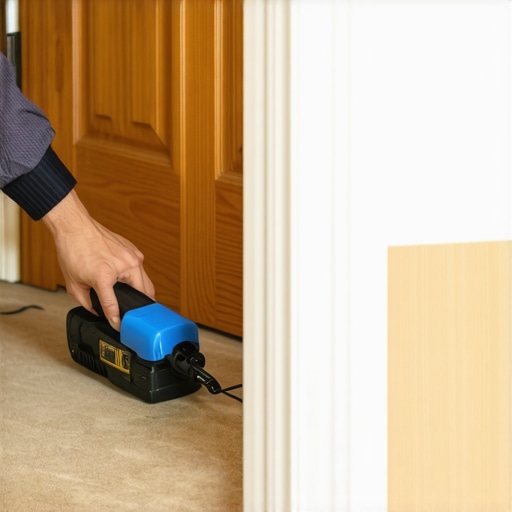
Professional carpet installation requires a power stretcher to distribute force evenly across the entire room. A knee kicker is only intended for setting the carpet onto the tack strips or for small adjustments in tight closets. If your installer only brought a knee kicker to the job, he did not install your carpet correctly. The power stretcher uses a long pole system that braces against the opposite wall. It applies thousands of pounds of pressure. This ensures the secondary backing is pulled to its limit. If you miss this step, the carpet will expand and contract with the seasonal changes in temperature and humidity. In the summer, the fibers swell. In the winter, they shrink. Without the pre-tension of a power stretcher, this cycle leads to permanent deformation. I have seen guys try to kick a twenty foot room. Their knees are shot by forty, and the carpet is wavy by fifty. It is a losing game.
| Factor | Impact on Bunching | Professional Standard |
|---|---|---|
| Subfloor Levelness | High | 1/8 inch over 10 feet |
| Tensioning Method | Critical | Power Stretcher Mandatory |
| Tack Strip Condition | High | Zinc-coated pins, no rot |
| Ambient Humidity | Moderate | 35% to 55% RH |
The intersection of carpet and laminate
Transitions between different flooring types are the most common failure points for tension maintenance. When carpet meets laminate, the transition strip must be anchored into the subfloor with masonry screws or heavy duty construction adhesive. If the laminate is a floating floor, it moves. If that movement pulls on the carpet transition, it will create a ripple right at the doorway. I hate seeing T-molding used where a proper reducer or Z-bar should be. The Z-bar allows the carpet to be tucked and tensioned right up against the harder surface. It creates a clean line. Most installers take the easy way out with a cheap metal strip. Those strips bend. They catch on socks. They look like garbage. A master installer knows that the transition is the handshake between two rooms. If the handshake is weak, the whole house feels cheap.
“Correct substrate preparation is the only way to ensure the longevity of the finished surface; shortcuts are always visible eventually.” – Master Flooring Axiom
The checklist for a permanent fix
- Verify the subfloor is within flat tolerances of 1/8 inch over 10 feet.
- Inspect the tack strips for rust or wood rot near wet areas.
- Ensure the carpet pad density is appropriate for the traffic level.
- Use a power stretcher to reset the tension across the long axis of the room.
- Check that all transitions to laminate or tile are mechanically fastened.
- Maintain indoor relative humidity between 30 and 50 percent.
The chemistry of carpet delamination
Delamination occurs when the secondary backing separates from the primary backing because the adhesive bond fails. This is often caused by over-wetting during steam cleaning or by the presence of pet urine. Once those layers separate, the carpet has no stiffness. It becomes like a wet blanket. No amount of stretching will fix a delaminated carpet. You have to replace it. I once saw a whole house of high end carpet ruined because a cleaning company used too much water and did not use enough suction to dry it. The moisture sat in the latex for two days. The SBR latex turned back into a liquid state and the backing just peeled away. It smelled like a swamp. When people ask why their carpet is bunching, I check for that crunching sound when you lift it. If it crunches, the glue is gone. The structural integrity is zero. You are walking on a ghost. In many cases, the bunching is just the first symptom of a dead floor. If you want a floor that lasts, you have to respect the materials. You have to respect the physics of the stretch and the chemistry of the bond. Anything else is just playing house. [“type”: “HowTo”, “name”: “How to Fix Bunched Carpet”, “step”: [{“@type”: “HowToStep”, “text”: “Clear the room of all furniture to allow for a full room stretch.”}, {“@type”: “HowToStep”, “text”: “Pull back the carpet from the affected baseboard areas carefully.”}, {“@type”: “HowToStep”, “text”: “Check the subfloor for any moisture or unevenness that caused the slack.”}, {“@type”: “HowToStep”, “text”: “Replace any damaged or rotted tack strips with new masonry-nailed strips.”}, {“@type”: “HowToStep”, “text”: “Use a power stretcher to pull the carpet toward the wall, engaging the pins.”}]]