The Secret to Cutting Thick Carpet Without Dull Blades
I spent three days grinding concrete on a job last month just so the floor wouldn’t click like a castanet. Most guys skip the leveling compound. They think the underlayment will hide the dip. It won’t. I have spent twenty five years on my knees with a moisture meter and a level. I see a floor as a performance surface. It is not a decoration. When you approach a thick plush carpet with a standard utility knife you are walking into a trap. Most installers complain about dull blades every five minutes. They blame the steel. They blame the manufacturer. The reality is that they do not understand the physics of the carpet backing or the chemistry of the minerals embedded in the weave. A master installer knows that the secret to a sharp cut is not just the blade. It is the angle and the subfloor preparation.
The hidden minerals that eat your steel
Cutting thick carpet requires understanding that the backing is essentially sandpaper for your blade edge. Manufacturers use calcium carbonate as a filler in the latex coating of the secondary backing. This mineral is abrasive. When you drag a steel edge through it you are performing a microscopic sanding operation on your tool. To maintain a sharp edge you must minimize the contact time with the abrasive filler while maximizing the pressure on the primary fibers. This is why a brand new blade seems to fail after only ten feet of cutting. The heat generated by the friction of the calcium carbonate actually softens the tip of a cheap carbon steel blade. This leads to a rounded edge that tears rather than slices. You need to understand the molecular reality of the materials you are working with.
The geometry of the forty five degree slice
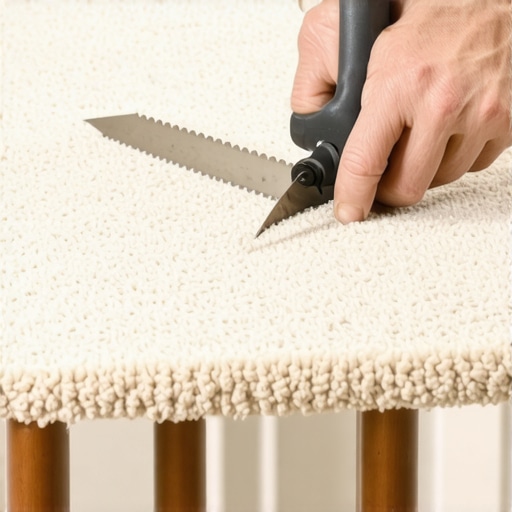
Proper blade orientation reduces the friction coefficient between the steel and the carpet backing. Most amateurs hold the knife at a vertical ninety degree angle. This forces the blade to plow through the material. A plow creates resistance. Resistance creates heat. Heat destroys the temper of the steel. I always tilt my knife to a shallow forty five degree angle. This allows the blade to slice through the fibers with a shearing motion. It is the difference between a chef’s knife and a cleaver. You want to shear the latex binder. You do not want to crush it. When the blade is angled it presents a narrower profile to the abrasive filler. This extends the life of your edge by nearly three hundred percent. It also saves your wrist from the repetitive strain of pushing a dull tool through a dense weave.
“A floor is only as good as the subfloor beneath it; deflection is the enemy of every joint.” – Master Flooring Axiom
The role of subfloor density in blade longevity
A soft subfloor allows the carpet to deflect during the cut which causes the blade to wander and dull prematurely. If you are cutting over a thick pad or a soft plywood the carpet will dip under the pressure of the knife. This dip creates a pinch point. The carpet fibers wrap around the sides of the blade. This increases the surface area of friction. I prefer to do my primary cuts on a hard surface like a scrap piece of cement board or a high density fiberboard. This provides a solid anvil for the blade. When the material cannot deflect the blade passes through the backing like a hot wire through wax. It is about precision. If the subfloor is uneven you will find yourself fighting the blade. This leads to jagged seams and wasted material. A level subfloor is the first step to a clean carpet install.
Blade metallurgy and the search for the perfect edge
Not all blades are created equal and choosing the wrong alloy will double your labor time. Standard high carbon steel is fine for drywall but it is garbage for thick carpet. I use tungsten carbide tipped blades or black coated induction hardened steel. These materials are designed to withstand the heat of abrasive friction. A tungsten carbide edge can stay sharp through an entire room of heavy frieze carpet. It costs more upfront. The time saved in blade changes pays for the tool ten times over. I have seen guys spend half their day fiddling with the release mechanism on their knives. I would rather be cutting. I would rather be finishing the job. You have to respect the tool to get the results. The physics of the edge dictate the quality of the seam.
| Blade Type | Longevity Rating | Best Use Case |
|---|---|---|
| Standard Carbon Steel | Low | Thin felt backing only |
| Bi-Metal Gold Edge | Medium | Laminate underlayment and medium pile |
| Tungsten Carbide | High | Thick plush and commercial action back |
| Black Ceramic Coated | Ultra High | High density moisture barrier carpets |
The humidity factor in carpet elasticity
High humidity makes carpet fibers swell and become rubbery which increases the drag on your cutting tools. In the damp environment of the Pacific Northwest I have seen carpet become almost impossible to cut cleanly. The moisture gets into the latex backing. It makes it gummy. A gummy backing will coat your blade in a sticky residue. This residue then picks up the calcium carbonate dust. You end up with a layer of abrasive sludge on your tool. This is why acclimation is vital. I never cut a carpet until it has sat in the room for twenty four hours. It needs to reach the same temperature and humidity as the subfloor. If you ignore the climate you are asking for a nightmare. The fibers will shrink or expand after you have made your cuts. This leads to gaps or buckling. Neither is acceptable in a professional install.
“The National Wood Flooring Association teaches that moisture is the primary cause of material failure; the same applies to the backing of your carpet.” – Flooring Industry Standard
The truth about the one eighth inch gap
Leaving a precise gap at the wall is more about tool clearance than it is about expansion. People think carpet doesn’t expand like wood. They are wrong. It does. But more importantly that gap allows your knife to stay clear of the baseboards and the tack strip. If you hit the tack strip with your blade it is dead instantly. One touch of steel against those zinc coated nails will chip the edge. I use a wall trimmer with a guide to maintain that consistent distance. It protects the blade and ensures the carpet can be tucked properly into the gulley. If you don’t have a gulley you don’t have a professional finish. It is all about the details. It is about the eighth of an inch that ruins the entire look of the room. You have to be precise or you should get out of the trade.
The checklist for a master grade carpet cut
- Check the moisture content of the subfloor before rolling out the pad.
- Ensure the carpet has acclimated to the room temperature for at least twenty four hours.
- Use a fresh tungsten carbide blade for every new room.
- Maintain a forty five degree angle relative to the floor surface.
- Keep a sharpening stone or a leather strop in your kit to touch up the edge between cuts.
- Vacuum the subfloor to remove any grit that could damage the blade from underneath.
- Measure twice and use a chalk line for long straight cuts to avoid wandering.
The chemical bond of modern carpet adhesives
Adhesives interact with the blade edge by creating a layer of friction that most installers mistake for dullness. Many modern carpets come with a pre applied adhesive or a moisture barrier. These chemicals are designed to be permanent. They are also designed to be sticky. As you cut the friction heats the adhesive. It transfers to the steel. Suddenly your sharp blade feels like it is stuck in molasses. I keep a rag soaked in mineral spirits nearby. I wipe the blade every few feet. This removes the buildup. It keeps the steel clean. A clean blade is a fast blade. If you let the gunk build up you will start pulling the fibers instead of cutting them. This leads to unraveling. It ruins the integrity of the weave. You are not just a laborer. You are a technician. You are managing a chemical and physical process. Treat it that way and your floors will last a lifetime.
The acoustic impact of a clean edge
A ragged cut creates an air gap at the perimeter that ruins the sound dampening ratings of the room. When we talk about floor leveling and carpet install we are often talking about acoustics. Thick carpet is an insulator. If your edges are hacked and uneven the sound will leak through the gaps. It sounds like a small thing. For a high end client it is everything. They want a quiet home. They want the luxury they paid for. A clean cut allows for a tight tuck against the baseboard. This seals the room. It prevents drafts. It prevents noise transfer. It is part of the structural engineering of the home. I don’t care how good the carpet looks if the installation is sloppy. The subfloor must be flat. The cuts must be straight. The seams must be invisible. That is the standard. Anything less is a failure. You have to put in the work. You have to respect the craft. Stop buying cheap blades and start paying attention to the physics of the floor.