The ‘Dime Test’ for Checking Carpet Tension on Stair Treads
The day the concrete fought back
Most guys skip the leveling compound. They think the underlayment will hide the dip. It won’t. I spent three days grinding concrete on a job last month just so the floor wouldn’t click like a castanet. That job was supposed to be a simple laminate install, but the slab was a mountain range. My hands still vibrate from the grinder. I smelled like WD-40 and oak dust for a week. That experience is exactly why I obsess over the mechanics of a carpet install on stairs. If the foundation is trash, the finish is trash. Whether you are dealing with showers leaking near a bathroom floor or floor leveling issues in a basement, the principle remains. You do not build a house on sand, and you do not stretch carpet over a loose stair tread. You do the work or the work does you.
Measuring the invisible pull on stair nosing
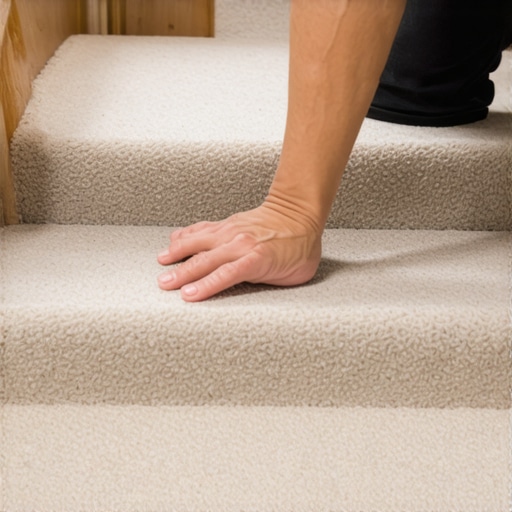
The dime test validates carpet tension by attempting to insert a coin between the carpet and the stair riser. If the coin slides in easily, the tension is insufficient. Proper carpet install requires the backing to be drum-tight against the tread to prevent tripping and premature fiber degradation. When you are on your knees with a knee kicker, you are not just pushing fabric. You are engaging with the structural physics of the stair assembly. A loose carpet on a stair is a slide waiting to happen. The dime test is the industry standard for those of us who actually care about the safety of the homeowner. You take a standard dime and try to shove it into the crotch where the tread meets the riser. If that dime finds a gap, your stretch is weak. You need to pull it tighter and reset your staples. It is about the resistance of the jute or synthetic backing against the wood. If there is any play, the carpet will move. Movement causes heat. Heat causes friction. Friction destroys fibers. Your high-end carpet becomes a rag in two years because you were too lazy to kick it in properly.
“A floor is only as good as the subfloor beneath it; deflection is the enemy of every joint.” – Master Flooring Axiom
Why loose carpet is a liability in your home
Loose carpet on stairs creates a rolling effect underfoot that can lead to catastrophic falls and structural wear. Tension is the only thing keeping the carpet from shifting during the high-impact descent of a human body. Without proper tension, the carpet fibers crush and the backing delaminates. I have seen people try to fix this with a few extra staples. That is a hack move. You have to understand the chemistry of the backing. Most modern carpets use a secondary backing made of polypropylene. This material has a specific elastic limit. If you do not stretch it to that limit, it will naturally relax over time. This relaxation creates ripples. On a flat floor, a ripple is an eyesore. On a stair, a ripple is a trip hazard. We call it the ghost in the expansion gap when we talk about hardwood, but in carpet, it is the bubble on the tread. If your carpet install does not involve a power stretcher or a heavy-duty kicker used with professional intent, you are just laying a blanket down, not installing a floor.
The physics of the dime test explained
The dime test works because it measures the gap between the carpet backing and the crotch of the stair. A professional installation leaves zero room for the thickness of a coin. This ensures the carpet cannot shift forward when a foot applies horizontal shear force to the tread. Think about the mechanics of walking down stairs. Your foot does not just land vertically. It pushes forward. If the carpet is not anchored at the back of the tread and the top of the riser, it slides. I have seen the results of poor tension in houses where the carpet has actually rounded over the nosing because it was not tucked tight. The dime test is a binary check. It either passes or it fails. There is no middle ground. If I can fit that dime in, I am pulling the carpet back off the tack strip and doing it again. I do not care if it takes another hour. My reputation is worth more than a sixty-minute shortcut.
| Installation Metric | Staple Method | Tackless Strip Method | Waterfall Method |
|---|---|---|---|
| Tension Strength | High | Extreme | Moderate |
| Durability Grade | Heavy Duty | Commercial | Residential |
| Dime Test Failure Rate | Low | Very Low | High |
| Lateral Movement | Minimal | Zero | Possible |
Tools that make the difference between safety and a fall
Professional carpet installation on stairs requires a specialized toolkit including a stair tool, a heavy-duty electric stapler, and a calibrated knee kicker. These tools allow the installer to drive the carpet into the crotch of the stair to pass the dime test with ease. You cannot do this with a hammer and a screwdriver. I have seen homeowners try to use a flathead screwdriver to tuck the carpet. All they do is rip the backing. You need a stair tool with a wide, blunt blade to drive that carpet deep into the crease. You also need a stapler that can penetrate the hardwood or OSB of the stair tread. If the staple does not seat fully, it will eventually work its way out. Then you have a sharp piece of metal waiting for someone’s heel. That is why I use 9/16-inch divergent point staples. They splay out when they hit the wood, creating a mechanical lock that no amount of foot traffic can pull loose.
Subfloor prep before the padding hits the wood
Subfloor preparation for stairs involves checking for tread deflection, silencing squeaks with structural screws, and ensuring the nosing is rounded to the correct radius. A poorly prepared subfloor will telegraph imperfections through the carpet and make the dime test impossible to pass. If the tread moves when you step on it, the carpet will never stay tight. I spend a lot of time on my knees with a screw gun before I ever touch a roll of carpet. I am looking for gaps in the stringers. I am looking for split wood on the nosing. If the nosing is too sharp, it will cut the carpet backing. If it is too blunt, the carpet will look bulky. While some think floor leveling is only for laminate or tile, a flat stair tread is just as vital. Any dip in that wood will create a pocket of air. Air is the enemy of tension. You want the padding to be an extension of the wood, not a bridge over a hole.
“Proper tensioning on stairs requires a minimum stretch of one percent in both directions to prevent premature wear and safety hazards.” – Carpet Installation Standards Board
The friction coefficient of various fiber types
Different carpet fibers such as nylon, polyester, and wool react differently to the tension required for stairs. Nylon is the preferred choice due to its high resilience and ability to maintain tension after the dime test is performed. Wool is beautiful, but it has a lot of stretch. You have to be careful not to over-stretch it or you will distort the pattern. Polyester is softer, but it lacks the memory of nylon. Once polyester stretches out, it stays out. This is a technical data point most sales guys will not tell you. They just want to sell you the softest carpet. I want to sell you the one that stays on the stairs. While most people want the thickest underlayment, too much cushion actually causes the locking mechanisms on LVP to snap under pressure, and in carpet, it causes the staples to pull through the backing. You want a dense 8-pound pad, not a thick mushy one. Density equals stability.
- Inspect the riser for any protruding nails or staples.
- Install tack strips with a 1/2 inch gap from the crotch.
- Apply 8lb density padding and stop it 1 inch short of the tack strip.
- Secure the carpet to the riser using a 12-inch staple pattern.
- Perform the dime test at three points across every single tread.
Why moisture impacts your carpet tension
Ambient humidity and moisture from nearby showers or basements can cause carpet fibers to swell and backings to soften. This change in physical state reduces the tension of the install and can lead to a failed dime test weeks after completion. I always check the humidity on a job site. If the house has been sitting without AC in the middle of a humid summer, that carpet is full of moisture. If I stretch it tight then, it will become a drum when the air dries out. Or worse, if I install it dry and the house gets humid, the carpet will expand and start to bag. This is why acclimation is not just for hardwood. You need to let that carpet sit in the environment for 24 hours. The chemistry of the latex adhesive used in the backing is sensitive to temperature. If it is too cold, the backing is stiff and brittle. If it is too hot, it is like stretching a rubber band. You want the sweet spot.
The final inspection protocol
The final step of any job is the walk-through. I take a dime out of my pocket and I show the homeowner. I go to the middle of the flight and I try to find a gap. When they see that the coin cannot even start to penetrate the crease, they know they got a real install. This is not about being fancy. It is about being a mechanic. It is about the sawdust under the nails and the knowledge that the floor is solid. I have seen laminate jobs fail because people did not understand expansion. I have seen carpet jobs fail because people did not understand tension. It all comes back to the same thing. You respect the material or the material will fail you. You do not need a computer to tell you a floor is good. You need a level, a dime, and a pair of knees that have seen a thousand jobs. That is the only way to ensure the work lasts longer than the check takes to clear.