How to Fix a Carpet Bubble Without a Power Stretcher
Most guys skip the leveling compound. They think the underlayment will hide the dip. It won’t. I spent three days grinding concrete on a job last month just so the floor wouldn’t click like a castanet. That same negligence causes carpet ripples. When a subfloor has a valley, the carpet cannot sit flat. Over time, foot traffic pushes the backing into those voids. The result is a bubble that grows every time someone walks over it. Fixing these issues without a heavy power stretcher is a test of physics and patience. It requires a deep understanding of the mechanical properties of the primary and secondary backing of the textile. You are not just pulling a rug. You are recalibrating the tension of a multi-layered synthetic system.
The tension reality of knee kickers
Knee kickers provide localized carpet tension through mechanical leverage, allowing installers to seat carpet backing onto tack strips without a power stretcher. This method relies on physical force applied to the primary backing to remove bubbles and ripples in smaller rooms or tight spaces. While the power stretcher uses a long pole and a lever to move the entire floor, the knee kicker allows for surgical strikes on specific ripples. You are using the weight of your body to overcome the static friction between the carpet padding and the secondary backing. This is often enough to reset the floor in a standard 10 by 12 room. If the room is larger, the physics change. The weight of the carpet itself creates enough drag that a kicker may only move the material a few millimeters at a time.
The ghost in the expansion gap
Expansion gaps are the breathing room for your floor, and when carpet is installed without adequate perimeter tension, the material will eventually migrate toward the center of the room. This migration creates bubbles and ripples that look like small waves. If your tack strips are failing or if the carpet was not properly tucked into the gully, the floor has no way to maintain its structural integrity. The gully is that narrow space between the tack strip and the baseboard. It acts as the anchor point for the entire installation. If the carpet was cut too short, it will slip off the pins. If it was cut too long, the excess material will bunch up and create a false bubble at the edge that eventually moves inward.
“A floor is only as good as the subfloor beneath it; deflection is the enemy of every joint.” – Master Flooring Axiom
Why your subfloor is lying to you
Subfloor moisture and uneven surfaces are the hidden culprits behind 90 percent of carpet bubbles. When concrete slabs or plywood sheets are not perfectly level, the carpet pad cannot provide a stable foundation. Over time, the latex adhesive in the carpet backing softens if the humidity is too high. This is especially true in regions with high moisture vapor transmission rates. When that adhesive softens, the primary and secondary backings begin to separate. This is called delamination. Once a carpet delaminates, no amount of stretching will keep it flat. The two layers are moving at different speeds. You can stretch the top, but the bottom is stuck to the pad. It is a structural failure disguised as a cosmetic ripple.
Steam and the molecular memory of nylon
Steam cleaners and industrial steamers can be used to reset the molecular memory of nylon fibers and synthetic backings. If a bubble has been in place for a long time, the plastic fibers have literally bent into that shape. Even if you stretch the carpet tight, the fibers want to go back to their wrinkled state. By applying controlled heat and moisture, you relax the tension in the polypropylene or jute. This allows the carpet to accept a new flat shape. You must be careful. Too much heat will melt the latex glue that holds the tufts in place. You want to warm the backing until it is pliable, then immediately apply tension with your kicker and reset it on the tack strips. This is a common trick in the trade when dealing with stubborn waves that refuse to flatten out.
Comparison of mechanical carpet tools
| Tool Type | Primary Function | Force Applied | Ideal Room Size |
|---|---|---|---|
| Knee Kicker | Localized Tension | Low to Moderate | Small (under 12ft) |
| Power Stretcher | Full Room Tension | High | Any Size |
| Carpet Tucker | Perimeter Setting | Manual | N/A |
| Stay Nails | Temporary Anchor | None | N/A |
The chemistry of adhesive failure
Adhesive breakdown occurs when the latex bond in the carpet backing is compromised by cleaning chemicals or pet accidents. If a bubble keeps appearing in the same spot regardless of how many times you stretch it, the backing has likely failed. The glue that holds the carpet together is water-soluble in many older installations. If a homeowner uses a steam cleaner too often or uses too much water, they are literally dissolving the floor. This leads to a loss of dimensional stability. The carpet becomes like a wet noodle. In these cases, you are not just fixing a ripple. You are fighting a chemical breakdown. Sometimes, the only solution is to inject a specialized repair adhesive through the face of the carpet into the backing to re-bond the layers before you attempt a manual stretch.
Essential steps for ripple removal
- Clear the room of all heavy furniture to allow the carpet to move freely across the pad.
- Inspect the tack strips along the perimeter to ensure the pins are sharp and not rusted.
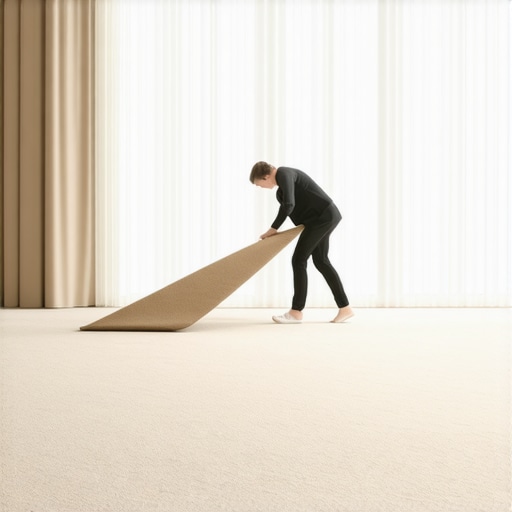
- Peel back the carpet in the corner closest to the largest ripple using a pair of pliers.
- Use a knee kicker at a 15 degree angle toward the wall to apply lateral force.
- Reset the carpet onto the tack strip and tuck the excess into the gully with a stair tool.
- Check for any remaining slack and repeat the process in a fan-like pattern from the center.
The physics of lateral force
Lateral force must be applied evenly across the carpet width to prevent diagonal wrinkles from forming. When you use a knee kicker, you are applying a burst of energy that travels through the material. If you only kick in one spot, you create a point of high tension surrounded by low tension. This causes the carpet to skew. Professional installers use a technique called the stair-step. We start in one corner, secure it, and then work our way down the wall in incremental steps. This ensures that the tension is distributed across the entire weave. If you are working with a patterned carpet, this is even more difficult. One wrong move and the entire pattern will look like it is underwater. You have to watch the grain of the carpet as you work. It will tell you where it wants to go. You just have to listen to the physics of the fiber.
“Standard carpet installation requires a minimum stretch of 1 to 1.5 percent in both width and length to maintain stability.” – NWFA Professional Guidelines
Environmental impacts on textile stability
Indoor air quality and ambient temperature play a massive role in whether a carpet will bubble after installation. Synthetic materials like polyester and nylon expand when they get warm and shrink when they get cold. If you install a floor in a house that does not have the HVAC system running, you are asking for trouble. Once the air conditioning kicks on, the carpet will contract. If it was not stretched tight enough, it will pull off the walls. Conversely, if it is cold during the install and the house warms up later, the carpet will expand and create waves. This is why acclimation is not just a suggestion for hardwood. It is a requirement for any textile. The roll needs to sit in the environment where it will live for at least 48 hours to reach an equilibrium state before you even think about putting it on a tack strip.
Final structural considerations
Fixing a ripple is a manual labor task that requires a sharp eye for detail. You must ensure that the pad under the carpet has not bunched up as well. Sometimes, the ripple you see on the surface is actually the pad underneath having failed. If the pad is not stapled or glued down properly, it will move with the carpet. If you find a lump in the pad, you have to pull the carpet back entirely and fix the foundation first. A floor is a system of layers, and if the bottom layer is failing, the top layer will never stay flat. Take the time to prep the subfloor. Sand down the high spots. Fill the low spots. Ensure the environment is stable. If you do those things, the carpet will stay flat for its entire lifespan. If you skip them, you will be back on your knees with a kicker in six months. Flooring is not about aesthetics. It is about engineering a performance surface that can withstand the thousands of pounds of pressure it will face every single day.