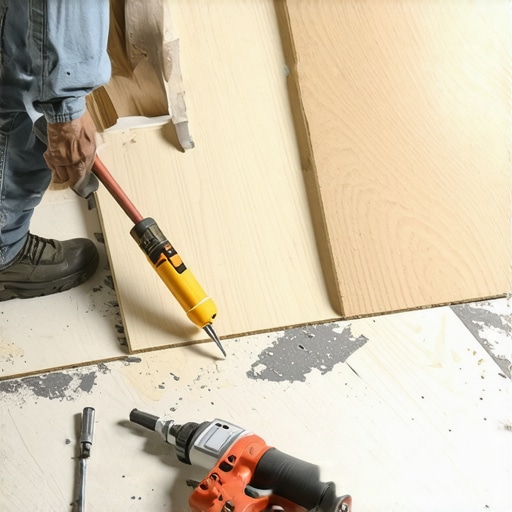
How to Seal Plywood Gaps Before Pouring 2026 Floor Leveler
Most guys skip the leveling compound. They think the underlayment will hide the dip. It won’t. I spent three days grinding concrete on a job last month just so the floor wouldn’t click like a castanet. That experience taught me one thing. If you do not seal every single breach in your plywood subfloor before you introduce a liquid leveling agent, you are asking for a structural and financial nightmare. You are essentially pouring money into a black hole where gravity and capillary action conspire to drain your self-leveling underlayment into the crawlspace or onto the ceiling of the room below. The 2026 standards for floor prep demand a level of airtight integrity that most old-school installers simply ignore until they hear the sound of liquid hitting a tarp in the basement. I have seen fifteen-thousand-dollar wide-plank walnut floors ruined because the subfloor prep was treated like an afterthought. We are going to treat this like a surgical procedure.
The subfloor secret that saves your slab
Plywood gap sealing involves using specialized siliconized sealants or heavy duty moisture resistant tapes to prevent self-leveling underlayment (SLU) from escaping through joints. To achieve a flat floor surface for laminate or hardwood, the subfloor must be entirely watertight to maintain the proper polymer hydration levels within the compound. If the liquid escapes, the remaining mix loses its structural integrity and cracks before it fully cures. This is the difference between a floor that lasts forty years and a floor that fails in forty days. I remember a specific job where a rookie thought a bit of duct tape would hold back a two inch pour of high flow leveler. By the time the pour was finished, the homeowner had six gallons of expensive polymer sitting on their furnace in the basement. We do not take shortcuts here. We look at the subfloor as a containment vessel. Every seam, every knot hole, and every perimeter edge where the wall meets the floor must be addressed with precision. The chemistry of 2026 levelers relies on a specific ratio of water to powder. When a gap allows liquid to seep out, that ratio is compromised. The result is a brittle, chalky surface that will eventually crumble under the weight of a heavy kitchen island or even a simple carpet install where the tack strips need a solid bite.
“A floor is only as good as the subfloor beneath it; deflection is the enemy of every joint.” – Master Flooring Axiom
Why gravity is the enemy of an unsealed gap
Liquid floor leveler has a viscosity similar to pancake batter or heavy cream, meaning it will find the path of least resistance through any plywood seam or screw hole. Without a watertight seal, the leveler will migrate through the subfloor assembly, creating voids that lead to floor squeaks and locking mechanism failure in LVP floors. This migration is not just a loss of material. It is a loss of engineering. When you pour a leveler, you are creating a new structural plane. If that plane is interrupted by a leak, the surface tension of the liquid is broken. You end up with a dip where you wanted a flat surface. This is particularly dangerous near showers or wet areas where the subfloor might already be compromised by historical moisture. You need to inspect the perimeter of the room with a high intensity light. If you see light coming through a crack, leveler will find it. The physics are simple. A one-eighth inch gap can drain a fifty-pound bag of leveler in less than ten minutes. You are not just sealing a hole. You are building a dam.
| Sealant Type | Drying Time | Max Gap Width | Best Use Case |
|---|---|---|---|
| Siliconized Acrylic | 4 Hours | 1/4 Inch | General Perimeter Sealing |
| Flash Patching Compound | 20 Minutes | 1/2 Inch | Deep Plywood Knots |
| High-Density Spray Foam | 1 Hour | 2 Inches | Pipe Penetrations |
| Self-Adhesive Seam Tape | Instant | 1/8 Inch | Long Linear Plywood Joints |
The chemistry of the perfect seal
Plywood expansion and contraction must be accounted for when selecting a sealing agent for floor leveling projects. Using a flexible caulk ensures that the expansion gaps remain functional while preventing the leveler leakage that leads to hollow spots under hardwood flooring or luxury vinyl plank. Many people think they can just use wood filler. That is a mistake. Wood filler is rigid. It will crack the second you walk on it. You need something that remains elastic. I prefer a high-grade siliconized acrylic because it sticks to the plywood fibers and the leveler can bond to its top surface without causing a chemical reaction that weakens the pour. You also have to consider the moisture content of the plywood itself. If your plywood is sitting at 12 percent moisture and you seal it tight, then pour a wet leveler on top, you are trapping that moisture. Always use a professional moisture meter. If the wood is too wet, you are sealing in a rot problem that will manifest as mold under your laminate in two years. This is why we use a primer. The primer serves two purposes. It stops the plywood from sucking the water out of the leveler too fast, and it provides a secondary layer of protection over your sealed gaps. It is a system, not a single step.
The 1/8 inch that ruins everything
Subfloor prep requires a flatness tolerance of 1/8 inch over a 10-foot radius according to NWFA standards. Sealing gaps effectively is the only way to ensure the self-leveling pour reaches this precision tolerance without slumping or pitting due to air bubbles escaping from the subfloor cavity. I have seen guys try to use masking tape. It is pathetic. The weight of the leveler, which can be over 100 pounds per square foot depending on the depth, will simply peel the tape back and the leak will start. You need a mechanical bond. For larger gaps, I recommend a two-part epoxy or a rapid-setting cementitious patch. This creates a bridge. Think of it like dental work. You are filling a cavity so the rest of the structure can remain healthy. If you are preparing for a carpet install, you might think leveler is overkill. But a flat subfloor makes the carpet feel twice as expensive. It eliminates those weird shadows and lumps that make a room look cheap. When you are working around showers, this sealing process is even more vital. Any leveler that leaks into a drain assembly or behind a wall plate can cause thousands of dollars in plumbing damage. Use a foam backer rod for the big gaps at the wall. It provides a cushion and a backstop for your sealant.
“Failure to prime and seal a wood subfloor prior to the application of a self-leveling underlayment will result in the dehydration of the compound and subsequent bond failure.” – TCNA Handbook Excerpt
A step by step guide to the airtight subfloor
- Vacuum every joint with a HEPA filtered shop vac to remove oak dust and debris.
- Apply a bead of siliconized acrylic caulk to every plywood seam wider than 1/16 inch.
- Fill all screw indentations and knot holes with a rapid set patching compound.
- Apply seam tape over the caulked joints for a secondary layer of leveler containment.
- Install a foam expansion strip around the entire perimeter of the room.
- Prime the entire surface with a high-solids floor primer to seal the wood pores.
- Conduct a final light test to ensure no visible gaps remain before the pour begins.
Why too much cushion kills the click lock
Floor underlayment should never be used to mask a poorly leveled subfloor because excessive deflection will cause the tongue and groove systems of laminate to snap. While most people want the thickest underlayment, too much cushion actually causes the locking mechanisms on LVP to snap under pressure. This is a hard truth that many retailers won’t tell you. They want to sell you the fancy 5mm foam. But if your subfloor has a 1/4 inch dip, that foam will just compress and your expensive floor will click and pop every time you walk on it. That is why we use 2026 leveler. We fix the problem at the source. By sealing the gaps and pouring a perfectly flat surface, you allow the floor to do its job. The locking mechanism stays neutral. There is no vertical movement. This is especially true for those massive 60 inch planks people love now. The longer the plank, the flatter the floor has to be. If you have a hump in the middle of the room because your leveler leaked out at the edges, those long planks will bridge the gap and eventually split right down the middle. It is a physics problem, plain and simple. You cannot fight gravity, and you cannot fight the leverage of a long board. You can only provide a surface that is as flat as a pool table. That starts with a tube of caulk and the patience to seal every single gap in that plywood. It is boring work. It is backbreaking work. But it is the only work that matters if you want a floor that doesn’t fail. Check your moisture. Check your level. Seal your gaps. Then, and only then, can you open those bags of leveler and start the clock. If you do it right, the pour will be the easiest part of the job. If you do it wrong, it will be the most expensive mistake of your career.