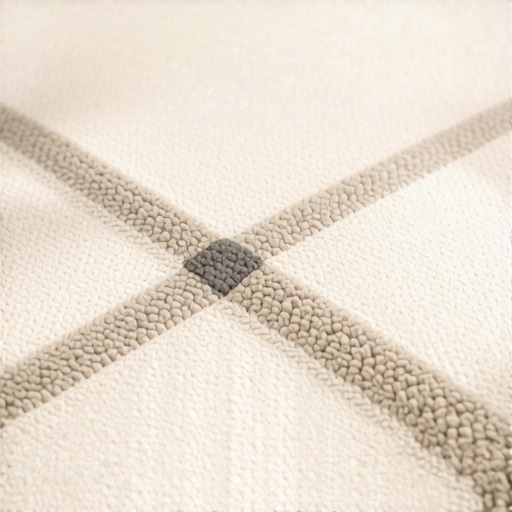
Most guys skip the leveling compound. They think the underlayment will hide the dip. It won’t. I spent three days grinding concrete on a job last month just so the floor wouldn’t click like a castanet. I have seen countless homeowners waste thousands on high-end nylon because their installer was too lazy to run a straightedge across the slab. If your subfloor is not flat within three-sixteenths of an inch over a ten-foot radius, your carpet seams will eventually fail. The tension from the power stretcher pulls at the low spots, and before you know it, that invisible seam is a gaping canyon that catches every piece of dust in the house. This is the reality of a professional carpet install where physics matters more than aesthetics.
The subfloor secret no one tells you
Floor leveling is the foundational requirement for invisible carpet seams in modern carpet install projects. If the subfloor contains dips or humps, the seam tape cannot make full contact with the carpet backing, leading to premature delamination and visible lines. You must use a self-leveling underlayment to ensure a dead-flat surface before the pad goes down. I have spent years fixing the mistakes of installers who thought they could bridge a gap with extra padding. It never works. When you walk over a hollow spot, the carpet flexes. That flex puts a mechanical shear force on the adhesive bond of the seam. Over time, the latex breaks down. The microscopic granules of the secondary backing start to flake away. You end up with a frayed mess that no amount of steam can fix. Grinding the high spots of a concrete slab is a dusty, miserable job, but it is the only way to guarantee the structural integrity of the installation. I smell like oak dust and WD-40 most days because I do the work others refuse to do. A floor is a performance surface, not a rug you just throw down and hope for the best.
“A floor is only as good as the subfloor beneath it; deflection is the enemy of every joint.” – Master Flooring Axiom
The molecular bond of heat tape resins
Seam tape resins undergo a chemical transition when heated to three hundred and fifty degrees during a carpet install. Achieving invisible seams requires precise thermal management to ensure the adhesive penetrates the primary backing without scorching the face fibers. The chemistry of modern hot-melt adhesives has changed. We are no longer using the thick, gummy waxes of the nineties. Today, we use low-profile, high-strength polymers that create a rigid bridge between two pieces of carpet. If your iron is too cold, you get a cold weld. The glue stays on top of the tape and never bites into the carpet. If it is too hot, you melt the synthetic fibers, and you get a permanent shiny line that glows under LED lighting. I use a digital thermometer to check my iron before I touch a seam. Most guys just wait for the smoke. That is how you ruin a five-figure job. You need to understand the melt-point of the specific resin on your tape. Some are designed for quick-grab on polyester, while others are engineered for the high-energy surfaces of nylon 6,6. When the adhesive cools, it should form a singular unit with the carpet backing. This is not just glue. It is a structural weld.
Row cutting as a structural engineering feat
Row cutting is the process of separating carpet fibers at the molecular level to ensure a perfect butt joint during a carpet install. By following a single warp yarn across the entire length of the room, the installer ensures that face fibers do not overlap or gap, creating the invisible seam effect. Most installers use a trace cutter. It is fast. It is also wrong. A trace cutter follows the edge of the first piece, but if that edge has any deviation, the second piece will mirror it. I get on my knees with a screwdriver and a row-finder. I manually separate the tufts to find the exact valley between the stitches. Then, I use a sharp blade to cut only the backing, never the pile. This preserves the integrity of the yarn. When you bring those two edges together, the fibers interlock naturally. It looks like the carpet grew out of the floor as one piece. If you cut through the fibers, you get a “burr” or a haircut. That cut fiber will reflect light differently than the factory-finished tip. That is why you see seams in the afternoon sun. It is not the glue. It is the geometry of the cut.
| Adhesive Property | Standard Grade Tape | Professional Premium Tape | Structural Requirement |
|---|---|---|---|
| Melt Temperature | 250 Degrees | 375 Degrees | Consistent Heat Penetration |
| Resin Density | Low | High | Primary Backing Saturation |
| Cooling Rate | Fast | Moderate | Stress Relaxation Time |
| Shear Strength | 300 psi | 850 psi | Power Stretching Resistance |
The humidity trap in modern carpet install
Ambient humidity and acclimation are the primary drivers of carpet expansion and seam failure in 2026. A carpet install performed in a high-humidity environment without proper HVAC stabilization will result in buckling and visible seams as the textile fibers relax and contract. I have seen beautiful laminate and carpet jobs destroyed because the builder turned off the air conditioning to save a few bucks. Carpet is a giant sponge. It absorbs moisture from the air. If you seam a dry carpet in a humid room, it will swell. If you seam a wet carpet in a dry room, it will shrink. You need a moisture meter for the air, not just the floor. The NWFA and carpet manufacturers agree that seventy-two hours of acclimation is the minimum. I won’t even unload my van if the house is not at living conditions. The chemical bonds in the tape need a stable environment to set properly. If the floor is moving while the glue is cooling, you are doomed. I once walked into a house where a walnut floor was cupping because of the crawlspace moisture, and the carpet in the next room was doing the same thing. The installer blamed the product. I blamed the installer for not checking the dew point.
“Textile floor coverings must reach an equilibrium moisture content with the installation environment to prevent dimensional instability.” – NWFA Technical Bulletin
The 1/8 inch that ruins everything
Precision stretching using a power stretcher is the only way to prevent carpet movement that exposes seams. Every carpet install must account for the one-eighth inch of mechanical tension required to lock the backing onto the tack strip. If you just use a knee kicker, you are not stretching the carpet. You are just moving it. A knee kicker is for positioning. A power stretcher is for installation. Without that mechanical tension, the carpet will eventually develop ripples. When a ripple hits a seam, the seam becomes the weak point. It will hinge and break. I use stay pins to hold the seam in place while I stretch the rest of the room. It takes longer. It is harder on my back. But it is the only way to ensure that the seam remains under uniform tension. If the tension is uneven, the seam will curve. A curved seam is a visible seam. You can’t hide a curve with a tractor. You have to get the physics right from the start.
- Always use a power stretcher for every room over ten feet.
- Seal every cut edge with a bead of thermoplastic or latex sealer.
- Verify subfloor flatness with a ten-foot straightedge before padding.
- Match the iron speed to the melt rate of the specific adhesive resin.
- Acclimate all materials to the final living environment for seventy-two hours.
Beyond the carpet with showers and laminate transitions
Transitioning from a carpet install to showers or laminate requires zero-threshold engineering to maintain safety and aesthetics. The floor leveling process must account for the height differential between different performance surfaces to avoid bulky T-moldings. Most people want the thickest underlayment for their laminate, but too much cushion actually causes the locking mechanisms to snap under pressure. You need a high-density, low-compression foam. The same logic applies to carpet transitions near wet areas like showers. You cannot have a high-profile transition that catches water or trips people. I prefer to use a hidden tack strip and a hand-tucked edge. It looks cleaner. It lasts longer. It requires a level of skill that the big-box discount retailers simply do not provide. They want to get in and out in two hours. I want to build a floor that lasts twenty years. Whether it is the chemical bond of modified thin-set in a shower or the heat-weld of a carpet seam, the principles are the same. It is all about the bond. It is all about the prep. If you ignore the subfloor, the subfloor will eventually ignore you. It will fail. It will click. It will buckle. And you will be the one paying to fix it.