4 Floor Leveling Tricks for 2026 Large Format Tile Installs
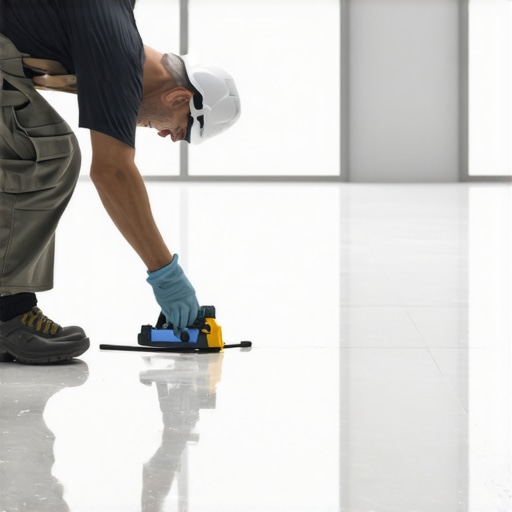
Most guys skip the leveling compound. They think the underlayment will hide the dip. It won’t. I spent three days grinding concrete on a job last month just so the floor wouldn’t click like a castanet. I have spent twenty five years on my knees with a moisture meter and a level. I have seen the way a $20,000 tile job can turn into a pile of junk because the installer was too lazy to address a 3/16 inch dip in the concrete. The industry is moving toward larger and larger porcelain, we are talking 24 by 48 inches and even 48 by 96 inch slabs. When you work with glass-flat material that large, your subfloor has to be a surgical table. There is no room for error. If that subfloor has a wave, the tile will bridge it. When you step on that bridge, it snaps. My knees might be shot and my hands might smell like WD-40 and oak dust, but I know how to make a surface flat. We are going to look at the physics and the chemistry of the subfloor because that is where the battle is won. If you think flooring is just about picking a pretty color, you are in the wrong trade. This is structural engineering at the ground level.
The 1/8 inch that ruins everything
Large format tile installations require a subfloor flatness of 1/8 inch over 10 feet. This industry standard prevents lippage and ensures the mechanical bond of the thin-set mortar is not compromised by excessive thickness or air pockets under the porcelain. The TCNA guidelines are not suggestions.
When we talk about 1/8 inch over 10 feet, we are talking about a tolerance that most framing crews cannot hit. A standard plywood subfloor or a poured concrete slab usually has dips of a half inch or more. When you lay a piece of tile that is four feet long across a dip like that, you create a void. You might try to fill it with more thin-set, but that is a rookie move. Thin-set is meant for bonding, not for leveling. As thin-set dries, it shrinks. If you have a half inch of mud in one spot and an eighth of an inch in another, the tile will pull unevenly as the water evaporates. This creates lippage where the edge of one tile sits higher than its neighbor. In 2026, with the advent of ultra-thin large format porcelain, this becomes even more dangerous. The edges are sharp. A 1/16 inch lippage is enough to catch a toe and cause a trip or to cause the tile edge to chip under heavy traffic. We are looking at the molecular level of how cementitious products cure. You need a substrate that does not move and does not have the topography of the rolling hills of Kentucky. This requires a level of precision that involves laser levels and long straightedges. I do not trust my eyes. I trust a 10 foot magnesium screed.
“A floor is only as good as the subfloor beneath it; deflection is the enemy of every joint.” – Master Flooring Axiom
Why your subfloor is lying to you
Subfloor preparation begins with a calcium chloride test to determine the moisture vapor emission rate of the slab. Even if a floor looks dry, it can be exhaling water that will eventually emulsify your adhesive or cause self-leveling underlayment to delaminate. You must check for flatness and levelness separately.
I have walked onto plenty of jobs where the homeowner told me the floor was level. Level is not the same as flat. A floor can be perfectly level but have a giant hump in the middle. Conversely, a floor can be dead flat but sloped toward a wall. For large format tile, flat is more important than level. We use a 10 foot straightedge to identify the high spots and the low spots. I mark the high spots with a red lumber crayon and the low spots with blue. It usually looks like a topographical map by the time I am done. Concrete is a living, breathing material. It shrinks as it cures. It curls at the edges. If you are dealing with a slab that was poured less than 28 days ago, do not even touch it. The hydration process is still happening. The chemical bond of the calcium silicate hydrate is still forming. If you pour a leveler over green concrete, the tension created by the leveler as it shrinks will pull the surface of the concrete right off. This is why I insist on mechanical abrasion. You have to open the pores of the concrete. You have to get rid of the laitance, that weak, milky layer on top. I use a diamond grinder with a vacuum shroud because the dust from silica is no joke. If you do not see the aggregate in the concrete, you have not ground it enough. You need that mechanical key for your primer to bite into. Without a proper bond, the whole thing is a house of cards.
The chemistry of a perfect pour
Self leveling underlayment depends on a precise water to powder ratio to achieve the correct flow characteristics and compressive strength. Over-watering the mix will cause the polymers to float to the top, creating a chalky surface that will fail under large format tile. Always use a dedicated mixing station.
Chemistry is king when it comes to levelers. You see guys in the big box stores grabbing any bag on the shelf. That is a mistake. You need to understand the difference between Portland cement based levelers and calcium aluminate based levelers. Calcium aluminate dries faster and has less shrinkage, which is what you want when you are prepping for tile. But the real secret is the primer. Never, ever skip the primer. The primer does two things. First, it seals the pores of the substrate so the leveler doesn’t lose its water too fast. If the substrate sucks the water out of the leveler, it won’t flow and it won’t heal. You will end up with ridges and bubbles. Second, the primer acts as a bridge between the old concrete and the new leveler. I like to use a two-coat system. The first coat is diluted to soak in, and the second coat is full strength to create a tacky surface. When you pour, you need to move fast. You need a spiked roller to release the air bubbles. Air is the enemy. Every bubble is a weak spot in the floor. We are aiming for a monolithic slab that is as smooth as glass. Once it is poured, stay off it. Don’t let the HVAC guy or the plumber walk across it before it reaches its initial set. I have seen a boot print in a leveler ruin a whole day’s work.
| Substrate Type | Required Prep | Max Moisture Content | Standard Flatness |
|---|---|---|---|
| Concrete Slab | Grinding/Shot-blasting | 3 lbs / 1000 sqft | 1/8″ in 10′ |
| Plywood Subfloor | Sanding/Screw Reinforcement | 12% MC | 1/8″ in 10′ |
| Existing Tile | Deep Cleaning/Abrasion | N/A | 1/8″ in 10′ |
| Radiant Heat | Encapsulation | Per Manufacturer | 1/8″ in 10′ |
The mechanical advantage of modern grinding
Mechanical concrete grinding removes surface contaminants and levels high spots that self-leveling compounds cannot easily cover. This process uses diamond segments to achieve a concrete surface profile of CSP 3, which is ideal for thin-set adhesion and eliminating floor deflection in 2026 installs.
Sometimes you don’t need to add material, you need to take it away. If you have a hump in the middle of the room, pouring leveler around it just raises the entire floor height, which messes up your transitions to other rooms. This is where the grinder comes in. It is loud, it is messy, and it is the only way to do the job right. I use a 7 inch angle grinder for the edges and a walk-behind unit for the main floor. The diamonds eat through the concrete, turning those high spots into dust. You have to be careful, though. You can’t just dig a hole. You have to feathered the edges. I use a long straightedge constantly. Grind a little, check it, grind some more. It is a game of millimeters. People ask me why I don’t just use more underlayment. The answer is height. In modern homes, especially with zero-threshold showers, you don’t have the luxury of adding a half inch of height to the floor. You have to keep the floor thin but flat. Grinding is a surgical strike. It allows you to maintain the architectural integrity of the transition. Also, grinding reveals any cracks in the slab. If there is a crack, it is going to telegraph through your tile. I use a high-modulus epoxy to fill those cracks and then I apply a crack isolation membrane. If the slab moves, the tile shouldn’t. That is the whole point of the membrane. It is a decoupling layer. It lets the house breathe without snapping the porcelain.
“Surface preparation is the foundation of every successful installation; failure to prep is preparation for failure.” – TCNA Handbook Commentary
- Check subfloor for deflection by measuring joist span and thickness.
- Remove all paint, oil, and wax from the surface before priming.
- Vacuum the floor three times to ensure no dust remains in the pores.
- Mix self-leveling compound with a high-torque drill to avoid air entrainment.
- Use a gauge rake to set the depth of the leveler across the entire room.
- Install perimeter isolation strips to allow for structural expansion.
Large format tile in shower environments
Shower floor leveling for large format tile requires a linear drain system to allow for a single-plane slope toward the waste outlet. This structural geometry eliminates the need for four-way envelopes, which are impossible to execute with tiles larger than 12 inches without creating significant lippage.
Showers are the ultimate test for an installer. You can’t put a 24 by 48 inch tile on a traditional center drain floor. It doesn’t work. The geometry is impossible. You would have to cut the tile into triangles, and it would look like a disaster. For 2026, the only way to do a large format shower is with a linear drain. This allows you to slope the entire floor in one direction, like a ramp. But that ramp has to be perfectly flat. Any dip in that shower pan will hold water. We call that bird-bathing. Standing water leads to mold and mineral buildup. I use a pre-sloped foam system or a dry-pack mortar bed to create that slope. If I use mortar, I use a screed to make sure it is a perfect plane. Then I apply a liquid waterproofing membrane. I want that shower to be a bathtub before a single tile goes down. I flood test every shower for 24 hours. If the water level drops, we have a problem. The transition from the bathroom floor to the shower floor must be seamless. This is why floor leveling in the main room is so vital. If the main floor is uneven, the transition to the shower will be crooked. It is all connected. You can’t isolate one part of the floor from the other. It is one continuous performance surface.
Why laminate and carpet prep feels like a different world
Laminate flooring and carpet installations have different subfloor requirements than tile, focusing more on joint stability and cushioning rather than absolute rigidity. While carpet can hide minor imperfections, laminate will fail if the subfloor has more than 3/16 inch of deflection over 10 feet.
I have seen guys try to prep for carpet the same way they prep for tile. It is a waste of time. Carpet is forgiving. You can have a bit of a dip and the pad will hide it. But laminate and LVP are different beasts. People think LVP is waterproof so they can put it anywhere. That is a lie. The vinyl is waterproof, but the installation is not. If you have a dip, the click-lock joints will flex every time you walk on them. Eventually, those plastic tongues will snap. Once they snap, the floor starts to gap. I have seen $10,000 LVP floors ruined in six months because the subfloor was wavy. Here is a contrarian point for you. Most people want the thickest underlayment they can find because they think it feels better. In reality, too much cushion actually causes the locking mechanisms on LVP to snap under pressure. You want a high-density, thin underlayment. You want a firm base. If the floor feels like a trampoline, it is going to fail. For laminate, you also have to worry about the expansion gap. I have seen walls literally pushed out because someone didn’t leave a 1/2 inch gap at the perimeter. The floor needs to breathe. It expands and contracts with the humidity. If you lock it in with heavy cabinets or no gaps, it will buckle. It will happen every single time. It is about the physics of the material. Respect the material and it will respect you. Ignore the rules and you will be tearing it out in a year. I don’t do tear-outs for free, so do it right the first time.