How to Repair a Snag in Your Berber Carpet Without Leaving a Scar
The loop pile calamity that ruins living rooms
Berber carpet snags and unraveled loops require immediate intervention with professional carpet latex adhesive and re-burling needles to prevent the zipper effect from destroying the entire floor textile. I once walked into a house where a five thousand dollar wool Berber was ruined because the owner tried to pull a loose thread. They ended up pulling out a ten foot run that looked like a scar across the room. I spent three days on my knees with a magnifying glass and a surgical needle trying to weave that yarn back into the primary backing. It was a nightmare that could have been avoided if they had just stopped and called a pro. Most people see a snag and think they can just trim it with kitchen scissors. That is the fastest way to turn a small repair into a full room replacement. You have to understand the physics of how these loops are locked into the polypropylene backing. If you do not secure the root of the fiber, the tension from foot traffic will continue to pull the yarn through the grid until the structural integrity of the row fails. This is not about aesthetics. This is about preventing a mechanical failure of the floor surface.
“A floor is only as good as the subfloor beneath it; deflection is the enemy of every joint.” – Master Flooring Axiom
The physics of the loop and the zipper effect
Loop pile construction utilizes continuous filament yarns that are tufted through a primary backing and then secured with a secondary laminate layer to provide dimensional stability. When a snag occurs, the tension on that single loop is transferred directly to the neighboring loops because they are often part of the same continuous strand. This creates a zipper effect where a single snag can unravel an entire longitudinal row of the carpet. You are dealing with a structural grid. The chemistry of the latex bonding agent used during manufacturing is what keeps these loops upright. Over time, or due to mechanical abrasion from vacuum cleaners and pets, that bond can weaken. When you see a snag, you are looking at a failed chemical bond. Repairing it requires you to recreate that bond at a molecular level using specialized adhesives that remain flexible when cured. If you use a hard glue like superglue, the fiber will become brittle and snap, creating a sharp point that will catch on socks and skin. You need the viscosity of the adhesive to penetrate the yarn without saturating the surrounding fibers and creating a visible dark spot on the carpet surface.
Tools that separate pros from weekend warriors
Carpet repair kits must include duckbill shears, curved upholstery needles, and clear-drying carpet sealer to ensure the re-burling process leaves no visual artifacts or tactile irregularities. I carry a specific kit that smells like old latex and precision oil. It has everything from seam sealers to row separators. If you use standard scissors, you will inevitably cut the surrounding loops, which creates a fuzzy patch that reflects light differently. This is known as optical variance. To avoid it, you need to use a row spreader to clear a path to the backing. You are essentially performing surgery on the floor. You need to see the primary backing grid. If you cannot see the hole where the loop came from, you are just guessing. This level of detail is why I charge what I do. It is not just about sticking glue on a string. It is about aligning the denier of the yarn with the gauge of the tuft. Most homeowners do not even know what those words mean. They just see a floor. I see a complex weave of synthetic polymers and natural fibers that are under constant stress from the weight of the furniture and the movement of the people in the house.
| Fiber Type | Janka Equivalent Stress | Acclimation Needs | Repair Difficulty |
|---|---|---|---|
| Nylon Berber | High Resilience | 48 Hours | Moderate |
| Olefin (Polypropylene) | Low Melting Point | 24 Hours | Difficult |
| Wool Blend | Natural Elasticity | 72 Hours | Expert Only |
| Triextra (Sorona) | Stain Resistance | 48 Hours | Moderate |
How to find the hidden yarn
Identifying the snag origin requires a high-intensity work light and a carpet awl to probe the interstices of the weave without damaging the integrity of the pile. You have to look for the empty spot in the grid. Every loop has a home. When it gets pulled out, it leaves a vacant space in the primary backing. You have to be meticulous. I have spent hours under a headlamp just looking for a single missing tuft. Once you find the entry point, you can begin the re-insertion process. You take the loose yarn and carefully thread it through your needle. You are not just pushing it down. You are anchoring it. You apply a small amount of thermoplastic adhesive or solvent-based sealer to the base of the loop. This creates a new mechanical bond. If you skip this step, the loop will just pull out again the next time someone walks over it. The 1/8 inch rule is vital here. If the loop is even 1/8 inch higher than the rest of the pile, the vacuum will catch it and rip it right back out. You have to match the pile height of the surrounding area perfectly. It is a game of millimeters.
- Inspect the snag for frayed ends or broken filaments before starting.
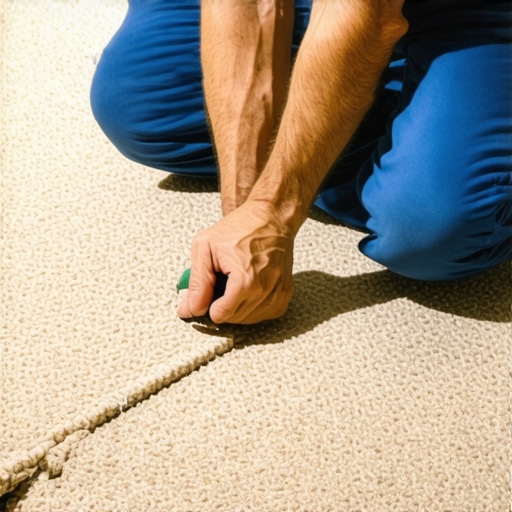
- Use a row spreader to isolate the damaged row from the surrounding carpet.
- Apply a bead of latex sealer to the primary backing hole.
- Use a curved needle to pull the yarn back through the backing.
- Trim any excess yarn flush with the existing pile height using duckbill shears.
- Weight the repair area for twenty four hours to ensure a flat cure.
The 1/8 inch that ruins everything
Precise pile height alignment is the critical metric for a successful carpet repair, as any deviation greater than one eighth of an inch will cause accelerated wear and premating cleaning failure. If the repair is too high, it catches. If it is too low, it creates a shadow. This shadow is what people see when they say a repair looks like a scar. I have seen guys try to fix a snag by just gluing the yarn on top of the backing. That never works. You have to get the yarn into the backing. The chemistry of the adhesive is also a factor. Some glues will yellow over time. Imagine spending all that time fixing a white wool Berber only to have a yellow spot appear six months later. You need UV-stable adhesives. This is why I avoid the big box stores and buy my supplies from professional flooring distributors. They carry the stuff that actually works in the long run. I have seen subfloor moisture wick up through the backing and ruin a repair because the installer used a water-soluble glue. You have to think about the environment of the room. Is it a basement with high humidity? Is it a sunny room with high UV exposure? Every detail matters when you are trying to make a repair invisible.
“Tuft bind strength is the measure of a carpet’s resistance to pilling and snagging; without it, the floor is temporary.” – Master Flooring Axiom
The ghost in the expansion gap
Perimeter tension in stretch-in carpet installations can pull on repaired snags if the tack strip is not properly engaged or if the underlayment density allows for too much vertical deflection. If your subfloor is soft, the carpet moves every time you step on it. This micro-movement puts stress on every single loop. If you have a snag near a wall, you have to check the tackless strip. Sometimes the wood is rotted or the nails are loose. I have seen moisture from concrete slabs rot out tack strips in less than five years. If the strip is loose, the carpet loses tension, and that puts more stress on the weave. I always check the calcium chloride moisture test results if I am working on a slab. If the moisture is too high, the alkalinity will eat the adhesive in your repair. You have to be a chemist and a structural engineer to do this right. Most people think flooring is just about what looks good. I look at the vapor transmission rate and the compression set of the pad. If the pad is too soft, the carpet stretches too much, and snags become inevitable. You want a high-density rebond pad or a fiber pad for Berber to minimize this movement. The less the carpet moves, the longer your repair will last. It is all about reducing the kinetic energy applied to the yarn.