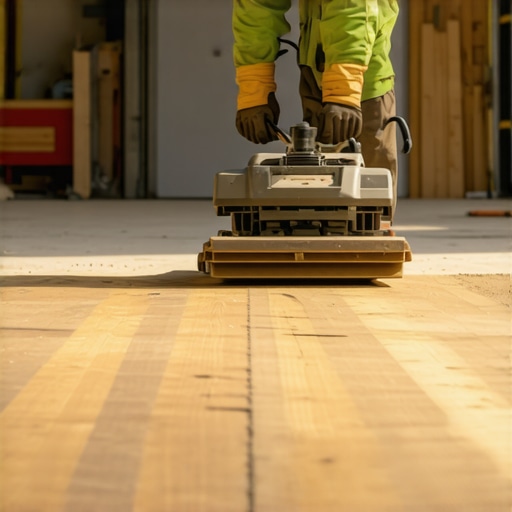
I spent three days grinding concrete on a job last month just so the floor wouldn’t click like a castanet. Most guys skip the leveling compound. They think the underlayment will hide the dip. It won’t. I was standing in a high-rise condo where the previous crew had poured self-leveling underlayment like they were frosting a cake. The result was a series of ridges that looked like a topographical map of the Appalachian Mountains. If I had laid the laminate over that mess, the locking tracks would have snapped within a month. My knees hurt just thinking about it, but the grinder is the only thing that saves a floor from a slow, creaking death. You cannot hide a bad subfloor with expensive finish materials. The chemistry of the bond and the physics of the flat plane are the only things that matter when the furniture moves in.
The high spots that kill laminate joints
Floor leveling ridges are sharp elevations in the subfloor caused by improper self-leveling compound application or concrete curing issues. These ridges create voids under laminate or LVP, leading to locking mechanism failure. Successful sanding requires diamond cup wheels or silicon carbide abrasives to restore flatness. When you pour a self-leveling underlayment, the surface tension and the rate of hydration determine how the material flows. If the installer fails to use a spiked roller or if the mix is too thick, ridges form at the edges of the pour. These ridges are often only an eighth of an inch high, but in the world of flooring, an eighth of an inch is a mountain. When a plank of laminate bridges over a ridge, it creates a hollow space. Every time someone walks over that spot, the plank flexes. That repetitive movement fatigues the tongue and groove. Eventually, the plastic or wood fiber shears off. Now you have a floating floor that actually floats away from itself. You have to understand that concrete is a living, breathing substrate. It has a specific pH and a moisture vapor emission rate. If you do not address the ridges, you are ignoring the structural integrity of the entire assembly. I see it in showers too. If the mud bed has a ridge, the large format tile will lippage and crack. Grounding those ridges down to a tolerance of 3/16 of an inch over 10 feet is the industry standard for a reason.
“A floor is only as good as the subfloor beneath it; deflection is the enemy of every joint.” – Master Flooring Axiom
Aggressive diamond grinding for concrete ridges
Diamond grinding involves using a variable speed angle grinder equipped with a segmented diamond cup wheel to mechanically abrade high spots. This tactic is essential for cured concrete or modified underlayments that are too hard for standard sandpaper. It ensures a CSP 3 profile for adhesion. If you are staring at a ridge that feels like a speed bump, sandpaper is a waste of time. You need industrial diamonds. I prefer a seven-inch grinder because it covers more surface area and helps prevent digging new holes. You must keep the tool moving in a sweeping, pendulous motion. If you stop in one spot for even two seconds, you will create a divot that is harder to fix than the ridge was. The dust is a massive health hazard. I never crack a trigger without a HEPA vacuum attached to a dust shroud. The silica dust from concrete and leveling compounds will ruin your lungs and coat every wall in the house. The grit of the diamond segment matters. A 30-grit segment is for heavy removal, while an 80-grit segment leaves a smoother finish ready for adhesive. You are looking for a surface that feels like 100-grit sandpaper. This allows the carpet install tack strips to hold or the laminate underlayment to sit dead flat. Measurement is your best friend here. I use a six-foot magnesium straight edge to find the light gaps. If light shines under the level, the floor is not flat. It is a game of millimeters. You grind, you sweep, you check. Then you do it again.
Orbital sanding for feathered transitions
Orbital sanding utilizes a floor buffer or a random orbit sander with 60-grit silicon carbide discs to smooth out minor ridges and feather the edges of patching compounds. This method provides the smoothness required for resilient flooring and vinyl without damaging the substrate integrity. While the diamond grinder is a sledgehammer, the orbital sander is a scalpel. This is for the ridges that are more like ripples. When I am prepping for a carpet install, I am less worried about a 1/16-inch ripple, but for glue-down vinyl, every ridge will telegraph through the surface. It will look like a wire running under the floor. I use a heavy-duty floor machine, often called a swing machine, with a sandpaper driver. The weight of the machine does the work. You do not push down. You let the centrifugal force and the weight of the motor grind the high spots into submission. This is where the chemistry of the leveling compound shows its face. Some cheap big-box store levelers turn into gum when they get warm from the friction of sanding. They clog the paper and smear. Professional grade, calcium aluminate-based levelers sand into a fine, crisp powder. This is the difference between a floor that lasts 30 years and one that fails in three. You have to be careful around the perimeter. If you hit the baseboards or the drywall with a swing machine, you are going to have a bad day. I keep a smaller five-inch hand orbital for the corners.
| Tool Type | Application | Aggression Level |
|---|---|---|
| Diamond Cup Wheel | Bulk concrete removal | High |
| Floor Buffer (16-inch) | Large area smoothing | Medium |
| Hand Orbital Sander | Edge work and corners | Low |
| Belt Sander | Wood subfloor ridges | High |
Manual abrasion and the straight edge protocol
Manual abrasion involves using a concrete rub stone or hand sanding block to detail ridges in hard-to-reach areas like showers or closets. This tactic ensures precision near vertical surfaces where power tools cannot reach. It is the final step in the subfloor preparation workflow. Sometimes the power tools are too much. If I am working in a small bathroom prepping for showers and tile, I grab the rub stone. It is a block of carborundum that feels like a brick. It is slow work. It makes your shoulders burn. But it gives you a level of control that a motor cannot match. You can feel the ridge disappearing under the stone. You can hear the pitch of the scraping change as the surface gets flatter. Most people think they can skip this. They think the thin-set for the tile will fill the gaps. They are wrong. Thin-set is an adhesive, not a leveler. If your thin-set is an inch thick in one spot and a quarter-inch thick in another, it will shrink at different rates as the water evaporates. This causes the tile to pull and tilt. This is how you get toe-stubbers.
“Standard tolerances for subfloor flatness are typically 1/8 inch over a 10 foot radius for most installations.” – TCNA Guidelines
The subfloor preparation checklist
- Check moisture content with a calcium chloride test or pinless meter.
- Identify high spots using a 10-foot straight edge or laser level.
- Vacuum all dust to ensure the bond between the substrate and the finish.
- Verify that no screw heads or nails are protruding above the plane.
- Re-check flatness after sanding to confirm the 1/8-inch tolerance.
The carpet install process is the only one that is somewhat forgiving of minor ridges, but even then, a sharp ridge can wear a hole in the carpet backing over time. For laminate, there is zero room for error. If you find a ridge after the floor is half-installed, you have to rip it all back up. There are no shortcuts. You have to be a scientist and a laborer at the same time. You have to respect the materials. The chemistry of the primers, the PSI of the concrete, and the grit of the sandpaper all work together. If you ignore one, the whole system fails. I have seen million-dollar homes with floors that creak like a haunted house because someone was too lazy to sand down a five-dollar bag of spilled leveler. Do not be that guy. Get on your knees, grab the straight edge, and find the truth about your floor. It is a structural engineering challenge that starts and ends with a flat surface.