Why Your New Carpet Feels Bumpy Under Your Feet
Why Your New Carpet Feels Bumpy Under Your Feet
The smell of WD-40 and fresh oak dust follows me into every job site, a scent earned through twenty five years of fixing what others broke. Most people think a floor is just something pretty to walk on. They are wrong. A floor is a structural engineering challenge that starts three inches below your socks. I spent three days grinding concrete on a job last month just so the floor would not click like a castanet. Most guys skip the leveling compound. They think the underlayment will hide the dip. It will not. When you walk across your brand new carpet and feel a lump, a dip, or a strange crunch, you are not feeling the carpet. You are feeling the failure of the installer to respect the subfloor. A carpet install is only as good as the surface it hides. If that surface is uneven, the carpet acts like a topographic map of neglect.
The ghost of a neglected subfloor
Bumps under a new carpet are almost always caused by improper subfloor preparation or debris left behind during the install process. When an installer fails to sweep, scrape, or level the floor, every pebble and staple becomes a permanent mountain under your feet. It will ruin the backing. This is not a cosmetic issue. It is a mechanical failure. I have seen guys leave chunks of old padding or even wood shims under a high end plush. Within six months, the friction between the carpet backing and that debris wears a hole from the bottom up. You need to understand the physics of the subfloor. A concrete slab might look flat, but it often has high spots called birdbaths or ridges from the trowel. If these are not ground down, the carpet will bridge over the gap. This creates a hollow feel. Eventually, the carpet will stretch into that gap. This is when the bumps appear. It is a slow motion collapse of the textile structure.
The unseen war between moisture and latex
Moisture vapor rising from a concrete slab can cause the latex adhesive in carpet backing to swell or delaminate. This chemical reaction creates ripples that look like waves in the ocean. It is a molecular problem. Concrete is a sponge. It holds water for decades. If the installer did not perform a calcium chloride test or use a moisture meter, they are flying blind. When the moisture vapor emission rate is too high, the secondary backing of the carpet loses its grip. The latex bond breaks down. This is called delamination. Once the two layers of the carpet separate, the top layer has nowhere to go but up. This creates those long, rolling bumps that you cannot just kick away. This is especially common near showers or external doors where the humidity levels fluctuate wildly. You must check the moisture levels. You must ensure the slab is dry before the pad ever touches the ground.
“A floor is only as good as the subfloor beneath it; deflection is the enemy of every joint.” – Master Flooring Axiom
Why your padding density matters more than thickness
Padding that is too thick or too soft allows the carpet to flex excessively which leads to premature stretching and buckling. Many homeowners choose the thickest pad thinking it will feel luxurious. This is a mistake. Too much cushion causes the carpet to move too much when you walk. This movement pulls the carpet off the tack strips. Think of it like a bridge. If the pilings are made of marshmallows, the road will ripple. You want a high density pad, not a thick one. A six pound or eight pound rebond pad provides the necessary resistance. If the pad is too soft, the mechanical bond of the carpet fibers is stressed every time you take a step. This leads to the ‘bumpy’ sensation because the carpet is literally sliding across the top of the pad. It ruins the install.
Comparing subfloor requirements for different materials
| Material Type | Max Deviation Allowed | Required Prep Tool | Acclimation Time |
|---|---|---|---|
| Plush Carpet | 1/4 inch over 10 feet | Industrial Vacuum | 24 Hours |
| Laminate Flooring | 1/8 inch over 10 feet | Floor Leveler | 48 Hours |
| Solid Hardwood | 3/16 inch over 10 feet | Sanding Block | 7 to 14 Days |
| Vinyl Plank | 1/8 inch over 6 feet | Grinder | 48 Hours |
How the stretch factor ruins your walk
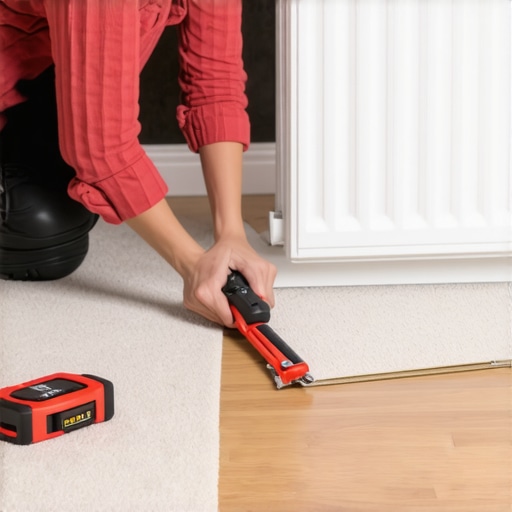
Improper stretching during the carpet install is a primary reason for bumps appearing after the first few months of use. A professional must use a power stretcher. A knee kicker is only for positioning. If an installer only uses a knee kicker, the carpet is not actually tight. It is just moved. Over time, the natural humidity in the air causes the fibers to relax. Because the carpet was not under tension, it begins to sag. These sags manifest as bumps or ridges. It is basic physics. If you do not tension the textile, it will respond to gravity and foot traffic by bunching up. I always tell my apprentices that if they do not break a sweat stretching the room, the job is not done. You should be able to bounce a quarter off a well installed carpet. Anything less is a failure.
The installation checklist for a smooth result
- Verify the subfloor is free of drywall mud and paint overspray
- Check for 1/8 inch levelness over a ten foot radius
- Confirm the moisture vapor emission rate is below 3 pounds per 1000 square feet
- Ensure the tack strips are placed 1/4 inch from the baseboard
- Use a power stretcher on every wall to wall installation
- Seal all seams with a high quality thermostatic iron
Transitions that fail at the threshold
When transitioning from carpet to laminate or tile, the height difference must be managed with the correct transition strip to avoid a trip hazard bump. Often, the bump you feel is actually the carpet bunching up against a T-molding that was installed too tight. The carpet needs a small amount of breathing room at the edge. If the installer jams the carpet into the transition, it will eventually peak. This is a structural bottleneck. In areas like hallways where you move from a carpet install to a hard surface, the subfloor must be perfectly level at the junction. If there is even a 1/16 inch lip in the plywood, you will feel it through the carpet. Floor leveling is not just for tile. It is the foundation of every professional finish. You cannot hide a bad transition with more staples. It requires precision and a sharp utility knife.
“The integrity of the textile is secondary to the stability of the foundation; prep work is ninety percent of the craft.” – Master Flooring Axiom
The chemistry of the adhesive bond
The secondary backing of a carpet is usually a woven polypropylene. This is bonded to the primary backing using SBR latex. This latex is filled with calcium carbonate. When we talk about the chemistry of the floor, we are talking about how these materials react to the environment. If the floor leveling compound used contains too much gypsum, it can draw the moisture out of the latex too fast. This makes the backing brittle. A brittle backing will crack and crunch under your feet. That ‘bumpy’ or ‘crunchy’ sound is the sound of the carpet’s skeleton breaking. You need to match the adhesive chemistry to the subfloor type. This is why I hate discount big box stores. They sell one size fits all solutions that fit nothing. You need a specialist who understands the ph balance of the concrete slab. If the slab is too alkaline, it will eat the adhesive. Then you get bubbles. Then you get bumps.
The reality of builder grade materials
Builders often use the cheapest yellow padding available. This material has a very low density. It collapses in high traffic lanes within months. When the pad collapses, the carpet in that area is now lower than the carpet near the walls. This creates a visible and tactile bump at the edge of the traffic pattern. It is not that the carpet went up. It is that the foundation went down. To fix this, you have to rip it all out. There is no shortcut. You cannot pump more foam under there. You need a structural fix. This means pulling the carpet back, scraping the old yellow foam off the subfloor, and installing a high density rebond or synthetic fiber pad. Only then will the floor feel like a solid surface again. A floor should not feel like a sponge. It should feel like the earth beneath your feet. Solid. Reliable. True.