Why Your Kitchen Laminate Is Swelling Near the Refrigerator
I have spent twenty five years with sawdust under my fingernails and a moisture meter in my back pocket. I have seen the same tragedy play out in high end kitchens from Seattle to Miami. A homeowner spends thousands on beautiful laminate planks, only to find the edges peaking and swelling like a mountain range six months later. Most people blame the product. They call the manufacturer and complain about a bad batch of material. I am here to tell you that the product is almost never the problem. The problem is a total failure to understand the structural and chemical reality of how a floor interacts with its environment. In my decades of service, I have witnessed homeowners who thought a waterproof label meant they could ignore a slow leak. I once walked into a house where the entire kitchen floor was buckled so badly it looked like a frozen ocean because the installer locked the floor under a massive refrigerator and a kitchen island. The floor could not breathe, it could not move, and the moisture from the fridge ice maker did the rest. You can do a perfect carpet install or build custom showers, but if you do not respect the physics of floor leveling and moisture migration, your laminate will fail every single time. It is a performance surface, not a rug. It requires precision.
The microscopic anatomy of a swelling plank
Laminate flooring swells because the high density fiberboard core absorbs moisture through capillary action at the joints. This absorption causes the wood fibers to expand at a cellular level, leading to peaked edges and delamination. Once the internal bond of the HDF core is compromised, the damage is irreversible and structural integrity is lost. When we talk about laminate, we are talking about a composite material. The core is typically High Density Fiberboard, or HDF. This is essentially wood fibers ground into a pulp and bound with resins under extreme pressure. At a molecular level, these fibers are hydrophilic. They want water. Even the best click-lock systems have microscopic gaps. When moisture sits near your refrigerator, whether from a slow drip or simple condensation, those fibers act like a straw. They pull the water in through the tongue and groove. Once that water hits the HDF core, the urea-formaldehyde resins begin to struggle. The wood fibers expand. Because the top wear layer is a hard melamine and the bottom is a stabilizing layer, the only place for the expanding core to go is up. This creates the peaking you see at the seams. It is not just a cosmetic issue, it is the physical destruction of the board core. The thickness of the wear layer does not matter here. You could have a 20 mil wear layer, but if the water gets into the joint, the board is toast. This is why I always tell my clients that the edge of the plank is the most vulnerable part of their entire kitchen.
Why your subfloor is lying to you
Floor leveling is the most overlooked phase of laminate installation and the primary cause of joint failure near heavy appliances. A subfloor that is not flat within 3/16 of an inch over a 10 foot radius creates vertical deflection. This movement stresses the locking mechanisms, allowing moisture to penetrate deeper into the core. I spent three days on a job last month just grinding concrete because the homeowner thought the underlayment would hide the dips. It will not. If your subfloor has a dip near the refrigerator, every time you walk by, the floor flexes. That flex acts like a bellows, sucking moisture and humid air into the seams. In my shop, we call this the castanet effect because the boards click and pop. If you are installing over a concrete slab, you have to worry about hydrostatic pressure. Concrete is a sponge. It looks dry on the surface, but it is constantly releasing water vapor. If you did not put down a 6 mil poly film moisture barrier, that vapor is hitting the bottom of your laminate. When you add a heavy refrigerator on top, you are trapping that moisture. The weight of the fridge creates a seal, and the vapor has nowhere to go but into the HDF core. This is why you see swelling right in front of the appliance. It is a combination of subfloor unevenness and vapor pressure.
| Metric | Standard Requirement | Impact of Failure |
|---|---|---|
| Subfloor Flatness | 3/16 inch per 10 feet | Broken locking joints and peaking |
| Moisture Content (Wood) | Under 12 percent | Warping and structural cupping |
| RH (Concrete) | Below 75 percent | Adhesive failure and mold growth |
| Expansion Gap | 3/8 inch to 1/2 inch | Buckling and board lifting |
| Acclimation Time | 48 to 72 hours | Immediate dimensional shifting |
The ghost in the expansion gap
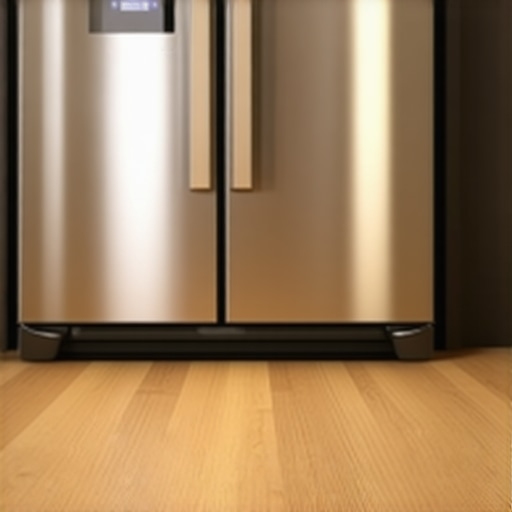
Expansion gaps are mandatory because laminate flooring is a floating system that moves with changes in temperature and humidity. If the floor is pinned against a wall or trapped under a heavy appliance, the internal stress causes the planks to lift and swell at the nearest weak point. The refrigerator is the heaviest thing in your kitchen. When you set a 300 pound fridge on a floating floor, you have effectively pinned that floor to the subfloor. Now, think about the physics. The floor wants to expand as the humidity in the kitchen rises. But it can not move past the fridge. It also can not move past the cabinets if they were installed on top of the laminate. The stress has to go somewhere. It goes to the joints. Those joints are already under pressure from the weight, and now they are being pushed together by the expansion of the rest of the floor. This pressure weakens the seal, making it even easier for moisture to get in. This is why I never, ever install cabinets over laminate. It is a floating floor. It needs to float. If you lock it down, you are asking for a failure. I have seen guys try to save time by skipping the T-moldings in large rooms too. That is a mistake. Anything over 30 feet needs a break. Without it, the cumulative expansion force is enough to snap the locking tabs right off the boards. It is simple engineering.
“A floor is only as good as the subfloor beneath it; deflection is the enemy of every joint.” – Master Flooring Axiom
The 1/8 inch that ruins everything
A slow leak from a refrigerator water line can destroy a laminate floor within 24 hours regardless of its waterproof rating. Most laminate is designed to withstand topical spills for a limited time, but it cannot survive standing water that seeps under the planks or behind the baseboards. I have seen homeowners ignore a tiny drip from their ice maker for weeks. They think the laminate is waterproof, so it is fine. It is not fine. The water travels along the subfloor, following the path of least resistance. It gets under the planks. Once the water is underneath, there is no airflow. It just sits there, saturating the underside of the boards. This is where the real damage happens. The backing layer of the laminate is not as protected as the top. It will soak up that water until the board is twice its original thickness. At that point, your floor is a total loss. You cannot dry it out. You cannot sand it down. You have to rip it out and start over. I always recommend installing a leak detector under the fridge. It costs twenty dollars and can save you five thousand. People worry about showers leaking through the floor, but in a kitchen, it is almost always the fridge or the dishwasher. If you do not have a perfectly level floor, that water will find a low spot and pool there, rotting your floor from the inside out.
- Verify subfloor flatness using a 10 foot straight edge before laying underlayment.
- Use a moisture meter to check the subfloor and the laminate planks themselves.
- Install a 6 mil poly vapor barrier on all concrete subfloors even if the underlayment has one.
- Maintain a consistent 3/8 inch expansion gap around the entire perimeter of the room.
- Never install heavy kitchen islands or cabinetry on top of the floating floor.
- Seal the perimeter of the refrigerator area with a 100 percent silicone caulk if you are worried about spills.
The chemistry of high density fiberboard
The internal bond strength of HDF is determined by the resin to fiber ratio used during the manufacturing process. Cheaper laminates use less resin and more air, making them far more susceptible to moisture absorption and thickness swelling. When you go to a big box retailer and buy the cheapest stuff on the rack, you are buying a floor that is mostly air and wood dust. High quality laminate has a much higher density. This makes it harder for water molecules to penetrate the core. But even the best material has a limit. In the flooring world, we look at the swell rate. A high quality board might have a swell rate of less than 8 percent after 24 hours of submersion. A cheap board can swell up to 20 percent. In a kitchen, you need the highest density core you can find. You also need to look at the locking system. Some systems, like the Uniclic, are designed to put the joint under constant tension. This creates a much tighter seal that helps keep water out. But again, if the floor leveling is off, that tension is lost. The joints open up, and the chemistry of the core is the only thing left to protect you. In a humid climate like Houston, this is even more vital. The air itself can provide enough moisture to swell a cheap floor if the house is not climate controlled.
“Moisture is the single greatest cause of wood flooring failure.” – NWFA Technical Manual
Final thoughts on subfloor integrity
Your floor is a system. It is not just the boards you see on top. It is the concrete or plywood underneath, the moisture barrier, the underlayment, and the expansion gaps. If any one of those components fails, the whole system fails. If your kitchen laminate is swelling near the refrigerator, do not just look at the water line. Look at the levelness of the floor. Look at the expansion gaps. Look at the weight of the appliance. You have to respect the materials. Laminate is a fantastic, durable product when it is treated like the engineered surface it is. But if you treat it like a DIY project where the details do not matter, it will fail you. I have spent my life fixing these mistakes. Do it right the first time. Check your moisture. Level your subfloor. Give the floor its room to move. That is how you get a kitchen floor that lasts for decades instead of months.