Why Your Kitchen Floor Tiles Are Cracking Near the Dishwasher
The hidden physics of kitchen floor failure
I spent three days grinding concrete on a job last month just so the floor wouldn’t click like a castanet. Most guys skip the leveling compound. They think the underlayment will hide the dip. It won’t. I have spent twenty five years on my knees with a moisture meter and a level. I have seen every way a floor can fail. When a homeowner calls me about cracked tiles near the dishwasher, they usually expect a simple answer. They want to hear that a plate dropped. They want to hear that the tile was defective. The truth is almost always found in the subfloor. A floor is a performance surface. It is a structural engineering project that you happen to walk on. If you treat it like a decoration, it will punish you. Kitchens are high stress environments where heat, moisture, and vibration converge on a single point. If the installer did not account for the specific physics of an appliance that vents 140 degree steam three inches from a grout line, the tile will crack. It is not a matter of if, but when.
The thermal impact of the steam vent
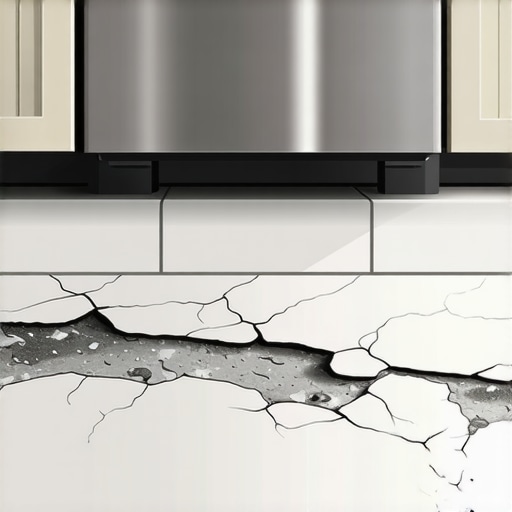
Kitchen floor tiles crack near the dishwasher because of localized thermal expansion caused by steam venting and heat cycles. This creates a micro-climate where the tile and the substrate expand at different rates. When the dishwasher runs, it radiates heat downward and outward. The porcelain or ceramic material absorbs this heat. Porcelain has a specific coefficient of thermal expansion. The subfloor, whether it is plywood or a concrete slab, has a different one. When these two materials are bonded together with a rigid mortar, something has to give. If there is no movement joint or if the thin-set is too brittle, the stress translates directly into the body of the tile. Most modern dishwashers vent from the bottom or the side. This concentrated heat dries out the mortar bed prematurely during the curing phase or stresses it during daily use. Over hundreds of cycles, the bond breaks down. You get a hollow sound first. Then you get the hairline fracture.
[IMAGE_PLACEHOLDER]
Subfloor deflection and the geometry of failure
Tiles crack when the subfloor bends beyond the allowable limit known as deflection. The industry standard for tile is L over 360. This means the floor should not bend more than the length of the span divided by 360. For natural stone, it is L over 720. When you put a heavy dishwasher filled with water and dishes on a subfloor that is already at its limit, the joists flex. This flex occurs right at the edge of the appliance. Kitchens often have heavy cabinetry and stone countertops that already pre-load the joists. Adding the dynamic weight of a dishwasher and the vibration of its motor creates a pivot point. If the installer did not check the joist spacing or the thickness of the subfloor, the tile is essentially being asked to act as a structural bridge. Tile is strong in compression but weak in tension. It cannot bend. When the wood beneath it bows even a fraction of an inch, the tile snaps. This is why you see cracks running parallel to the dishwasher door. It is the line of maximum stress.
“A floor is only as good as the subfloor beneath it; deflection is the enemy of every joint.” – Master Flooring Axiom
The chemical failure of the bond
Cracked tiles are often the result of an improper chemical bond between the thin-set and the substrate. In the kitchen, this is exacerbated by the presence of cleaning agents and moisture. If the installer used a standard unmodified thin-set in a high vibration area, the bond is too rigid. High performance installations require polymer modified mortars. These polymers act like microscopic shock absorbers. They allow for a tiny amount of movement without the bond shearing. Near a dishwasher, the constant vibration of the wash cycle acts like a slow motion hammer drill. If the mortar is poor quality, it will pulverize over time into a fine dust. I have pulled up cracked tiles near appliances and found nothing but grey powder underneath. The chemical chain has been broken. You also have to consider the cleaning products used on kitchen floors. Harsh chemicals can seep into grout lines and attack the alkaline nature of the cementitious bond if the grout was not sealed properly. It is a slow death for the floor.
| Material Type | Expansion Rate | Moisture Resistance | Vibration Damping |
|---|---|---|---|
| Porcelain Tile | Low | Excellent | Poor |
| Ceramic Tile | Medium | Moderate | Poor |
| Natural Stone | High | Variable | Moderate |
| Modified Thinset | Variable | High | High |
Moisture vapor and the concrete slab
Moisture vapor transmission through a concrete slab can cause tiles to de-bond and crack specifically under appliances. Dishwashers create a dark and warm environment. This creates a pressure differential. If your home is on a concrete slab without a proper vapor barrier, moisture is constantly being pulled up through the pores of the concrete. Under the dishwasher, this moisture cannot escape easily. It sits at the interface between the concrete and the thin-set. This leads to a condition called efflorescence or, in worse cases, osmotic blistering. The minerals in the concrete are carried to the surface where they crystallize. These crystals grow and actually lift the tile off the floor. When you walk past the dishwasher, you are stepping on a tile that is no longer supported by the slab. The weight of a human foot is enough to snap a de-bonded tile. This is why I always use a moisture mitigator on slab jobs. It is an extra step that most cheap contractors skip because it costs forty dollars a gallon. I do not skip it.
The expansion gap and the perimeter problem
A lack of expansion gaps at the perimeter of the kitchen causes the entire floor to buckle and crack. Tile floors must breathe. The TCNA recommends an expansion joint every 20 to 25 feet in interior installations. However, kitchens are smaller and more complex. If the tile is installed tight against the kitchen cabinets or the dishwasher frame, there is no room for the assembly to move. When the summer humidity hits or when the dishwasher heats up the area, the floor expands. If it hits a solid object like a cabinet base, the pressure has nowhere to go but up. This is called tenting. Even if the tile does not fully lift, the internal pressure is enough to cause a stress fracture. I always leave a quarter inch gap around the entire perimeter. This gap is hidden by the baseboards or the toe kicks of the cabinets. It is a simple rule. If the floor cannot move, it will break. I have seen thousand dollar islands bolted directly through a tile floor, locking it in place. That is a recipe for a callback in six months.
“Standard ceramic tile installations over wood subfloors require a total subfloor thickness of no less than one inch to prevent grout failure.” – Tile Council of North America standards
A checklist for the kitchen floor repair
Repairing a cracked tile near a dishwasher requires more than just a new piece of porcelain. You must address the underlying cause or the new tile will crack in the exact same spot. Follow this protocol for a lasting fix.
- Remove the cracked tile and all old thin-set down to the original substrate.
- Inspect the subfloor for water damage or rot caused by dishwasher leaks.
- Check the deflection of the floor by measuring joist span and plywood thickness.
- Apply a crack isolation membrane to the area before re-installing the tile.
- Use a high-quality polymer modified thin-set with a high shear bond strength.
- Ensure a 100 percent mortar coverage on the back of the tile to eliminate air pockets.
- Leave a soft joint filled with color-matched silicone caulk instead of grout at the appliance interface.
The solution for a permanent kitchen floor
The ultimate solution to prevent cracking is the use of an uncoupling membrane between the tile and the subfloor. Products like Ditra or various sheet membranes decouple the tile layer from the structural layer. This allows the subfloor to move, flex, and expand independently of the tile. When the dishwasher heats up the subfloor, the membrane absorbs the stress. The tile stays flat and stable. It also acts as a waterproof barrier. If the dishwasher ever leaks, the water will stay on top of the membrane instead of rotting out your plywood. Many people think these membranes are an unnecessary expense. They are wrong. It is the cheapest insurance policy you can buy for your kitchen. I refuse to install a kitchen floor without one. I have seen too many failures. I have done too many repairs. I want the floor to last as long as the house. That requires engineering. It requires understanding that the dishwasher is not just an appliance. It is a heat engine sitting on your floor. Respect the physics and the tile will stay intact. Ignore them and you will be calling me to grind your concrete next year.