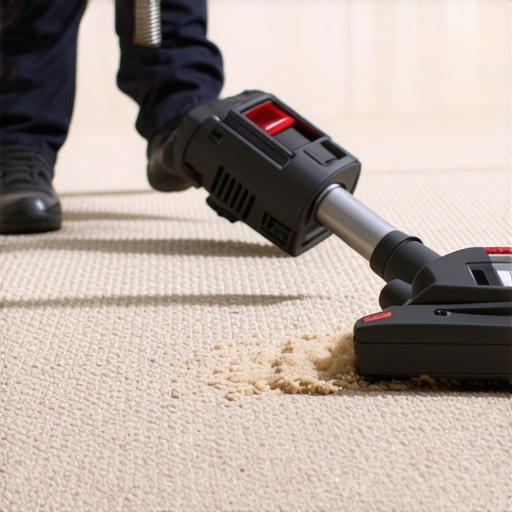
The Vacuum Hack for Removing Deep Sand from Old Carpet Fibers
Most guys skip the leveling compound. They think the underlayment will hide the dip. It won’t. I spent three days grinding concrete on a job last month just so the floor wouldn’t click like a castanet. That job started with a carpet tear-out that looked like a beach in the Sahara. People think carpet is just soft fabric. It is not. It is a filter. It is a massive, multi-layered trap for silica, quartz, and ground-up granite. When you walk on a carpet full of sand, you are literally grinding those fibers between two stones. You are destroying the structural integrity of the flooring from the inside out. I have seen fifteen-year-old carpets that looked pristine on the surface but were chemically and physically compromised because the owners never got the grit out of the base. If you are planning a new carpet install or transitioning to a hard surface like laminate, you need to understand the physics of what is happening under your boots.
The microscopic knives in your floor
Carpet sand removal requires understanding that sand particles are actually microscopic jagged stones that act as abrasive saws against synthetic polymers. When these particles settle into the base of the pile, they rest against the primary backing. Every footstep creates a shearing force. This force pushes the sharp edges of the sand into the side of the nylon or polyester fiber. Over time, this creates micro-scratches. These scratches catch light, which is why your carpet looks dull even after you clean it. It is not dirty. It is scratched. The sand has literally sanded the shine off your floor. This is why a standard vacuum pass does nothing for the health of the subfloor. You are only grabbing the top 10 percent of the debris. The real killers are the 90 percent at the bottom, sitting right on top of your floor leveling compound or plywood deck.
“A floor is only as good as the subfloor beneath it; deflection is the enemy of every joint.” – Master Flooring Axiom
The physics of deep particle extraction
Removing deep sand from carpet involves overcoming the static friction and the mechanical lock of the carpet backing. Most vacuum cleaners rely on airflow alone. Airflow is a fickle mistress. If you don’t have a seal, you don’t have suction. But even with a perfect seal, you cannot lift sand that is wedged between the weave of a tight Berber or a dense frieze. You need kinetic energy. This is where the hack comes in. You need to vibrate the carpet at a frequency that mimics an earthquake. In the old days, we used to take carpets outside and beat them with a rug beater. We cannot do that with wall-to-wall installs. Instead, we use the mechanical agitation of a high-speed orbital tool or a heavy-duty power head with specialized bristles. You are trying to jump-start the sand. You want it to bounce. If the sand is bouncing, the vacuum can grab it. Without that vibration, the sand stays anchored in the latex backing.
Why your expensive vacuum is lying to you
Commercial vacuum performance is measured in CFM and static lift, but most residential units prioritize quiet operation and lightweight plastic parts. A vacuum that costs five hundred dollars might have great marketing, but if the brush roll is soft, it is useless for sand. You need stiff nylon bristles that can penetrate to the backing. You also need to look at the filtration. If you are pulling up fine silica sand and your filter is not HEPA-rated, you are just performing a redistribution service. You are pulling sand out of the floor and spraying it into the air. It will land on your baseboards, your window sills, and eventually, it will settle right back into the carpet. It is a cycle of failure. I always tell my clients that if they are preparing for a floor leveling job or a new laminate install, they need to treat the demolition like a surgical site. Sand is a bond-breaker. If you leave it behind, your adhesives will fail. Your leveling compound will pop. Your showers will leak if sand gets into the waterproofing membranes during the transition phase.
| Tool Type | CFM Rating | Static Lift | Best Use Case |
|---|---|---|---|
| Standard Upright | 60-100 | 60-80 inches | Surface debris |
| Commercial Canister | 120-150 | 90-110 inches | Deep grit extraction |
| Industrial Shop-Vac | 150-200 | 50-70 inches | Bulk sand removal |
The subfloor secret that installers hide
Subfloor preparation for flooring often reveals the true extent of the damage caused by neglected sand. When I pull back an old carpet, I often find a layer of fine gray powder on the concrete. That is not just dust. That is the pulverized remains of the carpet backing and the subfloor itself. If the previous installer did not use a high-quality primer, the sand has been acting like a millstone, grinding away at the top layer of the slab. This creates a surface that is