The real reason your laminate floors look streaky after mopping
I spent three days grinding concrete on a job last month just so the floor wouldn’t click like a castanet. Most guys skip the leveling compound. They think the underlayment will hide the dip. It won’t. I walked into that house smelling like WD-40 and oak dust, and the homeowner was complaining about streaks on their new laminate. They had been mopping with a bucket and a string mop, pouring soapy water over a surface that has the absorption rate of a glass window. It was a mess. They spent five thousand dollars on material only to treat it like a garage floor. Laminate isn’t wood, and it certainly isn’t carpet. It is a high-tech sandwich of resins and fiberboard. If you treat it with the wrong chemistry, it will look like a smeared windshield every time the sun hits it.
The microscopic truth about your cleaning solution
Laminate floor streaks are primarily caused by surfactant residue and evaporated mineral deposits left behind by improper cleaning agents. When soapy water dries, the chemical solids remain on the non-porous melamine wear layer, creating a cloudy film that reflects light unevenly across the floor surface. This is not a matter of dirt. It is a matter of chemistry. Most commercial cleaners contain surfactants, which are molecules designed to lower the surface tension of water. While great for lifting grease off a plate, on a laminate surface, these molecules have nowhere to go. They don’t soak in. They just sit on top and wait for the water to evaporate, leaving behind a sticky, microscopic lattice that catches every footprint. If your cleaner smells like a pine forest or a lemon grove, you are likely leaving a scent-based oil on your floor. That oil is the enemy of a clear finish. Stop using it immediately. Use a pH-neutral cleaner specifically formulated for hard surfaces, or better yet, distilled water with a tiny splash of isopropyl alcohol. This mixture has a high vapor pressure, meaning it evaporates before it can leave a mark.
“A floor is only as good as the subfloor beneath it; deflection is the enemy of every joint.” – Master Flooring Axiom
[IMAGE_PLACEHOLDER]
The physics of the aluminum oxide wear layer
The aluminum oxide wear layer on your laminate flooring is an incredibly hard, translucent coating designed to protect the decorative paper from abrasion and UV damage. Because this layer is hydrophobic and non-porous, any residual cleaner stays on the surface, where the refractive index of the film creates visible streaks. You have to understand that laminate is essentially a photograph of wood protected by a layer of clear plastic and minerals. Aluminum oxide is the same stuff they use in sandpaper, just in a different form. It is tough as nails, but it is also very picky about light. When you mop, you are essentially trying to polish a mirror with a dirty rag. If the water you use has a high mineral content, such as calcium or magnesium from a hard water tap, those minerals stay behind as white spots. This is why the streaks often look white or grey. You are looking at a mineral field. To solve this, you need a microfiber pad with a high GSM (grams per square meter) count. The fibers are small enough to reach into the microscopic texture of the embossed-in-register grain and pull the moisture back up before it can air dry.
Why your subfloor is lying to you about levelness
Floor leveling is essential because an uneven subfloor causes deflection in the laminate planks, leading to pooling of cleaning liquids in low spots. These micro-depressions collect dirty water that cannot be reached by a flat microfiber mop, resulting in concentrated streaks and hazy spots once the moisture evaporates. When I talk about floor leveling, I am talking about the 1/8 inch rule. If your slab has a dip deeper than 1/8 of an inch over a 10-foot radius, your laminate is going to bounce. That bounce does more than just make a noise. It creates a bellows effect at the joints. Every time you step on a plank over a void, it sucks air and dust up through the click-lock system. When you mop, that dust turns into a muddy slurry that seeps out onto the surface, creating streaks that seem to come from nowhere. You can mop all day, but if the subfloor isn’t flat, you are just pushing dirt around a moving target. Grinding the high spots and filling the low spots with a high-quality self-leveler is the only way to ensure the floor stays still enough to be cleaned properly.
The transition from carpet install to hard surface reality
Moving from a carpet install to laminate flooring requires a total shift in maintenance logic. Unlike carpet fibers that hide soil and dust, the non-absorbent surface of laminate shows every micro-particle. Homeowners often over-wet the floor, a habit from steam cleaning carpets, which leads to moisture damage and streaking. When you have carpet, you are used to the idea that the floor absorbs. You spill something, and it disappears into the pad. With laminate, nothing disappears. It stays on top until you physically remove it. Many people try to use the same heavy-duty approach they used on their rugs. They use too much water and too much soap. This is a recipe for disaster. The water gets into the joints, causes the HDF core to swell, and then you have peaked edges. Those peaked edges act like little squeegees for your mop, scraping the dirty water off the pad and leaving it in a line right at the seam. It is a structural failure that presents as a cleaning problem. If you just finished a carpet install and switched to laminate, throw away your old mop. You need a dry-mopping routine first to remove the grit that acts like sandpaper on that aluminum oxide coating.
| Cleaning Method | Residue Level | Impact on Wear Layer | Recommended Frequency |
|---|---|---|---|
| Bucket and String Mop | High | Potential core swelling | Never |
| Steam Mop | Low | Extreme heat can delaminate | Not Recommended |
| Damp Microfiber | Minimal | Safe for all finishes | Daily |
| pH Neutral Spray | Zero | Protective and clear | Weekly |
The ghost in the expansion gap
The expansion gap is a structural requirement for laminate floors, and if it is clogged with debris or pinned by baseboards, the floor will buckle or peak, causing uneven wear and mopping streaks. A laminate floor is a floating floor. It moves. If you didn’t leave a 1/4 inch to 1/2 inch gap around the perimeter, the floor has nowhere to go when the humidity rises. This happens a lot near showers or in kitchens. The floor expands, hits the wall, and starts to arch. Even a tiny arch, something you can barely see, changes how the light hits the floor. It looks like a streak, but it is actually a shadow. While most people want the thickest underlayment, too much cushion actually causes the locking mechanisms on LVP or laminate to snap under pressure. This creates a lip. You want a high-density, low-compression underlayment. It provides a firm base that keeps the planks flat, which in turn makes your mopping much more effective. If the floor is flat, the mop makes 100 percent contact. If it is wavy, you are only cleaning the peaks and leaving the valleys dirty.
“Laminate performance is dictated by the density of the core and the integrity of the locking system; moisture is the primary catalyst for failure.” – Hard Surface Engineering Manual
The 1/8 inch that ruins everything
The flatness of the slab is the single most important factor in a successful laminate installation, as a deviation of 1/8 inch will cause the planks to move and trap cleaning residue. I have seen guys try to use double layers of foam to hide a bad subfloor. It never works. The floor feels like a sponge, and the joints will eventually crack. When those joints crack, they allow water from your mop to reach the wood-fiber core. Once that happens, the floor is toast. It will swell and stay swelled. This is why I insist on floor leveling before any hard surface goes down. It is about creating a predictable, static plane. If the floor is static, the cleaning is easy. You don’t need a lot of pressure. You just need a consistent, thin film of cleaner that can evaporate quickly. The goal is a controlled application. Use a spray bottle. Don’t pour anything. A mist is all you need. If the floor stays wet for more than sixty seconds, you used too much water. It is that simple. The chemistry of these floors is designed for dry-environment performance. They are not meant to be soaked.
Professional maintenance checklist
- Vacuum with a hard-floor setting to remove all abrasive grit and dust.
- Check the expansion gaps under the baseboards to ensure the floor can move freely.
- Use only distilled water or a manufacturer-approved pH-neutral cleaner.
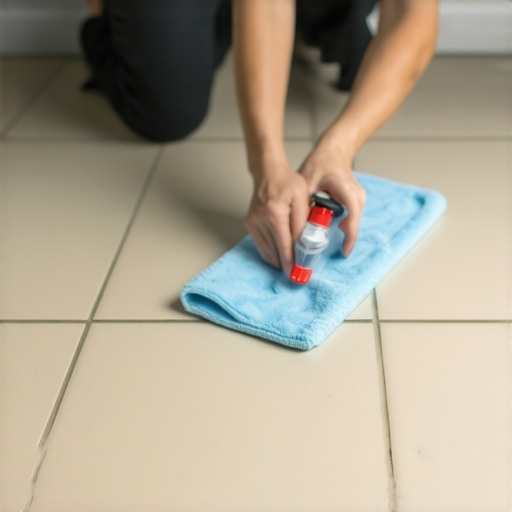
- Apply cleaner via a fine mist spray bottle rather than a bucket.
- Use a clean microfiber pad for every 200 square feet of flooring.
- Buff the floor with a dry microfiber cloth if any moisture remains after 30 seconds.
- Monitor indoor humidity levels to keep them between 35 and 55 percent.
The reality of laminate is that it is an engineering marvel that people treat like a sidewalk. You are walking on a high-resolution image of wood that is bonded to a compressed board made of sawdust and glue. It is incredibly durable but incredibly sensitive to moisture and light. If you want the streaks to go away, you have to strip the old wax and soap off the surface first. Use a mixture of one cup of white vinegar to one gallon of water just once to cut through the film. After that, never use vinegar again, as the acid can eventually dull the melamine. From that point on, use distilled water. It has no minerals and no surfactants. It is just H2O. When it evaporates, there is literally nothing left behind to create a streak. That is the secret the big-box stores won’t tell you because they want to sell you a twelve-dollar bottle of scented water every month. Take care of the subfloor, keep the water to a minimum, and your floors will look like they were just pulled out of the box.