
Why Your Laminate Floor Feels Soft and Spongy When You Walk on It
The physics of the deflection void
A spongy laminate floor is almost always caused by subfloor irregularities or incorrect underlayment thickness. If the subfloor has a dip greater than 3/16 of an inch over a 10 foot span, the planks will deflect into that void. This movement stresses the tongue and groove joints.
Most guys skip the leveling compound. They think the underlayment will hide the dip. It won’t. I spent three days grinding concrete on a job last month just so the floor wouldn’t click like a castanet. When you walk across a room and feel that give, that slight sinking sensation, you are feeling the structural failure of the floating system. It is not just an annoyance. It is the sound of your investment slowly breaking apart. Laminate is a composite material, usually a High-Density Fiberboard (HDF) core wrapped in a photographic layer and a melamine wear layer. It has no structural integrity on its own. It relies entirely on the substrate. If there is air beneath the plank, the plank must bend to fill that air. Over time, this repetitive bending causes the microscopic wood fibers in the locking mechanism to fatigue and snap.
The 1/8 inch that ruins everything
Subfloor flatness is the single most important factor in a successful laminate installation. The National Wood Flooring Association standards require a flatness of 1/8 inch within a 6 foot radius. Anything outside these tolerances creates a trampoline effect where the floor bounces under every step.
“A floor is only as good as the subfloor beneath it; deflection is the enemy of every joint.” – Master Flooring Axiom
I have seen it a thousand times. A homeowner pulls up an old carpet install and assumes the plywood or concrete underneath is ready for a hard surface. It never is. Carpet is forgiving. It hides humps and valleys that are half an inch deep. Laminate is the opposite of forgiving. When you transition from a soft surface like carpet to a floating laminate, you must treat the subfloor like a surgical table. If you are installing over concrete, you need to check for moisture and flatness simultaneously. If the slab is high in the center, you have to grind it down. If it is low, you need a high-compressive strength floor leveling compound. Do not use the cheap stuff that cracks under pressure. You need a polymer-modified self-leveler that can handle the micro-movements of a residential structure.
The dangerous myth of the thick underlayment
While most people want the thickest underlayment to make the floor feel softer, too much cushion actually causes the locking mechanisms on laminate to snap under pressure. A soft pad allows the floor to move vertically too much, which puts an impossible load on the thin HDF tongues.
People come into the shop and they want the thickest, squishiest foam they can find. They think it will make the laminate feel like real wood or even carpet. That is a lie that leads to a ruined floor. Most high-end laminate manufacturers specify an underlayment no thicker than 2mm to 3mm. When you go beyond that, you are creating a vertical travel distance that the click-lock system cannot handle. Think about the chemistry of that HDF core. It is compressed sawdust and resin. It is stiff. It does not like to bend. When you step on a plank that has 6mm of soft foam under it, the plank sinks. The plank next to it, which doesn’t have your weight on it, stays put. The tongue of the weighted plank then pries against the groove of the unweighted plank. Eventually, the tongue shears off. Now you have a floor that is not only spongy but also has visible gaps.
| Material Property | Standard Tolerance | Failure Point |
|---|---|---|
| Subfloor Flatness | 1/8 inch per 6 feet | > 1/4 inch deviation |
| Underlayment Density | > 2.0 lbs/cu ft | Low-density soft foam |
| HDF Core Density | 800-900 kg/m3 | Less than 750 kg/m3 |
| Expansion Gap | 3/8 inch minimum | Zero gap or tight fit |
The ghost in the expansion gap
An expansion gap is a mandatory space left around the perimeter of the room to allow the floor to grow and shrink with humidity. If the floor is installed tight against the walls, it has nowhere to go but up, creating a hollow, spongy peak in the room.
I once walked into a house where a $15,000 wide-plank walnut floor was cupping so bad it looked like a potato chip because the installer didn’t check the crawlspace humidity. Laminate does the same thing, but instead of cupping, it usually bows. The moisture in the air causes the wood fibers to expand. If the floor is locked against a baseboard or a door frame, the pressure builds until the entire floor lifts off the subfloor. This creates a massive air pocket. When you walk on it, you are literally pushing the entire floor back down to the ground. That is why your floor feels like a sponge. You need to check your perimeters. Pop off a piece of baseboard. If that laminate is touching the drywall, you have found your problem. You need to get a oscillating saw and cut back that gap. It needs to breathe. It needs to move as a single monolithic unit.
Moisture and the capillary action of HDF
Moisture is the primary enemy of any laminate floor because the HDF core acts like a sponge when exposed to high humidity or subfloor dampness. This moisture causes the edges to swell, creating an uneven surface that feels soft and unstable underfoot.
Even if you are not in a humid climate, the concrete slab beneath your house is constantly releasing water vapor. If you did not put down a 6-mil poly film moisture barrier, that vapor is being sucked directly into the bottom of your laminate planks. This is where the chemistry gets ugly. The resins holding the wood fibers together begin to break down. The board loses its density. A high-density fiberboard should be hard as a rock. Once it absorbs moisture, it becomes more like a wet cracker. You might notice the edges of your planks are slightly raised. This is called peaking. It happens because the core is expanding and pushing the edges together. In areas like kitchens or near showers, this is even more common. A single leak under a sink can ruin a hundred square feet of flooring by turning the subfloor into a damp, moldy mess that offers zero support.
“Deflection is not just a measurement; it is the death knell of the floating floor system.” – TCNA Technical Bulletin
The checklist for a solid floor
- Check subfloor flatness with a 10-foot straight edge.
- Verify moisture levels in the concrete or wood substrate using a pin-type meter.
- Ensure the underlayment has a high compressive strength rating.
- Leave a minimum 3/8 inch expansion gap around all vertical obstructions.
- Acclimate the flooring in the room for at least 48 hours before opening the boxes.
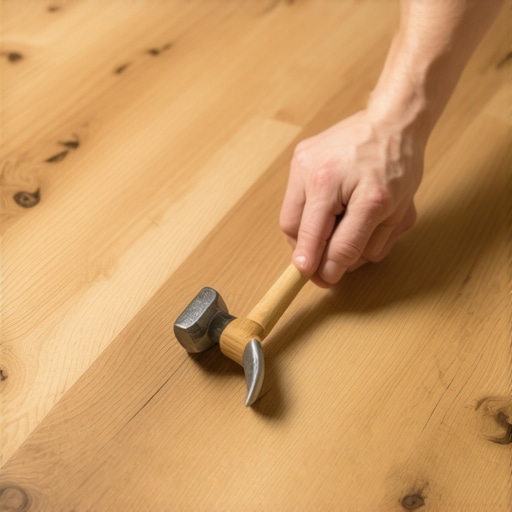
- Use a tapping block and a pull bar to ensure every joint is fully seated.
Fixing a spongy floor is a headache. If the issue is a dip in the subfloor, the only real fix is to pull up the planks, level the floor, and relay them. If the issue is an expansion gap, you can sometimes fix it in place. But the best way to avoid a soft floor is to do the prep work. Spend the money on the leveler. Spend the time on the grinder. If you ignore the substrate, you are just building a house on sand. You want a floor that feels like a rock when you walk on it. That only happens when the chemistry of the adhesive, the physics of the subfloor, and the quality of the plank all work together in a single, unyielding system. Never trust a contractor who says they can skip the prep. They are the ones who leave you with a floor that feels like a marsh. Do it right the first time or you will be doing it again in two years.