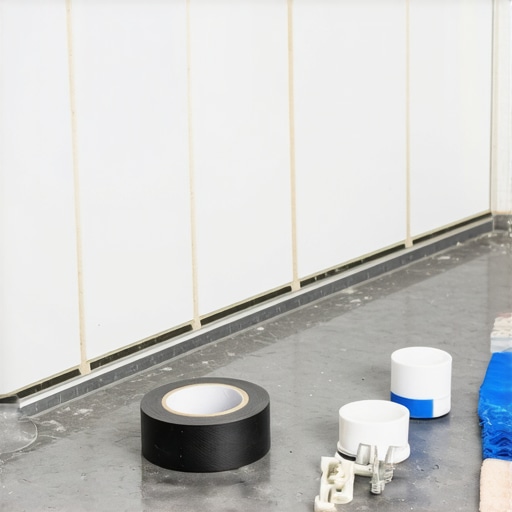
A leaky shower curb is a structural failure disguised as a minor inconvenience. I spent three days grinding concrete on a job last month just so the floor wouldn’t click like a castanet and the homeowner wouldn’t have to worry about the subfloor rotting out. Most guys skip the leveling compound. They think the underlayment will hide the dip. It won’t. When water escapes a shower curb, it is usually because the structural integrity of the pan or the curb itself has been compromised by poor installation or shifting subfloors. You are here because you do not want to tear out the tile. You want a surgical fix that stops the rot before it hits your laminate or carpet install in the next room. My knees have the scars from decades of fixing these exact failures. I smell like WD-40 and oak dust today because I just finished pulling up a warped hardwood floor ruined by a slow curb leak. We are going to look at the chemistry of sealants and the physics of water migration to solve this without a sledgehammer.
The mechanics of water migration through porous grout
Shower curb leaks occur when water bypasses the primary waterproofing layer through capillary action or structural cracks. You must identify if the leak is a topical breach or a membrane failure before applying epoxy sealants or polyurethane injections. Understanding the hydrostatic pressure of standing water is essential for a permanent repair. When grout fails, it creates a microscopic highway for moisture to reach the plywood or concrete below. This moisture then travels laterally, often showing up as damp spots on the carpet install in the bedroom or causing the floor leveling compound in the hallway to crumble. Water does not care about your aesthetic choices. It only cares about gravity and the path of least resistance.
“A floor is only as good as the subfloor beneath it; deflection is the enemy of every joint.” – Master Flooring Axiom
Topical epoxy penetration for micro cracks
Applying a high penetration epoxy resin to the grout lines and curb joints creates a covalent bond that stops moisture at the surface. This method uses low viscosity resins that wick into the capillary pores of the cementitious grout. The chemical structure of the epoxy ensures that once cured, it is harder than the tile itself. You start by drying the curb for 72 hours with a high velocity fan. If there is moisture trapped inside, the epoxy will trap it and cause the tile to delaminate. I have seen guys try to rush this. They end up with a cloudy mess that peels off in six months. You need the resin to sink deep. Once it hits the substrate, it forms a plasticized barrier that water cannot penetrate. This is a surgical strike against leaks. You are not just painting the surface. You are changing the chemical nature of the grout. This is particularly effective if your shower is adjacent to a laminate floor, as even a small amount of moisture will cause laminate edges to swell and peak like mountain ranges.
Targeted polyurethane injection for hollow voids
Injecting expanding polyurethane foam or resin into the curb cavity fills the air pockets where water collects and stagnates. You drill small pilot holes into the grout lines and use a pressure-rated injection port to deliver the material. The hydrophobic properties of the resin ensure it displaces any existing water while expanding to seal the waterproofing membrane. This is the heavy artillery of leak repair. When a curb is built poorly, there are often gaps between the 2×4 framing and the cement board. Water gets in there and sits. It rots the wood. It creates a breeding ground for mold. By injecting a high density resin, you are turning a hollow, weak structure into a solid, waterproof block. This also improves the structural rigidity of the curb. If someone steps on it, there is no flex. Flex is what kills grout. Flex is what snaps the seals on your glass door. You want that curb as solid as a block of granite.
| Material Type | Viscosity (cps) | Bond Strength (PSI) | Cure Time |
|---|---|---|---|
| Standard Silicone | 50,000 | 250 | 24 Hours |
| Epoxy Resin | 500 | 3,500 | 12 Hours |
| Polyurethane Injection | 150 | 2,800 | 4 Hours |
| Modified Polymer | 30,000 | 450 | 24 Hours |
The threshold cap modification and silicone reinforcement
Installing a solid surface threshold cap over the existing curb provides a mechanical shield that redirects water back into the pan. This involve using a single piece of quartz or marble bedded in a high performance polymer adhesive. You must ensure the cap has a slight inward pitch to prevent standing water on the curb surface. Most leaks happen because the curb was built flat or, heaven forbid, pitching outward. Gravity is a law, not a suggestion. If the water has nowhere to go but the floor, it will find a way through the silicone. By adding a solid cap, you eliminate the grout lines on the top of the curb. That is where 90 percent of the trouble starts. You bed that cap in a thick layer of modified thin-set or a high grade adhesive. Then you seal the perimeter with a 100 percent silicone sealant. Do not use cheap painter’s caulk. It will fail in a month. You need the stuff that smells like vinegar and stays flexible for twenty years.
Perimeter redirection and drainage optimization
Optimizing the drainage slope and sealing the transition between the curb and the floor leveling compound prevents lateral moisture migration. You should inspect the weep holes in the drain assembly and use a penetrating sealer on the first three rows of floor tile. This prevents wicking which is the primary cause of curb failure. I have seen beautiful walk-in showers ruin a whole house because the installer didn’t understand floor leveling. If the floor outside the shower is higher than the floor inside, water will travel uphill through the subfloor via capillary action. It is physics. You need to ensure the area around the curb is bone dry and then apply a topical moisture barrier.
“Waterproofing is not a single product but a system of redundant layers working in harmony to defy gravity.” – TCNA Technical Bulletin
Checklist for a successful curb seal
- Confirm subfloor moisture levels are below 12 percent using a pin-type meter.
- Clean all grout lines with phosphoric acid to remove soap scum and mineral deposits.
- Ensure the bathroom temperature is between 65 and 80 degrees for proper epoxy curing.
- Apply sealants only to surfaces that have been dry for at least 48 hours.
- Check the pitch of the curb with a digital level to ensure an inward slope.
The reality is that these fixes are stop-gaps. They work, and they can last a long time if done right, but they require precision. If your subfloor is already soft, no amount of epoxy will save you. You have to be honest about the damage. If you push on the curb and it moves, the wood inside is mush. At that point, you are just putting a band-aid on a gunshot wound. But if the structure is sound and the leak is just a failure of the surface seals, these four methods will save you thousands in demolition costs. You want to keep that carpet install in the hallway dry. You want your floor leveling to remain intact. Take your time. Measure twice. Seal once.