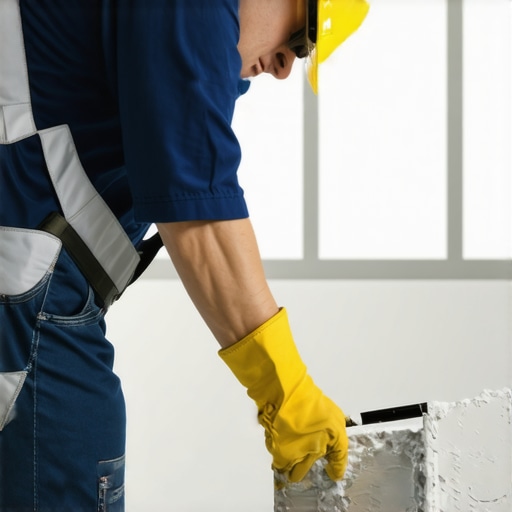
I spent three days grinding concrete on a job last month just so the floor wouldn’t click like a castanet. The homeowner thought I was wasting time. They wanted to see the shiny new laminate go down immediately. But I know better. My knees have the scars from twenty-five years of chasing the ghost in the expansion gap. I have smelled enough wet oak dust and burnt grinding wheels to know that a floor is not a decoration. It is a performance surface. When you walk into a room and the floor feels like a trampoline or you hear that sickening crunch of a breaking locking tab, it is not the product that failed. It was the man who held the level before the product arrived. Subfloor preparation is the physics of the home. If you ignore the chemistry of the bond or the moisture in the slab, your leveler will peel away like a bad sunburn by 2026.
The invisible barrier of surface dust
Subfloor contaminants like microscopic dust, drywall mud, and paint overspray create an unbondable layer that prevents self-leveling underlayment from anchoring to the substrate pores. This failure occurs at the molecular level where the polymer chains in the leveler cannot reach the capillary structure of the concrete slab. You must understand that vacuuming is not enough. You need to achieve a specific Concrete Surface Profile before you even think about opening a bag of material.
A lot of guys think they can just sweep the floor and dump the bucket. They are wrong. Most modern leveling compounds are cementitious matrices modified with polymers. These polymers are designed to grab onto the tiny ridges and valleys in a clean concrete surface. If those valleys are filled with white gypsum dust from the drywall crew, the leveler just sits on top. It creates what we call a cold joint or a bond breaker. Eventually, the weight of the furniture and the traffic from the family will cause the leveler to crack. It will sound like walking on potato chips. I have seen entire rooms where you could slide a putty knife under the leveler and lift it up in sheets. It happens because the installer was too lazy to use a damp mop or a HEPA filtered vacuum to get the fine particulates out of the pores.
The mechanical bond versus the chemical dream
Mechanical adhesion requires a rough surface known as a Concrete Surface Profile or CSP rating of 3 to 5 for heavy applications. Without this physical tooth, the chemical bond of the primer will fail under the tensile stress of the curing leveler as it shrinks and pulls away from the smooth substrate. This is why grinding is a mandatory step for most professional installations.
“A floor is only as good as the subfloor beneath it; deflection is the enemy of every joint.” – Master Flooring Axiom
The chemistry of the pour is fascinating and dangerous. When you mix that powder with water, you are starting a localized exothermic reaction. The material wants to grip something. If the concrete is power-troweled to a mirror finish, there is nothing for the leveler to grip. It is like trying to glue two pieces of glass together with school glue. You have to break that surface tension. I use a diamond grinder to open up the pores. If you do not see the aggregate, you are not deep enough. This is especially true when you are transitioning from a carpet install to a high-end laminate or tile in showers. The substrate must be thirsty. If you pour water on your concrete and it beads up, your leveler will fail. That is a fact of physics that no marketing brochure can change.
| Leveler Type | Compression Strength | Drying Time | Best Use Case |
|---|---|---|---|
| Cementitious | 5000 PSI | 24 Hours | High Traffic Areas |
| Gypsum Based | 3500 PSI | 12 Hours | Wood Subfloors |
| Fiber Reinforced | 4500 PSI | 16 Hours | Renovations |
Why moisture vapor is a silent killer
Hydrostatic pressure and high moisture vapor emission rates force alkaline salts to the surface of the concrete slab, which destroys the adhesive bond of the leveler primer. If the relative humidity inside the concrete pores exceeds 85 percent, the osmotic pressure will physically push the leveling compound off the floor. This leads to delamination and efflorescence at the edges.
I have walked into jobs where a walnut floor was cupping so bad it looked like a potato chip. The reason was a wet crawlspace and a wet slab. People buy these moisture meters and they use them once. You have to test the slab over 72 hours. While most people want the thickest underlayment, too much cushion actually causes the locking mechanisms on LVP to snap under pressure. You want a flat floor, not a soft one. Moisture is the enemy of every flooring professional. It moves through the concrete like a slow-motion flood. If you do not use a moisture vapor barrier primer before your leveler, you are just building a raft. Eventually, that raft will float away from the slab. I always tell my apprentices that if they skip the moisture test, they are paying for the fix out of their own pockets. The NWFA is very clear about this. You cannot install over wet wood or wet concrete without consequences.
The temperature of the slab matters
Substrate temperature affects the hydration rate of the cementitious leveler, causing flash drying or delayed setting that ruins the structural integrity of the pour. If the ambient humidity is too low, the surface water evaporates before the chemical reaction is complete, leading to chalking and a soft surface that cannot support a floor covering.
“Wood flooring will perform best when the environment is controlled within a stable range of temperature and relative humidity.” – NWFA Technical Guidelines
If you are working in a house without HVAC, you are asking for trouble. I have seen guys pour leveler in a house that was 40 degrees. The water in the mix does not react properly. It just sits there. Then the next day they crank the heat to 80 and the surface skin dries too fast. It creates a shell over a wet center. This is called mapping. You can see the cracks forming like a dry lake bed in the desert. You need to acclimate the bags of leveler and the room itself. A floor is a living thing in a sense. It expands and contracts. If you force the cure, you weaken the internal crystalline structure of the cement. You end up with a brittle floor that will turn back into dust under the weight of a refrigerator.
The failure of the unprimed surface
Primer application is the most underrated step in the flooring installation process, acting as the bridge between the porous substrate and the dense underlayment. Without diluted acrylic primer, the dry concrete will suck the water out of the leveler mix too quickly, preventing the material flow and causing pinholes or volcanoes in the finished surface.
- Grind the surface to a CSP 3 profile.
- Vacuum with a HEPA filter system.
- Apply the first coat of primer diluted to the manufacturer’s specs.
- Wait for the primer to turn from milky to clear and tacky.
- Apply a second coat of neat primer for highly porous slabs.
- Mix the leveler with the exact amount of water, never more.
- Use a spiked roller to release trapped air bubbles.
The primer is not just a sticky liquid. It seals the pores so air does not escape into your fresh pour. If you see little bubbles popping in your leveler, that is the subfloor breathing. It means you did not prime it well enough. Those bubbles become voids. Those voids become soft spots. Those soft spots become the reason you have to rip up five thousand dollars worth of laminate in three years. Do not be the guy who thinks he knows better than the engineers who designed the chemistry. Follow the instructions. Use the right tools. Respect the subfloor, or it will eventually humiliate you in front of your clients.
{ “@context”: “https://schema.org”, “@type”: “HowTo”, “name”: “How to Prevent Floor Leveler Failure”, “step”: [ { “@type”: “HowToStep”, “text”: “Mechanical preparation of the substrate using a diamond grinder to achieve a CSP 3 profile.” }, { “@type”: “HowToStep”, “text”: “Thorough decontamination and dust removal using industrial HEPA vacuums.” }, { “@type”: “HowToStep”, “text”: “Application of an acrylic or epoxy primer to seal the pores of the concrete.” }, { “@type”: “HowToStep”, “text”: “Correct mixing of the self-leveling compound using a measured water ratio to prevent segregation.” } ] }