Why Your White Grout is Turning Orange in the Shower
I spent three days grinding concrete on a job last month just so the floor wouldn’t click like a castanet. People often assume that the finish material is what matters, but that is a rookie mistake. In a shower, the subfloor is the foundation of your hygiene. If your white grout is turning orange, you are witnessing a chemical reaction or a biological invasion caused by poor structural planning. My boots are still covered in thin-set from a tear-out where the homeowner thought a cheap carpet install in the adjacent bedroom would hide the moisture wicking out of a failed shower pan. It did not. The subfloor was rotted through because the installer skipped the pre-slope. Flooring is not a cosmetic choice. It is a structural engineering challenge that requires precision down to the mil-thickness of your waterproofing layer. You cannot hide bad bones with a pretty surface. When that grout starts changing color, it is the house trying to tell you that the chemistry of your environment is out of balance.
The chemistry of iron oxidation in wet environments
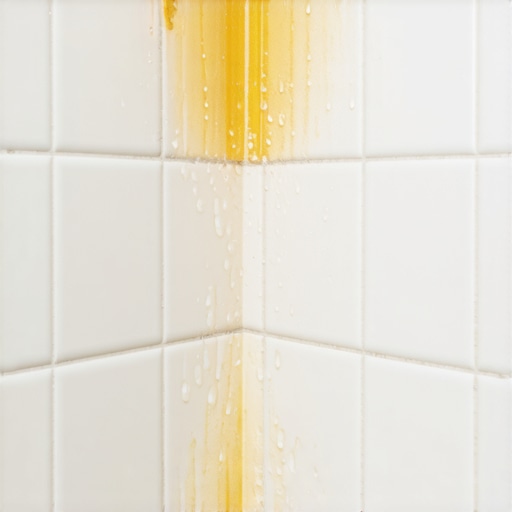
Iron oxidation occurs when dissolved minerals in your hard water react with oxygen on the surface of porous grout. This chemical reaction produces ferric oxide, which manifests as a stubborn orange stain or rust-colored residue that clings to cementitious grout joints. It is a microscopic battle between your plumbing and your aesthetics. If you are on a well system, this is almost a certainty. The iron is suspended in the water, invisible until it hits the air. Once it atomizes through your shower head, it finds the perfect nesting ground in the tiny pores of your grout. Cementitious grout is essentially a hard sponge. It has thousands of microscopic voids that pull in water through capillary action. When that water evaporates, the iron stays behind. It oxidizes. It turns that bright white into a dingy, pumpkin orange. This is not a cleaning issue. It is a chemistry issue. You can scrub until your knuckles bleed, but if you do not address the mineral content or seal the grout at a molecular level, the orange will return within a week.
The biological invasion of Serratia marcescens
Serratia marcescens is a bacterial colony that thrives in moist environments and feeds on phosphates found in soap scum and shampoo residue. This biofilm produces a prodigiosin pigment that appears as a pink or orange slime on grout lines and silicone caulk. It is a common airborne bacterium. It loves your shower because it is warm, wet, and full of food. If you see the orange tint creeping up the walls or forming a ring around the drain, you are looking at a living organism. It is not rust. It is a colony. The problem is that most people use bleach to kill it. Bleach is mostly water. While the chlorine kills the surface bacteria, the water penetrates the porous grout and feeds the roots of the colony. It is a cycle of growth and temporary removal. To stop this, you have to change the environment. You need to reduce the humidity and eliminate the food source. If your bathroom fan is not moving at least fifty cubic feet per minute, you are basically running a laboratory for bacterial growth.
Why floor leveling determines shower longevity
Floor leveling is the process of ensuring a perfectly flat substrate to prevent standing water and pooling which leads to mineral accumulation and grout discoloration. If the subfloor has a dip, the tile will follow that dip. Water is lazy. It will find the lowest point and sit there. When water sits, the concentration of iron or bacteria increases. I have seen guys try to fix a dip with extra thin-set. That is a recipe for failure. Thin-set is not a leveling agent. It shrinks as it cures. If you have a 1/8 inch dip in your shower pan, that area will always be orange because it never truly dries. You must use a high-quality self-leveling underlayment or a traditional mud bed to create a perfect slope of 1/4 inch per foot toward the drain. Without that slope, gravity works against you. The orange stains are just the visual symptom of a structural slope failure.
“A floor is only as good as the subfloor beneath it; deflection is the enemy of every joint.” – Master Flooring Axiom
The failure of laminate and carpet in wet zones
Laminate flooring and carpet install projects should never be attempted in or near a high-moisture shower area because they lack the impermeability required to resist capillary wicking and structural rot. I have walked into homes where someone thought they could put laminate in a powder room attached to a shower. The MDF core of the laminate acts like a wick. It pulls the moisture from the shower steam and swells. The joints peak. The edges turn black with mold. It is a disaster. Carpet is even worse. A carpet install in a bathroom is a relic of the seventies that needs to stay dead. The padding is a giant sponge. It traps the orange bacteria and the iron-rich water, holding it against the subfloor until the wood rots. If you are worried about orange grout, you should be terrified of what is happening under a bathroom carpet. There is no way to sanitize it. There is no way to dry it. It is a biohazard masquerading as comfort.
Technical comparison of grout performance
Choosing the right material is the difference between a floor that lasts thirty years and one that fails in three. We look at porosity and chemical resistance as the primary metrics for success in a wet environment. Cement grout is the old standard, but it is the most susceptible to orange staining because of its high absorption rate. Epoxy is the gold standard for those who want a white floor to stay white.
| Material Property | Standard Cement Grout | High Performance Grout | Epoxy Grout |
|---|---|---|---|
| Porosity Level | High (10-15%) | Low (3-5%) | Zero (<0.5%) |
| Stain Resistance | Poor | Moderate | Excellent |
| Chemical Stability | Low | Medium | High |
| Water Absorption | High | Low | None |
The physics of the wicking effect in natural stone
Natural stone tiles such as carrara marble or travertine contain trace minerals like pyrite that can oxidize internally when exposed to constant moisture. This is not just surface staining. It is a deep, internal rust. When you install stone without a proper moisture barrier or a high-quality sealer, the water travels through the stone and reacts with the iron deposits inside the rock itself. You get a deep orange bleed that no cleaner can touch. This is why site-finished wood or natural stone requires a level of expertise that most big-box installers simply do not possess. You have to understand the geology of the material. If you want white stone, you have to accept that you are managing a mineral-rich environment. One tiny crack in the sealer and the oxidation starts.
“True waterproofing happens behind the tile, not on top of the grout.” – TCNA Installation Manual Reference
Strategic maintenance checklist for white grout
If you want to keep your grout white, you have to be proactive. It is not about hard scrubbing. It is about environmental control and chemical management. Follow this checklist to ensure your installation remains pristine.
- Install a whole-house water softener to remove iron and manganese before they reach the shower head.
- Apply a high-quality penetrating sealer to cementitious grout every six months to block capillary action.
- Wipe down the shower walls with a squeegee after every use to eliminate the standing water that feeds bacteria.
- Maintain a bathroom humidity level below fifty percent using a timer-controlled exhaust fan.
- Avoid using acidic cleaners that can etch the grout and create more surface area for stains to cling to.
The orange tint in your shower is a warning sign. It tells you that your water is hard, your ventilation is poor, or your grout is too porous. In the coastal humidity of places like Florida or Houston, these problems are magnified ten times. The air is already saturated, so the shower never truly dries out. This creates a permanent state of oxidation. If you are building a new shower, skip the cement grout entirely. Spend the extra money on a high-grade epoxy. It is harder to install. It requires a master’s touch to spread and clean before it sets. But it will never turn orange. It is a non-porous plastic shield that locks out the iron and the bacteria. I have seen many floors fail, but I have never seen an epoxy floor lose its color to rust. Do it right the first time, or you will be calling me in three years to jackhammer the whole thing out.