Why Your Kitchen Tiles Always Crack Near the Dishwasher
I spent three days grinding concrete on a job last month just so the floor wouldn’t click like a castanet. The homeowners thought I was being difficult. They wanted the new porcelain down by Tuesday. But I saw the dip. Most guys skip the leveling compound. They think the underlayment will hide the dip. It won’t. I showed them a 1/8 inch deviation over two feet. If I had tiled over that, the first time they stepped on it while the dishwasher was running, those tiles would have snapped. I’ve spent twenty-five years on my knees with a moisture meter and a level. I know that a floor is not a decoration. It is a performance surface. When your kitchen tiles crack specifically near the dishwasher, it is not bad luck. It is a failure of engineering and a fundamental misunderstanding of subfloor physics. You are dealing with a localized zone of extreme thermal stress and mechanical vibration that most installers simply ignore.
The heat of the machine creates structural movement
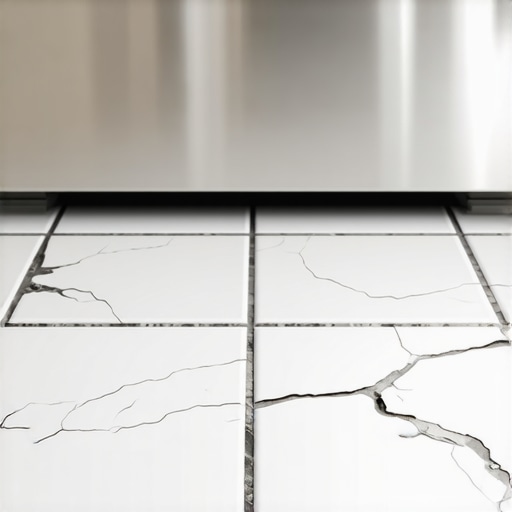
Tiles crack near the dishwasher because of thermal expansion and repetitive moisture cycles. The dishwasher heating element warms the subfloor, causing the plywood or concrete to expand. Without a flexible bond or movement joints, the rigid tile and grout cannot accommodate this structural shift, leading to stress fractures.
Think about the molecular reality of your kitchen. Every time you run a heavy load of dishes, the space under that machine turns into a sauna. The heat radiates downward. Wood is a hygroscopic material. It breathes. It moves. When that heat hits the subfloor, the fibers in the wood expand. If you have used a cheap, modified thin-set with low polymer content, that bond is brittle. It does not want to move. The tile is even more stubborn. It wants to stay exactly where it is. When the subfloor expands and the tile does not, the bond breaks. This is often where we see the phenomenon of tenting, where the tile actually lifts off the substrate. In other cases, the grout, which is the weakest link in the chain, simply disintegrates. It starts as a hairline fracture. Then, every time the dishwasher vibrates during the spin cycle, that fracture grows. It is a slow-motion car crash happening under your feet.
The subfloor physics of deflection and weight
Vertical movement known as deflection is the primary cause of cracked grout lines and broken tile units. If the joist spacing exceeds 16 inches or the subfloor thickness is insufficient, the static load of a full dishwasher causes the floor assembly to bend beyond the TCNA L/360 standard. This mechanical stress ruins the adhesive bond.
We need to talk about the L/360 rule. Most people think their floor is solid because it does not feel like a trampoline. That is not the standard. The Tile Council of North America is very clear about this. The floor must not deflect more than the total span divided by 360. If you have a ten-foot span, that is only a third of an inch of movement allowed under a heavy load. When you fill a modern dishwasher with water and dishes, you are adding significant weight to a very small footprint. If your floor leveling was done poorly, or if the installer used a cheap laminate style approach to a tile job, that weight creates a localized dip. Every time you walk past that machine, you are adding your body weight to that stress point. The floor is literally bending and unbending. Porcelain and ceramic do not bend. They break. This is why I insist on double-layer subfloors or uncoupling membranes. You need a buffer between the movement of the house and the rigidity of the stone.
“A floor is only as good as the subfloor beneath it; deflection is the enemy of every joint.” – Master Flooring Axiom
The chemical bond failure of cheap thin-set
The chemical bond between the tile and substrate fails when standard mortar is used instead of high-polymer modified thin-set. In high-moisture zones like kitchens and showers, the adhesive must maintain elasticity. If the thin-set lacks polymer resins, it cannot withstand the vibration and thermal shock from kitchen appliances.
I have seen guys use unmodified thin-set for everything because it is five dollars cheaper a bag. That is a recipe for disaster. The polymers in modern mortars act like tiny rubber bands at a microscopic level. They allow for a fraction of a millimeter of movement. In the zone near your dishwasher, those rubber bands are working overtime. They are absorbing the heat. They are absorbing the vibration from the motor. When you use a low-grade product, you are essentially gluing your tiles down with something that has the flexibility of a cracker. The first time the dishwasher hits 140 degrees, those bonds snap. Then you get that hollow sound when you walk on the tile. That is the sound of a failed installation. It is the sound of a contractor who wanted to save twenty bucks on materials and ended up costing the homeowner thousands in repairs.
The hidden danger of moisture vapor
Excessive moisture vapor from the dishwasher vent penetrates unsealed grout and reaches the subfloor. This leads to wood rot or alkali-silica reactions in concrete slabs. Proper floor leveling and the use of a waterproof membrane are the only ways to prevent substrate degradation in the kitchen wet zone.
Water is the universal solvent. It finds a way. Many modern dishwashers vent out the bottom or the side. This sends a plume of hot, moist air directly toward the edge of your tile. If your grout was not sealed, or if you used a cheap sanded grout without an additive, that moisture travels down. It hits the subfloor. If you have a plywood subfloor, it starts to delaminate. If you have a concrete slab, it can trigger a chemical reaction that increases the pH of the concrete, destroying the bond of the mortar. I have pulled up tiles near dishwashers where the subfloor was literally mush. You could poke a screwdriver right through it. This is why the prep work is more important than the tile itself. If you do not have a moisture barrier, you are building on a foundation of sand. It is the same reason a carpet install in a basement fails if you do not check the moisture levels first. You cannot ignore the environment.
| Material Property | Porcelain Tile | Luxury Vinyl (LVP) | Laminate Wood |
|---|---|---|---|
| Heat Resistance | High | Moderate | Low |
| Flexibility | Zero | High | Moderate |
| Moisture Tolerance | Excellent | High | Low |
| Structural Weight | Heavy | Light | Light |
| Acclimation Time | None | 48 Hours | 72 Hours |
The 1/8 inch that ruins everything
A flat substrate is different from a level substrate, and both are required for a successful tile installation. Using a self-leveling underlayment ensures that the large format tiles common in kitchens have 100 percent mortar coverage. Without this, air pockets form, creating weak points where the tile will inevitably crack under pressure.
When I talk about floor leveling, I am not talking about making it perfectly horizontal with the earth. I am talking about planarity. The surface must be flat within a specific tolerance. For large format tiles, that is 1/8 of an inch over ten feet. If you have a hump near the dishwasher, the tile is going to teeter on that hump. If you have a dip, the tile is going to bridge over it. That creates a hollow space. When you step on a tile that has a hollow space underneath it, you are putting 100 percent of the pressure on the ceramic itself rather than transferring that pressure to the subfloor. It will snap. I do not care how expensive the tile was. I do not care if it was imported from Italy. Physics does not care about your budget. This is why I spend so much time with the grinder and the level before the first tile ever touches the floor. It is the boring part of the job, but it is the part that makes the floor last fifty years instead of five.
“Substrate preparation is 90 percent of the floor; the tile is just the skin.” – TCNA Handbook Wisdom
The checklist for a permanent fix
If you want to stop the cycle of cracking tiles, you have to address the root causes during the installation phase. It is not enough to just swap out one broken piece. You need to look at the whole system.
- Verify the joist span and add blocking if the floor feels even slightly bouncy.
- Install a dedicated uncoupling membrane to separate the tile from subfloor movement.
- Use a high-quality polymer-modified thin-set specifically rated for large format porcelain.
- Apply a waterproof sealant to all grout lines near appliances that use water.
- Leave an expansion gap at the perimeter where the floor meets the cabinets and walls.
- Ensure the dishwasher is leveled properly so it does not vibrate excessively against the floor.
Comparing kitchen stresses to other environments
While the kitchen is a high-stress zone, we see similar issues in other areas of the home. A carpet install in a high-traffic hallway requires a different density of pad to prevent crushing, just as a kitchen requires a specific mortar. In showers, we deal with direct water pressure and the weight of the water in the pan. The principles remain the same. You have to account for the physics of the space. Even laminate flooring, which people think is easy, fails near dishwashers because the edges swell when exposed to steam. There is no such thing as a waterproof floor if you do not handle the seams and the transitions. The industry has been flooded with products that claim to be DIY friendly, but they do not teach you about the 1/8 inch gap. They do not teach you about the Janka scale or the moisture vapor transmission rate. They just sell you a box of planks and wish you luck. I am here to tell you that luck has nothing to do with it. You either build it to the standard, or you build it twice.
The next time you see a crack in your floor, do not just reach for the grout saw. Look at the machine. Look at the way the light hits the floor to see the dips. Check the moisture coming off the vent. The floor is talking to you. It is telling you that the subfloor is moving, the heat is too high, or the bond has failed. Listen to it. Fix the structure, and the tile will take care of itself. If you ignore the science, you will be back on your knees in two years doing the same job over again. Do it right the first time so you never have to see me again.