Why Your Carpet Tack Strips Keep Pulling Out of the Concrete
I spent three days grinding concrete on a job last month just so the floor would not click like a castanet. Most guys skip the leveling compound. They think the underlayment will hide the dip. It won’t. I was working in a basement in the humid sprawl of Houston. The homeowner had tried to install the carpet himself. Every time he pulled the power stretcher, the tack strips flew off the slab like shrapnel. He was using standard masonry nails in a high-strength 5000 PSI concrete mix. The concrete was so dense it was literally spitting the steel back at him. I had to explain that a floor is a performance surface. It is a structural engineering challenge that starts at the molecular level of the slab. If your tack strips are failing, you are likely fighting a battle against moisture, chemistry, or physics that you do not yet understand. I have seen fifteen thousand dollar wide-plank walnut floors ruin because of the same subfloor ignorance. We are going to look at the grit under the carpet. We are going to talk about the carbonation of the slab and the failure of the bond.
The failure of standard masonry nails in high PSI concrete
Carpet tack strips pull out of concrete when the fluted masonry nails cannot penetrate the dense aggregate or when the concrete undergoes spalling under tension. High-strength concrete slabs often reach five thousand PSI which resists standard impact fasteners. This creates a mechanical failure where the nail shank vibrates and loosens. When you swing a hammer at a tack strip, you are trying to force a piece of hardened steel into a matrix of Portland cement and rock. If the slab was poured with a high-strength mix, the nail will not bite. Instead, it creates a micro-fracture. As soon as the carpet installer hooks the carpet onto the pins and applies three hundred pounds of pressure with a power stretcher, that micro-fracture gives way. The concrete around the nail head simply turns to dust. This is especially common in newer builds where the concrete is still hydrating. You cannot treat a modern slab like the soft, chalky concrete found in a nineteen-fifties ranch house. The physics of the strike must change. You might need to pivot to a shorter nail or a specialized pneumatic fastener that fires with enough velocity to penetrate without shattering the surrounding crystalline structure of the cement paste. If the nail is too long, it will simply bounce. It will vibrate. It will fail. Every strike must be clean. Every nail must be seated deep into the aggregate without crushing the wood of the strip itself.
“A floor is only as good as the subfloor beneath it; deflection is the enemy of every joint.” – Master Flooring Axiom
The chemistry of concrete moisture and adhesive degradation
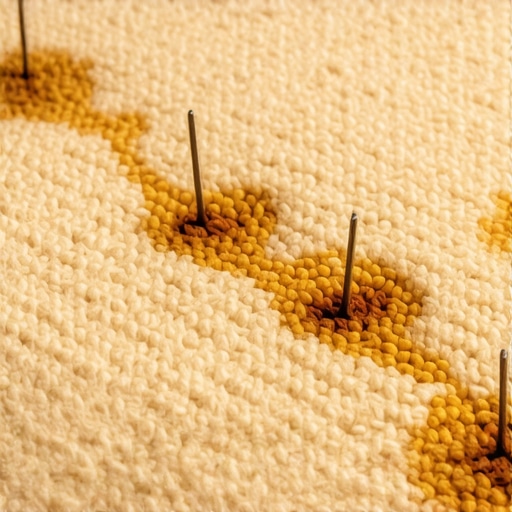
Moisture vapor emission rates or MVER are the primary killers of chemical bonds between carpet tack strips and concrete subfloors. High alkalinity on the slab surface destroys the resins in construction adhesives and epoxy. This causes the strip to delaminate from the floor during the stretching process. Concrete is a sponge. It looks solid but it is full of microscopic capillaries. In regions with high humidity like the Gulf Coast, the slab is constantly exhaling moisture. This moisture carries salts to the surface. We call this efflorescence. If you are using a glue-down method for your tack strips because the concrete is too hard to nail, those salts will eat your glue. The pH level of a healthy slab should be around seven or eight. When it hits eleven or twelve, it becomes a caustic environment. The adhesive undergoes a process called saponification. It literally turns into soap. You will see a gooey, yellowish residue where the strip used to be. This is why a moisture meter is the most important tool in my bag. I do not care how dry the surface feels to your hand. If the relative humidity inside that slab is over eighty percent, your carpet install is a ticking time bomb. You are better off using a moisture-cured urethane adhesive, but even that has limits. You have to clean the concrete with a diamond cup wheel first. You have to get past the laitance. You have to find the real structural heart of the concrete.
The role of floor leveling compounds in tack strip stability
Floor leveling compounds provide a smooth surface for laminate or carpet but they often lack the shear strength to hold a masonry nail. When carpet installers nail tack strips into self leveling underlayment, the brittle material often cracks or separates from the structural slab below. You might have used a leveling compound to fix a dip before your carpet install. This is common when transitioning from tiled areas like showers or kitchens. However, these compounds are mostly gypsum or thin-set based. They are designed for compression, not tension. A carpet stretcher puts immense lateral force on the tack strip. If that strip is only anchored into a quarter-inch of leveling compound, it will pop. The compound will shear right off the concrete. To avoid this, you must ensure your fasteners are long enough to pass through the leveler and at least three-quarters of an inch into the base slab. Or, you must use a high-strength, polymer-modified patch that is rated for at least three thousand PSI. I have seen guys try to install laminate over a bad leveling job and the floor bounces. With carpet, the failure is louder. It is a snap. It is the sound of your hard work coming undone. You have to prime the concrete before the leveler goes down. If you do not, the concrete will suck the water out of the leveler too fast. It will become a weak, dusty layer that cannot hold a nail or a glue bead.
| Fastener Type | Concrete Age | PSI Rating | Success Rate |
|---|---|---|---|
| Fluted Masonry Nail | 30+ Years | 2500-3000 | High |
| 1/4 Inch Concrete Screw | Any | 4000+ | Extreme |
| Pneumatic T-Nailer | New Build | 3500-5000 | Moderate |
| Construction Epoxy | Any | Any | High (Clean surface only) |
Why cheap epoxy won’t save your tack strip installation
Low-grade construction adhesives fail because they cannot handle the shear stress of a power-stretched carpet. Quality carpet installation requires specialized tack strip adhesives that reach full cure strength within minutes rather than hours. Standard liquid nails will remain too flexible and allow the strip to creep. I see this in every DIY job. Someone buys a tube of the cheapest adhesive at the big-box store. They go home and glob it on the concrete. They wait an hour and start stretching. The strip slides. It moves just enough to lose tension. Professional grade carpet epoxy is a different beast. It is designed to be brittle and strong. It bites into the pores of the concrete. But here is the secret. The concrete must be open. If the slab has a sealer on it, or if it was power-troweled to a mirror finish, no glue will stick. You have to scuff it. I use a sixty-grit sandpaper or a wire brush on a drill. You want to see the aggregate. You want the surface to look like a tiny mountain range. That is the only way to get a mechanical bond. If you are working near showers or wet rooms, you need a waterproof adhesive. Otherwise, the humidity from the bathroom will eventually migrate under the carpet and soften the glue. It is a chain reaction of failure that starts with one cheap tube of caulk.
“Deflection in the subfloor is the primary cause of fastener fatigue in all residential flooring systems.” – TCNA Engineering Handbook
The 1/8 inch that ruins everything
Precision in the expansion gap and tack strip placement determines the longevity of the carpet edge. If the tack strip is placed more than one-quarter inch from the baseboard, the carpet will not tuck properly. This creates a leverage point that pulls the strip upward. Most people think the strip just needs to be near the wall. Wrong. It needs to be exactly about the thickness of the carpet pile away from the vertical surface. If it is too far out, the carpet creates a bridge. When you step on that bridge, it acts like a lever. It pries the nails out of the concrete. This is physics. You are creating a fulcrum. I have walked into rooms where the carpet was loose at the edges because the installer was lazy with the hammer. He didn’t want to get too close to the baseboards. So he moved the strips out. Now every time someone walks by the wall, the strip gets a little looser. Eventually, the masonry nails give up. The concrete around them is tired. It has been pulverized by the constant micro-movements. You have to get that strip tight. You have to use a rhythmic strike. One blow to set, one blow to drive. If you are hitting it five times, you are just vibrating the nail loose before it even sets.
A checklist for permanent carpet anchoring
- Test the concrete moisture levels with a calcium chloride kit.
- Identify the PSI of the slab to choose between nails or screws.
- Remove all paint, oil, and old adhesive from the perimeter.
- Ensure the tack strip is gapped precisely for the carpet thickness.
- Use a power stretcher rather than a knee kicker for final tension.
- Seal the concrete if MVER exceeds manufacturer specifications.
- Verify that the masonry nails are fluted and hardened steel.
Regional humidity impacts on the Florida slab
The swampy humidity of places like Florida or the Carolinas means a concrete slab is never truly dry without a top-tier vapor barrier. This constant moisture cycle causes the steel nails in tack strips to rust and the wood to swell. In a dry climate like Phoenix, you can get away with a lot. In the humidity, you cannot. I have pulled up carpet in Miami where the tack strips were nothing but black rot and rusted metal. The nails had oxidized so much they had actually expanded and cracked the concrete around them. This is why I tell people that in high-humidity zones, you might want to look at plastic tack strips or stainless steel fasteners. They are expensive. They are hard to find. But they do not rot. If you are doing a carpet install in a basement or a ground-floor slab in a humid region, you have to assume the floor is wet. Use a high-quality primer. Use a moisture-stable adhesive. Do not trust the builder-grade crap. They are building houses as fast as they can and they do not care if your carpet stays down for more than two years. I care. I am the one who has to come back and fix it when the strips start popping. If you want a floor that lasts, you have to respect the climate. You have to respect the chemistry of the house. It is not just about the color of the carpet. It is about the bond to the earth.