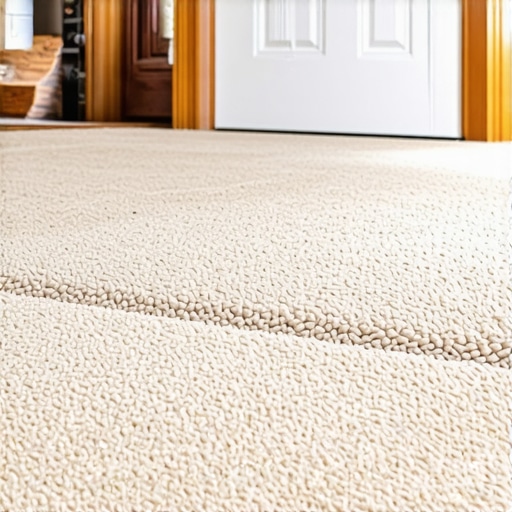
I spent three days grinding concrete on a job last month just so the floor wouldn’t click like a castanet. Most guys skip the leveling compound. They think the underlayment will hide the dip. It won’t. I have seen the same mistake made with carpet. People think a thick, marshmallow-like pad will compensate for a subfloor that looks like a topographical map of the Ozarks. It is a lie. After twenty-five years of smelling oak dust and floor wax, I can tell you that the most expensive carpet on the market will fail in six months if you put it over a pad that is too thick and too soft. We are entering a new era of home construction in 2026 where thinner, denser materials are the standard, yet homeowners still cling to the idea that thicker means better. It does not. Flooring is a structural engineering challenge, not a soft-goods purchase.
The trap of the thickest cushion
Thick carpet pads fail because they create excessive vertical movement that strains the primary backing and ruins the seams. Over-cushioning leads to a loss of structural integrity. In 2026 installs, standardizing on high-density rather than high-thickness is the only way to prevent premature wear and maintain the warranty requirements of the Carpet and Rug Institute. When you step on a carpet with a half-inch of low-density foam, the carpet fibers are forced to bend at an extreme angle. This mechanical stress breaks down the latex bond that holds the face yarns to the backing. You see it as carpet delamination, but I see it as a physics failure. The shear force applied to the backing every time someone walks across the room is multiplied by the depth of the pad. A dense 7/16 inch pad offers more support than a airy 9/16 inch pad. The latter is just a trampoline waiting to snap your tack strip tension.
“A floor is only as good as the subfloor beneath it; deflection is the enemy of every joint.” – Master Flooring Axiom
The ghost in the expansion gap
Proper carpet install techniques require an expansion gap at the perimeter to allow the subfloor to breathe and the carpet to be tensioned correctly. Thick padding often interferes with the tack strip height, causing the carpet to slip off the pins. This leads to carpet ripples and waves that appear within the first year. If the pad is thicker than the tack strip, the carpet cannot properly bite into the wood. I have walked into hundreds of homes where the carpet is literally floating because the pad was too tall. This is especially true when transitioning to showers or tiled areas where the TCNA standards for height transitions are strict. If you are also installing laminate in adjacent rooms, the height mismatch caused by a thick pad creates a tripping hazard that no T-molding can fix. The physics of the expansion gap are non-negotiable. You need a 1/4 inch space for the subfloor to move, but you also need the carpet to sit flush against the baseboard. A thick pad ruins that geometry every single time.
The hidden chemistry of mold and trapped vapor
High-thickness pads act as a thermal and moisture insulator that can trap vapor between the slab and the flooring material. This moisture vapor transmission (MVT) can lead to microbial growth and the breakdown of adhesives. In 2026, we are seeing more floor leveling compounds that are sensitive to trapped moisture. If you are in a high-humidity region like the Gulf Coast, a thick pad is essentially a sponge. It absorbs the ambient humidity and holds it against the primary backing. This creates a petri dish for mold. The cellular structure of rebound foam is often open-cell, meaning it can hold gallons of water without ever feeling wet to the touch. By the time you smell the mustiness, the subfloor is already rotting. I have pulled up carpets where the wood subfloor was black with rot because the homeowner wanted a “soft feel” and chose a 1/2 inch frothed foam pad that didn’t allow the house to breathe. You have to consider the perm rating of your padding. A denser, thinner pad often has a better moisture profile than the thick stuff.
| Pad Type | Density (lb) | Thickness (in) | Compression Set (%) | Failure Risk |
|---|---|---|---|---|
| Rebound Foam | 6.0 | 0.50 | 15.0 | High |
| Frothed Foam | 10.0 | 0.375 | 5.0 | Low |
| Synthetic Fiber | 12.0 | 0.25 | 2.0 | Very Low |
| Specialty LVP Pad | 20.0 | 0.125 | 1.0 | None |
Why your subfloor is lying to you
Subfloor irregularities are often masked by thick padding in the short term, but they manifest as permanent carpet damage as the pad compresses. A floor leveling project is the only real solution for a dip in the plywood or concrete. If there is a 3/16 inch dip over ten feet, the thick pad will bridge that gap for about three months. Then, gravity and foot traffic will win. The pad will compress into the dip, and you will see a visible hollow spot in your floor. This is a structural engineering failure. I tell my clients that if they don’t spend the money on the self-leveling underlayment now, they will spend it on new carpet in three years. The industry is moving toward stricter tolerances. We are looking at 1/8 inch over ten feet as the new gold standard. Thick padding is the enemy of this precision because it encourages laziness in the carpet install process. You cannot hide a bad foundation with a soft blanket. I have spent decades proving this to skeptical homeowners who thought they could save five hundred dollars on prep work by buying a twenty dollar roll of extra-thick cushion.
“Excessive cushion thickness allows for secondary backing movement that leads to premature seam failure.” – Master Flooring Axiom
The 1/8 inch that ruins everything
Precision floor leveling requires a tolerance of 1/8 inch to ensure that the carpet backing does not undergo stress fractures. When a pad is too thick, it allows the carpet to dip and valley in ways the manufacturer never intended. This is particularly problematic with modern laminate and luxury vinyl transitions. While most people want the thickest underlayment, too much cushion actually causes the locking mechanisms on LVP to snap under pressure, and it causes carpet seams to pull apart. The Janka Hardness of the subfloor doesn’t matter if the cushion is a failure point. We are seeing a trend in 2026 toward high-performance, low-profile installs. This means the subfloor must be flat, the adhesive must be chemically compatible with the pad, and the thickness must be minimal. If you are doing a carpet install over a radiant heat system, a thick pad is even worse. It acts as an insulator, blocking the heat from reaching the room and causing the heating elements to overwork and fail prematurely.
- Check the moisture content of the concrete slab using a calcium chloride test.
- Verify that the subfloor is flat within 1/8 inch over a 10-foot radius.
- Choose a pad density of at least 8 pounds for residential high-traffic areas.
- Ensure the pad thickness does not exceed 7/16 inch for cut-pile carpets.
- Confirm that the tack strips are architectural grade with three rows of pins.
The molecular zoom into polyurethane failure
To understand why thick padding fails, you have to look at the polyurethane cell structure. Standard padding is made of scrap foam bonded together. When you increase the thickness without increasing the density, you are essentially just adding more air pockets. Under the weight of a human step, those air pockets collapse. If the pad is 1/2 inch thick, the vertical displacement is significant. This displacement creates a vacuum effect every time the weight is released, pulling dust and allergens deep into the pad. It also causes the carpet latex to stretch. Latex has a memory, but only to a certain point. Once you exceed that elastic limit, the carpet develops “pouching” or permanent ripples. A thinner, denser pad has smaller, stronger air cells that resist this total collapse. It supports the carpet backing like a firm mattress supports your spine. In 2026, the focus is on long-term performance and indoor air quality. Thick, low-density pads are the biggest contributors to VOC off-gassing and dust accumulation in the modern home. Stick to the high-density frothed foams or synthetic fibers. Your knees, your lungs, and your wallet will thank you in a decade when the floor still looks like it was installed yesterday. Stop looking for the softest feel in the showroom. Start looking for the most stable performance on the spec sheet.