The Hidden Danger of Installing Laminate Over Old Carpet
I spent three days grinding concrete on a job last month just so the floor wouldn’t click like a castanet. Most guys skip the leveling compound. They think the underlayment will hide the dip. It won’t. I have seen too many homeowners try to take a shortcut by leaving their old builder-grade carpet under a new laminate installation. It is a recipe for a structural disaster that will cost you three times the original price to fix. You are not just laying a floor. You are building a mechanical system. If the foundation is soft, the system fails. I have spent twenty-five years watching floors fail because people treat flooring like a rug instead of an engineering challenge. Smelling like oak dust and joint compound is my daily reality, and that reality tells me that carpet is the enemy of any floating floor system. You want to save time, but you are really just burying a problem that will rot, stink, and eventually snap your expensive new planks into pieces.
The structural lie of the soft subfloor
Installing laminate over old carpet creates a structural instability that leads to total joint failure and permanent damage to the flooring planks. The soft surface prevents the laminate from resting on a solid foundation. This causes the tongue-and-groove connections to flex beyond their engineered limits every time someone walks. Laminate flooring is designed as a floating system, but it requires a substrate that is flat to within three-sixteenths of an inch over a ten-foot radius. Carpet is the opposite of flat. It is a three-dimensional weave of fibers designed to compress under weight. When you place a rigid High-Density Fiberboard or HDF plank on top of that cushion, you are creating a trampoline effect. Every step applies hundreds of pounds of pressure per square inch to the locking mechanism. The tongue of a laminate plank is often less than two millimeters thick. It was never designed to act as a weight-bearing lever. In a standard installation on a hard subfloor, the plank transfers the load directly to the ground. Over carpet, that load is absorbed by the joint itself. The joint eventually shears. Once the locking mechanism snaps, the floor starts to gap. You will see those gaps appear near doorways and heavy furniture first. No amount of wood glue or tapping will fix a snapped HDF core.
“A floor is only as good as the subfloor beneath it; deflection is the enemy of every joint.” – Master Flooring Axiom
The microscopic rot hiding in your padding
Trapping old carpet beneath a new floor creates a sealed environment where moisture, skin cells, and dust mites undergo a process of biological decomposition. Without airflow, the organic materials in the carpet fibers begin to break down and release gasses that can affect your indoor air quality. Think about what is in that carpet. It has years of pet dander, spilled drinks, and moisture from the air. When you lay a vapor-retardant laminate over the top, you are creating a petri dish. The humidity from the subfloor, especially if it is a concrete slab, gets trapped in the carpet fibers. This leads to the growth of Stachybotrys chartarum and other mold species. You won’t see it, but you will smell it. That musty odor that homeowners often blame on “new floor smell” is actually the smell of rotting padding. The chemistry of the adhesives used in carpet backing also comes into play. Many older carpets use latex-based binders that degrade over time. As these binders break down, they release VOCs. When trapped, these gasses can actually react with the underside of your laminate planks, causing the HDF to swell or delaminate from the bottom up. This is why the NWFA and TCNA maintain strict standards regarding the removal of existing soft goods before any hard surface installation. You cannot clean a floor that is buried under another floor.
Mechanical limits of the locking joint
Laminate locking systems like Uniclic or Valinge are engineered for lateral tension and vertical support on rigid surfaces only. They cannot withstand the shear force generated by a compressible substrate like carpet and padding. Over time, the vertical deflection causes the microscopic wood fibers to fatigue. Let us zoom into the physics of the joint. When you step on a plank, the edge of that plank pushes down. If there is carpet underneath, that plank edge moves down several millimeters. The adjacent plank, which is not yet under the weight of your foot, stays higher. This creates a vertical shear at the seam. Laminate is essentially compressed sawdust held together by melamine resin. While it is very hard, it is also brittle. Repeated flexing causes micro-fractures in the resin binder. Eventually, the tongue becomes soft. It loses its ability to grip the groove. You will hear this before you see it. It starts as a faint clicking sound. That click is the sound of the locking mechanism grinding against itself. If you are installing in an area with high foot traffic, this failure can happen in as little as three months. If you have heavy furniture like a bookshelf or a refrigerator, the floor will likely buckle at the first change in seasonal humidity because the weight has locked the floor in place on a soft surface, preventing the necessary expansion and contraction.
| Metric | Laminate Over Rigid Subfloor | Laminate Over Carpet |
|---|---|---|
| Vertical Deflection | <0.5 mm | 5.0 mm to 12.0 mm |
| Joint Longevity | 15 to 25 Years | 6 to 18 Months |
| Mold Risk | Low (with vapor barrier) | Extreme |
| Acoustic Rating (STC) | Depends on underlayment | High but unstable |
| HDF Core Stress | Compression only | Shear and Tension |
The physics of floor leveling and flat surfaces
Floor leveling is the process of ensuring a subfloor has no deviations greater than the manufacturer’s tolerance, usually one-eighth of an inch over six feet. This flat surface is essential for the even distribution of weight across the entire floor assembly to prevent localized stress. Most people think a floor needs to be level, meaning parallel to the horizon. In reality, it needs to be flat. You can have a floor that is slightly sloped but perfectly flat, and the laminate will perform fine. But if you have a dip, the laminate will bridge that dip. This creates a hollow space. When you walk over that hollow space, the floor bends. Now, imagine that dip is everywhere because the carpet is uneven. You are essentially asking the laminate to act as a structural bridge across the entire room. It is not designed for that. I always tell clients to get a long straightedge. If you can see light under the level, you have work to do. On concrete, this means using a self-leveling underlayment or a grinder. On wood subfloors, it might mean sanding down high spots or adding a layer of 1/4 inch Baltic birch plywood. If you leave the carpet, you are effectively ignoring the topography of your subfloor. You are building on sand. The 1/8 inch that ruins everything is the difference between a floor that lasts decades and one that becomes a trip hazard within a year.
“Deflection in the substrate must not exceed L/360 of the span under concentrated load to ensure hard surface integrity.” – Structural Engineering Standard
Why your moisture meter is your best friend
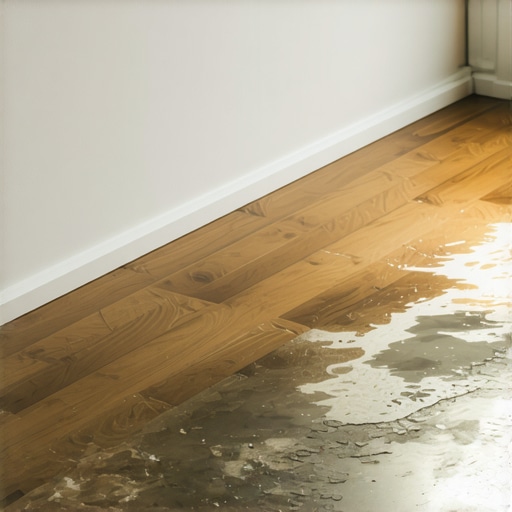
Moisture testing is a non-negotiable step in subfloor preparation that determines the relative humidity of the slab or wood before installation begins. High moisture levels lead to plank swelling, peaking, and the eventual disintegration of the laminate core material. Even if you remove the carpet, the work isn’t done. You need to know if your subfloor is dry. On concrete slabs, I use a calcium chloride test or an in-situ RH probe. If the moisture vapor emission rate is too high, you need a 6-mil poly film as a vapor barrier. When you leave carpet in place, you cannot test the subfloor. You are flying blind. In regions with high humidity like the Gulf Coast, moisture travels through the slab and gets trapped in the carpet. This creates a humid microclimate directly under your laminate. The HDF core will soak up that moisture like a sponge. When HDF absorbs water, it expands. Since the planks are locked together, they have nowhere to go but up. This is called peaking. The edges of the planks push against each other and rise, creating little ridges at every seam. Once peaking starts, it is nearly impossible to reverse. You have to rip it all out. Removing the carpet is the only way to ensure you have a dry, stable surface to build upon.
The checklist for a professional subfloor prep
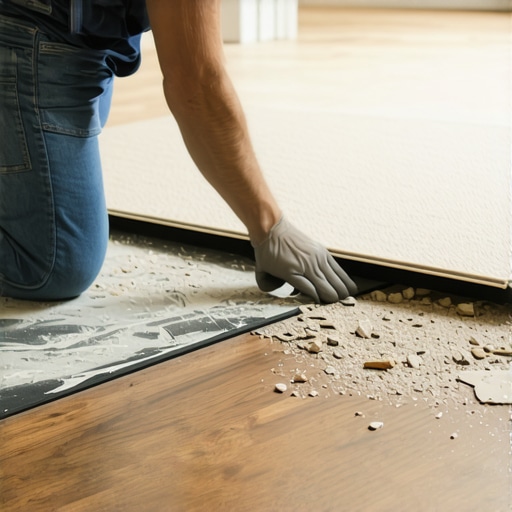
- Strip all existing carpet, padding, and tack strips from the room.
- Pull up all staples or nails used to hold the padding down.
- Vacuum the subfloor three times to remove all grit and organic dust.
- Check the floor for flatness using a 10-foot straightedge or laser level.
- Fill all low spots with a high-compressive strength floor patch.
- Grind down any high spots or ridges in the concrete or wood.
- Perform a moisture test and record the readings for warranty purposes.
- Install the manufacturer-recommended underlayment or vapor barrier.
Vapor barriers and the smell of failure
A vapor barrier is a protective layer, usually made of polyethylene, that prevents moisture from the subfloor from reaching the laminate planks. Proper installation of this barrier is the primary defense against mold and structural warping in hard surface flooring. When you skip the carpet removal, you cannot install a proper vapor barrier. Some people try to lay plastic over the carpet, but that is even worse. You are sandwiching a layer of organic material between two layers of plastic. Any moisture that gets in there will never get out. It will fester. I have seen jobs where the installers didn’t even use a vapor barrier on a concrete slab because they thought the carpet padding was enough. It isn’t. Padding is porous. It allows vapor to pass through. Once that vapor hits the cold underside of the laminate, it condenses into liquid water. This water then sits on the carpet, causing the fibers to rot and the laminate to fail. If you want a floor that doesn’t smell like a damp basement, you have to do the work. It starts with a clean, bare subfloor. You have to respect the chemistry of the materials. Laminate is a fantastic, durable product when installed correctly, but it is unforgiving of laziness. Do not let a contractor tell you it is okay to leave the carpet. They are just trying to get to the next job faster. They won’t be there in two years when your floor is crunching under every step.