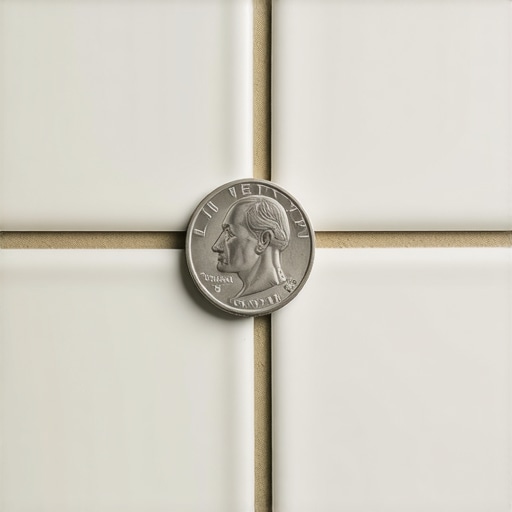
The ‘Dime Test’ for Checking Grout Depth Before Sealing
The hidden physics of the dime test and why your grout lines fail
Most guys skip the leveling compound. They think the underlayment will hide the dip. It won’t. I spent three days grinding concrete on a job last month just so the floor wouldn’t click like a castanet. That same obsession with the subfloor must extend to your grout. If you are staring at a freshly tiled shower and wondering if you are ready to seal, you need a reality check. Grout is not just a filler. It is a structural component of the assembly that manages moisture and prevents tile movement. The dime test is the industry standard for verifying that your grout has cured and recessed to the proper depth, ensuring the sealant actually bonds to the cementitious matrix rather than sitting on top of a damp, overfilled mess.
The 1.35 millimeter threshold that determines shower longevity
Grout depth must be at least one eighth of an inch deep or roughly the thickness of a standard US dime to ensure proper sealant penetration and structural integrity of the tile joint. If the grout is too high, the sealant will fail to form a capillary bond with the aggregate. I have seen countless showers where the installer wiped the grout flush with the tile. This is a rookie mistake. As the grout dries, it naturally shrinks. If it starts flush, it ends up with microscopic ridges that catch soap scum and harbor mold. You want that slight recess. A dime should sit comfortably in the valley of the joint without protruding above the tile edge. This creates a mechanical lock for the sealer.
“A floor is only as good as the subfloor beneath it; deflection is the enemy of every joint.” – Master Flooring Axiom
The chemistry of shrinkage in cementitious bonds
Cementitious grout undergoes a hydration reaction where water molecules bond with Portland cement to create a crystalline structure. As excess water evaporates, the grout volume decreases, leading to vertical shrinkage within the tile cavity. Understanding this chemical shift is why the dime test is performed twenty four hours after installation. If you test too early, the grout is still swollen with moisture. If you test too late and the grout was over-washed during the cleaning phase, you will find the joints are too deep, which leads to standing water and eventual failure of the waterproof membrane. The mechanic knows that the water to powder ratio is the most important variable in the shop. Too much water and you get pinholes. Too little and you get cracking. I have smelled the sour rot of a shower floor that was sealed too early. It is the smell of wasted money.
When floor leveling becomes the silent killer of grout lines
Floor leveling compounds and self-leveling underlayments are the foundation of any ceramic tile or natural stone installation. If the subfloor has a deviation greater than one eighth of an inch over ten feet, the thin-set mortar thickness will vary, causing lippage and inconsistent grout depths. You cannot fix a bad subfloor with grout. I tell my apprentices that if they do not start with a flat slab, they are just polishing a pig. When the floor is uneven, one tile sits higher than the next. You try to use the dime test on those joints and the coin will wobble. That wobble is the sound of a future crack. Whether you are prepping for a shower or a laminate install, the flatness of the substrate is the only thing that matters. I have seen guys try to hide a hump in the concrete with extra padding under a carpet install, but you cannot hide that under 12 by 24 porcelain.
The ghost in the expansion gap
Expansion joints are mandatory per TCNA EJ171 standards to allow for thermal expansion and structural movement in large format tile layouts. Without these movement joints, the grout will eventually tent or spall regardless of how well it was sealed. People think the floor is a static object. It is not. It is a breathing, moving beast. The wood in your walls swells in the summer and shrinks in the winter. If you pack grout tight against the baseboards or the tub flange, something has to give. Usually, it is your expensive grout job. I always leave a quarter inch gap at the perimeter. For laminate, this is common knowledge, but in the tile world, people get lazy. They grout the corners and then act surprised when the grout turns to powder in six months. Use 100 percent silicone in the changes of plane. Grout is for the flats. Silicone is for the moves.
| Grout Type | Minimum Depth | Acclimation Time | Shrinkage Rate |
|---|---|---|---|
| Sanded Grout | 1/8 inch | 24 to 48 hours | High |
| Unsanded Grout | 1/16 inch | 24 hours | Moderate |
| Epoxy Grout | Full Depth | 12 to 24 hours | Near Zero |
| High-Performance Cement | 1/8 inch | 4 to 6 hours | Low |
Why laminate and carpet installers ignore these physics at their peril
Floating floors like laminate and luxury vinyl plank require a subfloor flatness that mirrors the requirements of tile to prevent locking mechanism failure. While they do not use grout, the structural zoom remains the same. If there is a void under a laminate plank, the joint flexes. Over time, that flex snaps the plastic tongue. It is the same reason we check grout depth. We are looking for support. In a carpet install, people think they can get away with murder because the nap hides the sins. But a dip in the floor causes the tack strip to pull or the padding to bottom out. I have walked on carpets that felt like a roller coaster because the installer was too lazy to pour five gallons of leveler. My hands are calloused from fixing these mistakes. Do it right the first time or do not do it at all.
The technical checklist for a successful dime test
- Verify the grout has cured for at least 24 hours in a temperature controlled environment.
- Clean the tile surface of all grout haze to ensure the coin sits flush on the ceramic edge.
- Place a US dime vertically into the grout joint at three foot intervals across the floor.
- Confirm the top of the dime is slightly below or perfectly flush with the highest point of the tile edge.
- Inspect the joint for pinholes or soft spots that indicate a poor water to powder mix ratio.
- Vacuum the joints thoroughly to remove any aggregate dust before applying the first coat of sealer.
“The integrity of the wear layer is secondary to the stability of the substrate; a moving floor is a failing floor.” – Master Flooring Axiom
The 1/8 inch that ruins everything
Grout sealing is the final defensive barrier against staining and water intrusion, but it requires a clean substrate and proper depth to function. If your grout is too shallow, the sealer has nothing to soak into. It just sits on the surface like a film and peels off in the shower. I have seen DIY homeowners try to use a toothbrush to scrub sealer into a joint that was never deep enough to begin with. It is a waste of time. You need that depth to create a reservoir of protection. If the dime sticks up, you need to rake out the joint and redo it. It sounds harsh, but I have seen $20,000 bathrooms destroyed by a $50 bucket of bad grout. You do not want to be the guy calling me to tear it all out because you couldn’t be bothered to use a ten cent coin as a gauge.
The atmospheric reality of the job site
The smell of the job site tells me more than the blueprints ever could. I can smell the alkalinity of the concrete when it is too wet. I can smell the solvents in the sealer when it is being applied in a room with no ventilation. When you are performing the dime test, you should be looking for the details that the average person misses. Look at the way the light hits the grout line. If it is wavy, your thin-set was inconsistent. If it is dark in some spots and light in others, you have moisture trapped in the subfloor. This is why we check the calcium chloride levels before we even think about opening a bag of grout. Flooring is a science of moisture management. If you ignore the science, the floor will eventually punish you. I have seen it a thousand times. The guy who thinks he is faster than the drying racks is the guy who is back on his knees for free six months later. Don’t be that guy. Use the dime. Respect the depth. Seal it once and walk away with your head high.