Is Your 2026 Shower Pan Sloped Wrong? Use This Marble Test
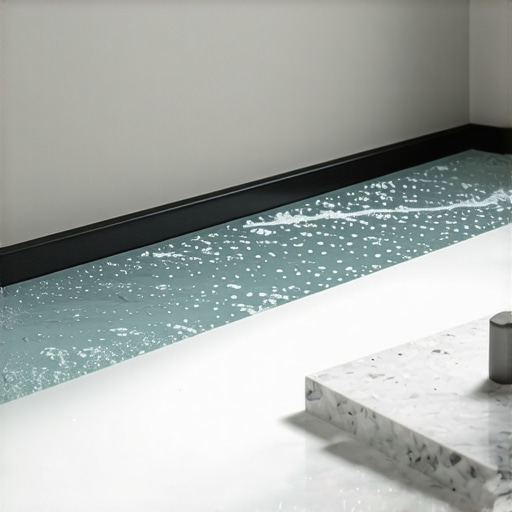
The marble test is a diagnostic procedure where a glass sphere is placed on a finished or waterproofed shower substrate to verify a 1/4 inch per foot slope toward the primary drain. This mechanical check identifies surface tension issues, pooling zones, and negative pitches that violate TCNA B415 requirements for wet area drainage.
I spent three days grinding concrete on a job last month just so the floor wouldn’t click like a castanet. Most guys skip the floor leveling compound because they think the underlayment will hide the dip. It won’t. I recently walked into a high-end master suite where the homeowner had just spent thirty thousand dollars on book-matched marble. The air smelled of damp earth and stale water. I pulled a simple glass marble from my pocket and dropped it near the curb. Instead of racing toward the drain, the marble rolled lazily into the far corner and stopped. That marble told me more in three seconds than the contractor’s laser level did in an hour. The subfloor had deflected under the weight of the mortar bed because the installer failed to calculate the live load capacity of the joists. Now, that beautiful marble has to come up, or the mold will eventually eat the floor joists from the inside out.
The physics of the pitch and why gravity never lies
The standard slope for a shower pan must maintain a vertical drop of one-quarter inch for every horizontal linear foot to ensure kinetic energy overcomes surface tension. This ratio, dictated by the International Residential Code (IRC), prevents stagnant water accumulation which leads to biofilm growth and capillary migration through grout joints into the alkaline mortar bed.
When we talk about the physics of a shower, we are managing fluid dynamics. Water has a natural property called cohesion, where molecules want to stick together. If your slope is too shallow, the weight of the water isn’t enough to break that cohesive bond with the tile surface. You end up with a puddle. If the slope is too steep, you create a slip hazard that turns a morning scrub into a trip to the emergency room. The marble test works because a sphere has a single point of contact, minimizing friction and allowing the gravitational pull to reveal the exact path a water droplet will take. You aren’t just looking for the marble to move, you are looking for its velocity. A marble that accelerates indicates a healthy pitch. A marble that wobbles or wanders suggests an uneven application of the thin-set or a failure in the floor leveling process before the pan was even poured.
“A floor is only as good as the subfloor beneath it; deflection is the enemy of every joint.” – Master Flooring Axiom
The chemical bond between thinset and waterproofing membranes
Polymer-modified thin-set mortars create a chemical and mechanical bond between the waterproofing membrane and the tile underside through a process of crystalline formation. Achieving 95 percent coverage in wet areas is mandatory under ANSI A108.02 standards to prevent hollow spots where moisture can collect and breed anaerobic bacteria.
I see it every day. Installers treat thin-set like glue. It is not glue. It is a cementitious bridge. When you are working with a 2026 shower pan, you are likely using a topical membrane. The chemistry here is delicate. If the mortar bed underneath hasn’t fully cured, the moisture trapped inside can’t escape, leading to a phenomenon called cellular hydration failure. This softens the pan. When you step on the tile, the pan flexes. That flex breaks the bond of the grout. Now, compare this to a carpet install in a bedroom. In a carpet install, you want cushion. You want give. In a shower, any ‘give’ is a death sentence. The marble test should be performed after the membrane is set but before the tile is laid. If the marble finds a flat spot on the membrane, you fix it with a bit more slope. Once the tile is down, your options disappear.
Floor leveling secrets the builder skipped
Self-leveling underlayment (SLU) acts as a high-flow hydraulic cement that creates a monolithic, level substrate for secondary flooring installations. Failure to apply a substrate primer before pouring SLU results in pinholing and bond failure, which eventually causes telegraphing cracks in the finished laminate or tile surface.
| Metric | Minimum Requirement | Industry Standard |
|---|---|---|
| Shower Pitch | 1/8 inch per foot | 1/4 inch per foot |
| Subfloor Deflection | L/360 for Ceramic | L/720 for Natural Stone |
| Thin-set Coverage | 80% (Dry) | 95% (Wet/Shower) |
| Acclimation Time | 24 Hours | 48 to 72 Hours |
If you think you can skip floor leveling because you are just doing a laminate install outside the bathroom, you are dreaming. Laminate is a floating floor. It needs a flat surface to distribute the load across its locking mechanisms. If there is a dip in the subfloor leading up to the shower transition, every time you walk on it, you are pumping air and moisture like a bellows. This drives humidity right into the edge of your shower pan. I have seen the edges of ‘waterproof’ laminate swell like a sponge because the installer didn’t level the transition. You need to use a straight edge that spans at least ten feet. If you see a gap wider than an eighth of an inch, you reach for the leveler. No excuses.
The ghost in the expansion gap
The perimeter expansion gap is a mechanical requirement that allows volumetric changes in the flooring material due to hygroscopic expansion and thermal contraction. Omitting this 1/4 inch space at the vertical wall junction forces the flooring to buckle or tent, compromising the structural integrity of the locking joints.
People hate the look of a gap. They want the floor to run tight against the baseboard or the shower curb. But wood and even some composites are alive. They breathe. In the summer, when the humidity hits eighty percent, those planks are going to grow. If they have nowhere to go, they will push against each other until the weakest point snaps. Usually, that is the tongue of the click-lock system. I once saw a floor that had risen three inches off the subfloor in the middle of the room because the installer pinned it tight at the edges. It looked like a speed bump. This is especially true near showers. The localized humidity is higher there. You need to treat that transition with a high-quality silicone caulk that can compress and expand, not a hard grout that will just crack and fall out the first time the temperature shifts.
Why your subfloor is lying to you
A visual inspection of a plywood or OSB subfloor is insufficient to detect delamination or moisture-induced rot. Professional installers utilize pinless moisture meters to ensure wood subfloor moisture content is within 2 to 4 percent of the finished flooring material to prevent post-installation warping.
- Check the joist spacing to ensure it meets the L/360 deflection limit.
- Verify that all subfloor panels are glued and screwed, not just nailed.
- Sand down any high spots at the seams of the plywood.
- Ensure the moisture barrier overlaps by at least six inches at the seams.
- Vacuum every speck of dust before applying any adhesive or leveler.
Dust is the great bond-breaker. I don’t care how expensive your thin-set is. If you spread it over a layer of drywall dust, you are basically tiling over a layer of talcum powder. It will fail. You need a shop vac and a damp sponge. When I’m prepping a shower for the marble test, the floor has to be clean enough to eat off of. This isn’t about being a neat freak. It is about the chemistry of the bond. The molecules of the thin-set need to interlock with the pores of the substrate. If there is dust in the way, that mechanical interlock never happens. The floor becomes a series of loose plates just waiting for a heavy footstep to pop them loose.
“Standardization of the substrate is the only path to a predictable finish; assume every subfloor is out of spec until proven otherwise.” – Tile Council of North America (TCNA) Guideline Reference
The 1/8 inch that ruins everything
A deviation of 1/8 inch over a ten-foot span can cause lippage, where one tile edge sits higher than its neighbor, creating a tripping hazard and a failing aesthetic. Using a mechanical leveling system during installation ensures that surface planes remain co-planar while the adhesive cures.
While most people want the thickest underlayment, too much cushion actually causes the locking mechanisms on LVP to snap under pressure. It’s counter-intuitive. You think more foam equals more luxury. In reality, it creates a trampoline effect. Every step puts a shear load on the plastic joint. Eventually, the plastic fatigues and breaks. Now you have a floor that creaks and shifts. The same logic applies to the shower pan. If the mud bed is too soft because you used too much sand and not enough portland cement, the marble test might pass on day one, but by day ninety, the pan has settled. The slope is gone. The marble doesn’t roll anymore. You have to be a chemist and a physicist. You measure your water. You measure your ratios. You don’t ‘eyeball’ it. You respect the material, or the material will humiliate you. If you follow the 2026 standards, you are building a vessel that will hold water for fifty years. If you take shortcuts, you are just building a very expensive leak.