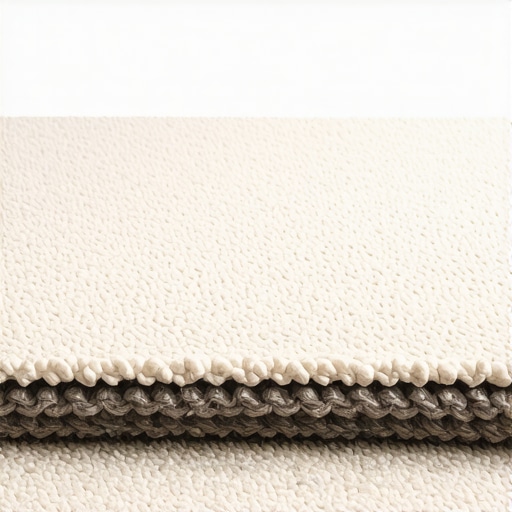
The hidden orientation of cellular foam
Installing a carpet pad upside down compromises the structural integrity of the textile bond. You identify it by checking the scrim side, which must face up to facilitate carpet sliding during the power stretching process. Incorrect placement leads to premature wear and delamination of the primary backing.
I have spent twenty-five years on my knees with a power stretcher and a sharp blade. I have seen the same mistake repeated from the humid coastal builds in Florida to the dry mountain homes in Colorado. Most guys skip the leveling compound. They think the underlayment will hide the dip. It won’t. I spent three days grinding concrete on a job last month just so the floor wouldn’t click like a castanet. That job taught me that even the most expensive broadloom is worthless if the foundation is flawed. If your pad is upside down, your carpet is effectively fighting itself every time you take a step. This is not about aesthetics, it is about the physics of friction and the chemistry of polyurethane foam.
The first sign involves the friction of the scrim
Carpet pad orientation is determined by the scrim layer, a thin mesh or plastic film designed to reduce friction between the carpet backing and the pad. If this side faces the subfloor, the carpet will catch on the raw foam during installation, preventing a tight stretch. This results in ripples and buckling within months of the initial carpet install.
When you look at a roll of 8-pound re-bond pad, you will notice one side has a shiny, almost slippery texture. That is the skin. It is there for a reason. During a professional carpet install, we use a power stretcher to put thousands of pounds of tension on the fabric. If the rough, porous side of the foam is facing up, that secondary backing of the carpet will grab those foam cells like Velcro. You can stretch until your arms give out, but the tension will never distribute evenly. The result is a floor that looks good for a week and then starts to wave like the Atlantic Ocean. You want that carpet to glide over the pad during the stretch, then settle into place. Flip the pad, and you lose that mechanical advantage.
The second sign is the waffle pattern orientation
Waffle rubber padding must be installed with the textured side up to provide the necessary air pockets for vacuum efficiency and impact absorption. Placing the flat side up traps moisture and reduces the Cushioning Factor, leading to a hard, unresponsive floor surface. This is particularly problematic in high-traffic zones where the pad must rebound instantly.
“A floor is only as good as the subfloor beneath it; deflection is the enemy of every joint.” – Master Flooring Axiom
The physics of a rubber waffle pad are different from re-bond. In a waffle pad, those little bubbles are designed to compress and air needs to move. If you put the flat side up, you are creating a seal. When you run a vacuum over that carpet, you are not getting the airflow you need to pull dirt out of the base of the fibers. You are effectively suffocating your carpet. Over time, the dirt stays trapped, acts like sandpaper, and shreds the fibers from the bottom up. I have pulled up twenty-year-old carpets where the pad was upside down, and the amount of silt trapped in the backing was enough to fill a five-gallon bucket. It is a death sentence for high-end nylon or wool.
The third sign is moisture migration from the slab
Moisture barriers on premium carpet pads are directional membranes designed to prevent liquid spills from reaching the subfloor while allowing vapor to escape. If the pad is inverted, the moisture barrier traps ground vapor against the carpet fibers, leading to mold growth and mildew odors. This is a common failure in basement carpet installations or homes with unsealed concrete.
In regions like Houston or New Orleans, the humidity is a constant predator. Concrete is a sponge. It is always breathing out water vapor. Modern pads often have a spill-guard layer on top. This is a polyethylene film that keeps your puppy’s accident from soaking into the foam. However, if you flip that pad, you are now holding that concrete moisture right against the back of your carpet. I have seen $10,000 installations ruined because the installer did not understand vapor drive. The back of the carpet becomes a petri dish. If you walk into a room and it smells like a wet dog even though you do not own a dog, check your pad orientation. The chemistry of the bond will break down, and the latex in the carpet backing will start to rot.
The fourth sign is the sound of the walk
Acoustic dampening relies on the cellular structure of the pad to break up sound waves. When a pad is installed upside down, the impact noise is not properly diffused, resulting in a hollow clicking sound or a crunching noise similar to walking on dry leaves. This is especially noticeable in multi-family housing where IIC ratings are strictly enforced by building codes.
Sound is just vibration. In a proper 8-lb density re-bond pad, the foam cells are packed to absorb that energy. But there is a specific density gradient in how these pads are manufactured. The top skin helps distribute the weight of a footfall across a wider area of foam. If the soft side is up, your heel sinks in too fast and hits the subfloor with more force. It sounds different. I can walk across a room and tell you if the installer was lazy. It feels mushy instead of firm. It is the difference between walking on a high-quality athletic track and walking through a swamp. You want the floor to support you, not swallow you.
The fifth sign is uneven wear patterns
Premature fiber crushing occurs when the carpet pad does not provide uniform support. An inverted pad causes the carpet backing to stretch unevenly, leading to visible paths in hallways and entryways. This wear is irreversible and often voids the manufacturer warranty for both the carpet and the underlayment.
Look at your hallways. If the carpet looks dead and flat after only a year, and you bought a decent face-weight, the pad is the prime suspect. I often see people spend all their money on the carpet and buy the cheapest pad available. Or worse, they buy good pad and let a cut-rate installer throw it down. If that pad is upside down, the friction between the carpet and the pad is all wrong. The carpet moves too much underfoot. That movement creates heat. That heat, combined with the grit that cannot be vacuumed out, melts the synthetic fibers. It is a slow-motion car crash for your flooring investment.
Subfloor preparation requirements for 2026
Before you even think about the pad, you have to look at the bones of the house. A subfloor must be flat within 1/8 inch over a 10-foot radius. I see guys trying to install over old adhesive or dips in the plywood. That is garbage work. If you are moving from a carpeted area to a bathroom with showers, you need to ensure the transition is level. You cannot just ramp it up with extra padding. That creates a trip hazard and a point of failure for the carpet tack strip.
| Pad Property | Correct Orientation (Face Up) | Incorrect Orientation (Face Down) |
|---|---|---|
| Scrim Layer | Allows carpet to glide for stretching | Creates friction and bunching |
| Spill Guard | Keeps liquids out of the foam | Traps subfloor moisture in the carpet |
| Cellular Structure | Distributes weight evenly | Causes localized fiber crushing |
| Airflow | Maximized for vacuuming | Restricted, leading to dirt buildup |
Carpet installation checklist for homeowners
- Verify that the subfloor is clean, dry, and level to within 1/8 inch.
- Ensure the padding is the correct density, at least 8 lbs for residential use.
- Check that the shiny scrim side of the pad is facing the ceiling.
- Confirm that the pad seams are taped with a high-quality moisture-resistant tape.
- Observe the power stretching process to ensure no ripples remain.
- Inspect transitions to laminate or tile for flush heights.
The relationship between carpet and laminate subfloors
Many homeowners are switching between laminate and carpet in different rooms. The floor leveling requirements for laminate are even stricter than for carpet. If you have a dip in the floor that you didn’t fix before putting down carpet, you will definitely have to fix it before installing laminate. Carpet is forgiving for a few months, but eventually, that dip will show. Laminate will just snap at the tongue and groove. Treating every floor like it is a structural engineering project is the only way to ensure it lasts thirty years instead of three. I do not care how pretty the color is if the locking mechanism fails or the pad rots from underneath. Do it right the first time or do not do it at all.
http://Maggie%20Carter
I found this detailed breakdown of carpet pad orientation really insightful, especially since many homeowners might overlook the importance of facing the right side up. From my experience remodeling older homes, I’ve seen how flipped pads can cause uneven wear and mold issues over time. The point about moisture migration struck a chord with me—I once dealt with a basement carpet where trapped moisture led to nasty odors and fiber rot, which was heartbreaking after investing so much. The article’s mention of the impact on acoustic dampening was also eye-opening; I hadn’t considered how flipping the pad could make the floor feel hollow or unresponsive. It makes me wonder—when homeowners install carpet themselves, what are some common quick checks they can do to ensure they’re placing the pad correctly, especially if they’re not professional installers? I’d love to hear others’ tips on simple ways to verify proper pad installation to prevent these issues from the start.