How to fix a laminate plank that is bowing upward
The physics of the laminate buckle
A laminate plank bows upward because the material has expanded beyond the available perimeter space or is trapped by heavy objects. This creates vertical tension that forces the boards to lift at the joints. Fixing it requires restoring the expansion gap or relieving the pressure points.
Listen. I do not care if the box says the floor is waterproof or if the salesman told you it is indestructible. I have spent twenty-five years with sawdust under my nails and a level in my hand. I have seen thousands of feet of flooring. Laminate is not a rug. It is a mechanical system of high-density fiberboard and resin. When the humidity in your house shifts, that floor moves. It breathes. If you do not give it room to breathe, it will fight you. Most people call me when the floor starts clicking or when a peak forms in the middle of the hallway. They think the floor is defective. It is almost never the floor. It is the installation. I once walked into a house where a homeowner had installed twelve hundred square feet of laminate without a single transition strip. The whole floor was one giant sheet. When the summer humidity hit, the floor buckled so hard it lifted a coffee table. They locked it under a heavy kitchen island, killing the floor ability to move. That is a death sentence for laminate. You cannot pin a floating floor. It must be allowed to float or the physics of expansion will win every single time.
The ghost in the expansion gap
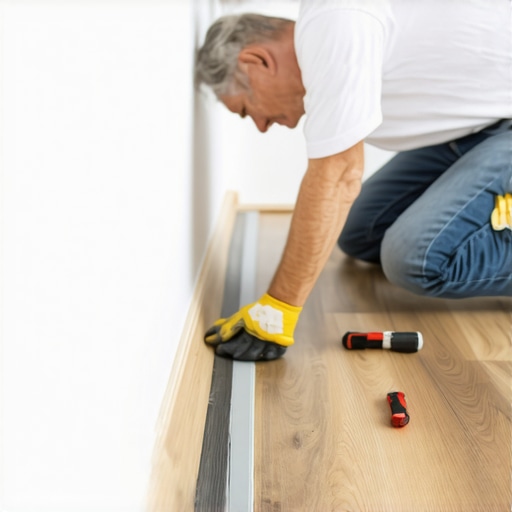
The expansion gap is the empty space left between the edge of the flooring and the wall or any fixed object. For most laminate products, this gap should be at least one quarter inch to three eighths of an inch. Without it, the floor hits the wall and bows.
When we talk about expansion, we are talking about the molecular reality of wood fibers. Laminate cores are made of HDF which stands for High Density Fiberboard. These are tiny wood particles bonded with resins like melamine-formaldehyde. Wood is hygroscopic. It wants to reach an equilibrium moisture content with the air around it. When the air is wet, the fibers absorb water molecules through hydrogen bonding. The cell walls of the wood fiber actually swell. If you have a twenty foot run of flooring and every board expands by just a hundredth of an inch, you suddenly have a floor that is nearly a quarter inch wider than it was in the winter. If your gap at the wall is only an eighth of an inch, those boards have nowhere to go. They hit the drywall or the baseboard and the pressure builds. Eventually, the weakest point in the system gives way. That weak point is usually the tongue and groove locking mechanism. The boards push against each other and lift off the subfloor, creating a bridge. You walk on it and it feels bouncy. That is the floor warning you that it is under extreme stress. You need to pull the baseboards and check the perimeter. If the floor is touching the wall anywhere, that is your culprit. You need to cut that gap back.
“A floor is only as good as the subfloor beneath it; deflection is the enemy of every joint.” – Master Flooring Axiom
Why your subfloor is lying to you
Subfloor flatness is the foundation of a successful laminate installation and must not deviate more than one eighth of an inch over a ten foot radius. If the subfloor has a high spot or a hump, the laminate will bow as it passes over it.
Most guys skip the leveling compound. They think the underlayment will hide the dip. It will not. I spent three days grinding concrete on a job last month just so the floor would not click like a castanet. If your subfloor is not flat, the locking mechanisms are constantly under a shearing force. When you walk across a hump, the planks are forced to bend. Laminate is stiff. It does not like to bend. If the hump is significant, the plank will naturally want to straighten itself out, which results in the board bowing upward away from the subfloor. This is especially common in older homes with plywood subfloors that have settled or in new builds where the concrete slab was poured too fast and has a birdbath or a ridge. You have to use a long straightedge. If you see light under that level, you have work to do. Do not trust the padding to fix a structural problem. It is like putting a band-aid on a broken leg. You must address the substrate before the first plank ever clicks into place.
| Material Type | Expansion Rate | Moisture Tolerance | Subfloor Requirement |
|---|---|---|---|
| Standard Laminated HDF | High | Low | 1/8 inch over 10 feet |
| Water-Resistant Laminate | Moderate | Medium | 1/8 inch over 10 feet |
| Stone Plastic Composite | Low | High | 3/16 inch over 10 feet |
| Solid Hardwood | Extreme | Very Low | Strict NWFA Standards |
The kitchen island trap
A floating floor must never be pinned down by heavy cabinetry, kitchen islands, or built-in bookshelves. These items act as anchors that prevent the floor from sliding during thermal or moisture-related expansion. This restriction causes the floor to buckle in the center of the room.
This is the most common mistake I see in modern open-concept homes. People want that beautiful floor to run under their cabinets. They think it looks cleaner. But here is the reality. A kitchen island can weigh several hundred pounds. When you set that on top of a floating floor, you have essentially glued that section of the floor to the spot. When the rest of the floor tries to expand or contract, it is being pulled against that anchor. It is like trying to run while someone is holding your shirt. Something is going to tear or break. In the case of laminate, the floor will buckle or the joints will snap. The correct way is to install the island first, then install the floor around it, leaving the proper expansion gap and covering it with a trim piece. If you already have an island on top of your bowing floor, you might have to perform surgery. You can use a toe-kick saw to cut the floor around the perimeter of the island. It is a messy job, but it is the only way to save the rest of the installation. A floating floor needs to be exactly that. Floating.
The humidity factor in basements and showers
High humidity environments like basements or areas near showers can saturate the HDF core of laminate flooring, leading to irreversible swelling and bowing. Managing the ambient environment is as important as the installation itself.
If you are putting laminate near a bathroom with a shower, you are playing with fire. The steam from a hot shower is essentially pressurized moisture. It gets into the joints and penetrates the core. Once the HDF core of a cheap laminate board gets wet, it is like a sponge. It swells and it never goes back to its original size. I have seen guys try to fix this by putting heavy weights on the floor. That does nothing but hide the problem for an hour. You have to control the air. Use a dehumidifier in the basement. Make sure your bathroom fan is actually venting to the outside and not just spinning air in the attic. If the floor has already bowed due to moisture damage, the integrity of the locking system is likely compromised. You can try to dry it out with fans, but often the only real fix is to replace the affected planks and find a way to seal the joints better next time. Use a 100 percent silicone sealant in the expansion gaps in wet areas. It stays flexible and keeps the water out of the edges where the floor is most vulnerable.
A checklist for troubleshooting a bowing floor
- Check the perimeter for expansion gaps at every wall and doorway.
- Inspect door casings to ensure the floor was not pinched during installation.
- Verify that no heavy furniture or cabinetry is pinned to the floor.
- Measure the relative humidity of the room to ensure it is between 35 and 55 percent.
- Use a straightedge to check for subfloor humps or debris under the planks.
- Remove the baseboards to see if the floor is tight against the drywall.
The solution for a pinched plank
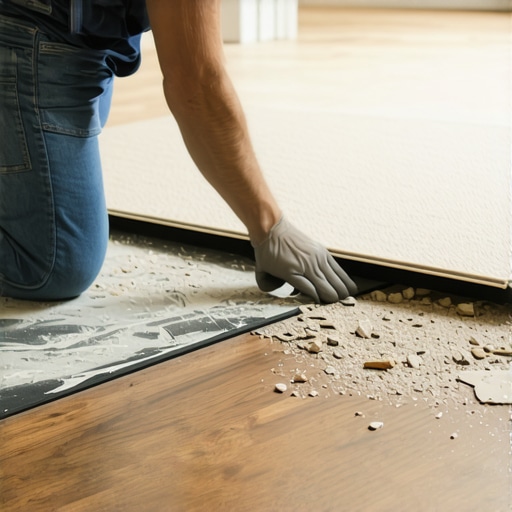
If you find a spot where the floor is touching the wall, you can use a oscillating multi-tool to trim the edge of the laminate while it is still on the floor. This creates the necessary space for the floor to drop back down into a flat position.
Sometimes you do not have to rip the whole floor up. If the bow is caused by a pinch point at a door frame or a vent, you can be surgical. Take your multi-tool with a wood-cutting blade. Carefully trim back the plank where it is hitting the obstruction. You want to see daylight between the floor and the wall. Once the pressure is released, the bow might not disappear instantly. It has been under tension for a while. It might take a few days for the boards to relax and settle back down. You can help it along by walking on it or placing a few boxes of flooring on the spot to encourage it to lie flat. But remember, if the bow was caused by a subfloor hump, trimming the edges will not help. You have to know what you are looking at. I have seen people cut their whole perimeter only to realize the floor was bowing because there was a forgotten carpet staple sticking up from the plywood. Details matter. In this business, the difference between a floor that lasts thirty years and one that lasts three months is usually about an eighth of an inch.
“Laminate flooring expansion is a function of thermodynamic reality; you cannot argue with a board that needs more room.” – Master Flooring Axiom
The contrarian truth about underlayment
While most people want the thickest underlayment available for comfort, too much cushion actually causes the locking mechanisms on laminate to snap under pressure. A thin, high-density underlayment is superior for floor stability and long-term performance.
Everyone wants that soft, squishy feel under their feet. They buy the thickest foam they can find. They think it will make the floor feel like carpet. It is a massive mistake. When the underlayment is too soft, the floor deflects too much every time you take a step. Think about the tongue and groove. It is a tiny piece of pressed wood. If the floor sinks a quarter inch every time you walk on it, that joint is bending and flexing. Eventually, it fatigues and snaps. Once the joint is broken, the boards start to separate and bow. You want an underlayment that has a high compression strength. It should feel firm. Its job is to provide a moisture barrier and a slight sound dampening effect, not to act as a mattress. If your floor is bowing and it feels like a trampoline when you walk on it, you probably used the wrong padding. There is no easy fix for that except to pull it all up and start over with the right materials. It is a hard lesson, but the physics of the joint do not care about your comfort. They care about support.