The ‘Ice Cube’ Trick for Removing Heavy Furniture Dents from Your Carpet
The Ice Cube Trick for Removing Heavy Furniture Dents from Your Carpet
I have spent twenty five years watching people ruin perfectly good flooring because they do not understand the physics of the materials they walk on. Most guys skip the leveling compound. They think the underlayment will hide the dip. It won’t. I spent three days grinding concrete on a job last month just so the floor wouldn’t click like a castanet. When you put a heavy sofa on a carpet, you are not just pushing down the fluff. You are engaging in a mechanical compression of the polymer chain that requires more than a simple vacuuming to reverse. I am tired of seeing homeowners buy cheap polyester from a big box store and then wonder why it looks like a matted mess after six months. If you want a floor that lasts, you have to treat it like an engineered system. The ice cube trick is a classic because it relies on the slow release of moisture and the thermal expansion of fibers, but it is not a magic wand for every situation. You need to understand what is happening at the subfloor level before you start dumping water on your investments.
The molecular reality of crushed synthetic fibers
Crushed carpet fibers represent a state of structural deformation where the internal polymer bonds have been forced into a new and compressed geometry under heavy loads. Recovery requires moisture and heat to reset the hydrogen bonds within the nylon or polyester strands to their original vertical orientation and height. When a heavy dresser sits on a carpet for five years, the weight forces the air out of the fiber gaps. It also collapses the secondary backing of the carpet. Most retail carpet is made of Nylon 6 or Nylon 6,6. These are long chain polymers. When you compress them, the molecules are pushed closer together. The friction between the fibers actually creates a set in the material. This is similar to how a crease stays in a pair of pants. If the carpet install was done correctly, the tension across the room helps the fibers stand up, but localized pressure overrides that tension. I have seen guys try to steam these out with a professional iron and melt the backing. That is a disaster. You have to be surgical. You have to be patient. Most people want an instant fix but the chemistry of the polymer does not work that way. It took years to crush those fibers. It will take more than a second to bring them back to life. You are essentially trying to re-inflate the molecular structure of the plastic without melting the bond that holds the carpet together.
Why a frozen water molecule restarts the pile
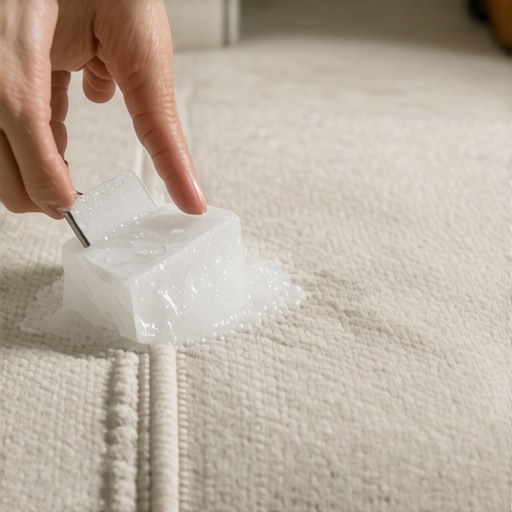
The ice cube trick works through controlled capillary action and the slow absorption of water into the core of the carpet fiber. As the ice melts, it provides a consistent and cold moisture source that prevents the carpet backing from becoming oversaturated while allowing the fibers to swell. If you just pour a cup of water on a dent, the water rushes past the fiber and hits the pad. This creates a mold risk. An ice cube is a slow release mechanism. It sits on top of the crushed pile. As it melts, the water is drawn into the thirsty, compressed fibers by capillary action. This is the same principle that moves water up the stem of a plant. The cold temperature is also important. Heat can sometimes lock a synthetic fiber into its new, crushed shape if it is applied too aggressively. Cold water allows the fiber to expand naturally as it absorbs the liquid. Once the fiber is saturated, it loses the mechanical memory of being crushed. It becomes pliable. I have had customers tell me they tried using a hair dryer first. That is usually when I get the call to replace the section because they scorched the nylon. You cannot rush the physics of moisture absorption. You have to let the water do the heavy lifting at the molecular level.
“A floor is only as good as the subfloor beneath it, deflection is the enemy of every joint.” – Master Flooring Axiom
The invisible danger of moisture reaching the pad
Excessive moisture during carpet repair can penetrate the primary and secondary backing, leading to the degradation of the SBR latex adhesive and the growth of microbial colonies within the polyurethane foam pad. Controlling the volume of liquid is essential to protect the structural integrity of the subfloor. This is where the amateurs mess up. They think if one ice cube is good, then a bucket of water is better. If that water hits your subfloor, especially if you have a plywood or OSB base, you are looking at swelling. If you have a concrete slab that was not properly sealed, you are feeding the moisture vapor that lives in the concrete. I always tell my crews that we are not just installers, we are moisture managers. Every carpet install should include a discussion about the subfloor condition. If you are doing this on a laminate floor transition, you have to be even more careful. Laminate is basically high density fiberboard which is essentially a sponge for water. If your ice cube melts and the water runs off the carpet onto the laminate, you will see the edges peak. Then you are calling me to replace the whole room. You have to contain the moisture. Use a small towel to create a barrier around the dent if you are near a hard surface transition. This is not just about the carpet pile, it is about the entire assembly of the floor.
Comparing carpet resilience across industrial grades
Different carpet materials respond uniquely to pressure and moisture based on their chemical composition and the way the yarn is twisted and heat set. Understanding these differences is the first step in successful floor maintenance and long term durability within any residential or commercial space. Below is a comparison of how different materials handle the mechanical stress of furniture weight.
| Fiber Type | Resilience Rating | Ice Cube Effectiveness | Moisture Absorption |
|---|---|---|---|
| Nylon 6,6 | High | Excellent | Medium |
| Polyester (PET) | Low | Poor | Low |
| Wool | High | Good | High |
| Olefin | Very Low | Very Poor | None |
As you can see, if you bought cheap Olefin or Polyester, the ice cube trick might not do much. Those fibers have poor memory. Once they are crushed, they stay crushed. Nylon 6,6 is the gold standard for a reason. It has a high glass transition temperature and excellent elastic recovery. If you are shopping at a big box store, they will try to sell you on the softness of polyester. Do not listen to them. Softness is a trap. Softness usually means the fiber is thin and lacks the structural backbone to stand up to a sofa leg. I always tell people to look at the twist of the yarn. A tight twist means the fiber is more likely to bounce back. When I do a carpet install, I make sure the customer knows that their choice of fiber determines their maintenance schedule for the next decade. You get what you pay for in this business.
How to execute the restoration without ruining the backing
Following a strict protocol for carpet dent removal ensures that the fibers are revived without damaging the delicate latex bonds that hold the tufts in place. Precision and patience are the primary tools required for a professional grade restoration of the floor surface pile. Use this checklist to ensure you do not turn a small dent into a large permanent stain or structural failure.
- Identify the fiber type to ensure it can handle moisture without shrinking or browning.
- Vacuum the area first to remove any loose debris that could be ground into the fibers.
- Place a single ice cube in the center of the furniture dent and leave it for several hours.
- Blot up excess moisture with a clean white cotton towel once the ice has melted completely.
- Use a dull spoon or a carpet groomer to gently lift the fibers back into a vertical position.
- Allow the area to air dry naturally without applying direct high heat from a blow dryer.
- Vacuum again once the area is dry to blend the pile with the surrounding carpet.
If you follow these steps, you are working with the material instead of against it. The use of a white towel is vital. If you use a dyed towel, the moisture can cause the dye to transfer into your carpet. I have seen beautiful cream colored carpets ruined by a red shop rag. It is a rookie mistake that costs thousands. Also, do not use a sharp knife to lift the pile. You will cut the fibers and create a bald spot. A spoon is the best tool for this job. It has the right radius to lift without shearing. You are trying to coax the fiber back, not force it.
“Deflection in the subfloor will telegraph through any finished surface, making even the best materials look like a failure.” – Master Flooring Axiom
When the subfloor determines the outcome of your repair
A subfloor that is out of level will cause furniture weight to be distributed unevenly, leading to deeper and more permanent indentations in the carpet and pad. Proper floor leveling is a prerequisite for any installation that intends to remain aesthetically pleasing and structurally sound. If your house has a settling issue, your furniture is not sitting flat. One leg might be carrying sixty percent of the weight. That concentrated force will crush the carpet and the pad into the subfloor. No amount of ice cubes will fix a dent where the pad has been completely pulverized. This is why I am obsessed with floor leveling. If I see a dip in the subfloor during a carpet install, I stop. I pull out the level and the patching compound. Most installers will just roll the carpet over the dip. They say it is just carpet. I say it is a failure waiting to happen. If you have a dip, the carpet will bridge that gap. When you walk on it, or put a chair on it, the carpet stretches more than it was designed to. This weakens the backing. Eventually, the carpet will delaminate. Then you have a wrinkle that you can never get out. A flat subfloor is the foundation of a good repair.
The relationship between carpet installs and floor leveling
Integrating floor leveling into the carpet installation process prevents common post installation issues such as premature wear patterns and deep furniture tracking. A flat surface ensures that the carpet pile and padding work together to distribute loads effectively across the entire room. People think leveling is only for tile or showers. That is a lie. If you are installing laminate or even a heavy carpet, the substrate must be flat to within three sixteenths of an inch over a ten foot radius. If it is not, the floor moves. Movement leads to friction. Friction leads to heat. Heat leads to fiber breakdown. I have been in houses where the carpet feels crunchy. That is often because the carpet is rubbing against a rough or uneven concrete subfloor. When you are dealing with moisture like the ice cube trick, an uneven floor can also cause the water to pool in one spot instead of staying in the dent. This increases the risk of mold. I always check the perimeter expansion gaps too. If the carpet is tucked too tight or not tight enough near the baseboards, the tension is wrong. Everything in a floor is connected. You cannot change one thing without affecting the others.
Transitioning from soft goods to laminate or showers
Transitions between different flooring types such as carpet and laminate require careful planning to manage height differentials and moisture barriers. Each surface has a unique expansion coefficient and must be treated as an independent mechanical system during the installation phase. When I am finishing a carpet install that meets a shower area or a kitchen with laminate, I am looking at the thresholds. If you use the ice cube trick near a transition, you have to be careful about the track. Most carpet tracks are made of aluminum or steel. If they get wet and are not dried, they can rust or corrode. This leaves a permanent orange stain on your carpet. In showers, the moisture levels are already high. If your carpet is right up against a tile entry, it is already fighting a battle with humidity. You do not want to add more water to that area unless you have to. I always recommend a solid stone or tile threshold for showers to create a definitive moisture break. This protects the carpet from the constant humidity of the bathroom. If you have laminate, make sure your transition molding is properly seated. A loose molding will allow water from your carpet cleaning efforts to seep under the laminate and cause the core to swell. It is all about the details. If you miss the small stuff, the big stuff will fail every time. Do not be the person who ruins a five thousand dollar floor because you were too lazy to use a towel. Take your time and do it right. Your floor will thank you for it twenty years from now.