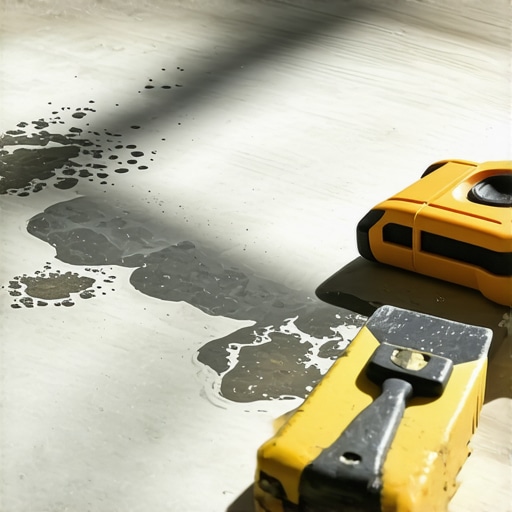
The hidden reality of subfloor prep
Most guys skip the leveling compound. They think the underlayment will hide the dip. It won’t. I spent three days grinding concrete on a job last month just so the floor wouldn’t click like a castanet. I walked into that house smelling like oak dust and WD-40, knowing exactly what I would find. The homeowner had tried to DIY a self-leveling pour over a slab that was as thirsty as a desert. The result was a landscape of craters and bubbles that looked more like the moon than a subfloor. If you are prepping for a laminate or carpet install, you cannot ignore the physics of the pour. A floor is only a performance surface if the foundation is stable. When I see bubbles in a 2026-grade polymer-modified leveler, I know the installer ignored the chemistry of the slab. It is not just a cosmetic issue. It is a structural failure that will snap the locking mechanisms on your planks. You cannot hide a bad pour under thick padding. It will crunch. It will move. Eventually, it will break.
The invisible breath of concrete slabs
Floor leveler bubbles are primarily caused by outgassing from a porous concrete substrate that has not been properly sealed. When wet self-leveling underlayment hits a dry, porous slab, air trapped in the concrete capillaries is forced upward. This air creates pinholes or larger craters as the leveler begins to set, compromising the integrity of the surface. You must treat the concrete as a living, breathing entity that needs to be choked off before you pour. This is especially true in showers where moisture levels are high. If you do not seal those pores, the air will escape. It has nowhere to go but up. I have seen guys lose thousands on a single pour because they thought they could save sixty minutes on the primer stage. You cannot. The concrete will win every time.
“A floor is only as good as the subfloor beneath it; deflection is the enemy of every joint.” – Master Flooring Axiom
Why your primer is failing the bond test
Improper primer application is the second leading cause of bubbling in floor leveling projects. If the primer is spread too thin, puddled in low spots, or not allowed to reach a tacky state, it fails to create a moisture-proof barrier. In 2026, we use advanced acrylic and epoxy primers that require precise dilution ratios and specific atmospheric conditions to bond effectively. I have seen installers dump primer on a dusty floor and wonder why it did not stick. Dust is the enemy of the bond. You need to vacuum that slab until you can sit on it without getting your pants dirty. If the primer does not form a continuous film, the leveler will react with the raw concrete and create a chemical fizz. This is why your floor leveling looks like Swiss cheese. You need to use a soft-bristled push broom to work that primer into the pores. Do not just roll it on like paint. Scrub it in. Let it dry until it is clear and tacky. If it is still wet, the leveler will mix with it and fail. If it is too dry and dusty, it will peel.
The chemistry of high speed mixing errors
Excessive mixing speeds introduce air directly into the liquid leveler, leading to surface bubbles once the product is poured. When you use a high-RPM drill with the wrong paddle, you are essentially whipping meringue. This trapped air cannot escape the viscous liquid before it starts to gel. I always use a heavy-duty, low-speed mixer specifically designed for cementitious products. You want to see a vortex, not a whirlpool of foam. The water ratio is also a non-negotiable factor. If you add even a cup too much water, you change the molecular weight of the mix. The heavy aggregates sink to the bottom while the water and fine polymers rise to the top. This creates a weak, chalky surface that will bubble and flake. It is a chemistry project, not a cooking show. Follow the bag instructions to the milliliter. If the bag calls for 5.2 quarts, do not give it 5.5. You are asking for a failure that will haunt your carpet install for years.
| Material Property | Standard SLU | High-Flow 2026 Formula | Fiber-Reinforced Patch |
|---|---|---|---|
| Working Time | 15-20 mins | 30-40 mins | 10-15 mins |
| Compresive Strength | 3500 PSI | 5500+ PSI | 4000 PSI |
| Outgassing Risk | High | Moderate | Low |
| Max Thickness | 1.5 inches | 5 inches | 0.5 inches |
Structural requirements for showers and wet areas
Installing floor leveler in wet environments requires a specialized approach to prevent moisture-induced bubbling. In areas like showers, the leveler must be rated for submerged or high-moisture use and usually requires a waterproof membrane on top. Many installers make the mistake of using a standard gypsum-based leveler in a bathroom. This is a recipe for disaster. Once moisture hits that gypsum, it turns back into mud. You need a Portland cement-based product with high polymer content. This prevents the leveler from re-emulsifying. It also creates a denser matrix that resists the passage of water vapor. I have ripped out enough moldy bathrooms to know that cutting corners here is a crime. Use a perimeter isolation strip to allow for the expansion of the slab. If you lock the leveler against the wall, it will crack as the house moves. This is basic engineering. Do not fight the physics of the building.
- Vacuum the substrate twice to remove all micro-dust particles.
- Measure water with a calibrated container, never by eye.
- Apply two coats of primer if the concrete is exceptionally old or porous.
- Use a spiked roller immediately after pouring to release trapped air.
- Maintain a consistent room temperature between 65 and 75 degrees.
Carpet installation on compromised subfloors
Even soft surfaces like carpet require a level subfloor to prevent premature wear and unsightly transitions. People think carpet hides everything. It does not. If your leveler bubbled and you just threw padding over it, you will feel those bumps every time you walk barefoot. Those bubbles will eventually crush under foot traffic, creating hollow spots and crunching sounds. This is especially true for the low-pile commercial carpets popular in modern designs. If you want a professional finish, you have to fix the bubbles. Take a cold chisel and a hammer. Pop the bubbles. Fill the craters with a high-quality feather finish patch. It takes an extra hour. It saves you a decade of regret. My reputation is built on the things people do not see. They do not see the leveler, but they feel the stability of the floor. That is the difference between a pro and a hack. While most people want the thickest underlayment, too much cushion actually causes the locking mechanisms on LVP to snap under pressure. The same logic applies to leveler. It needs to be a rock-solid, flat base. No exceptions. No shortcuts. Just a floor that performs exactly how it was engineered to do.