The ‘Feather Edge’ Secret for Perfectly Smooth Flooring Transitions
The smell of floor wax and sawdust is a permanent part of my skin. Most people see a floor as a pretty surface, a color on a sample board, or a texture under their feet. I see it as a structural challenge. Most guys skip the leveling compound. They think the underlayment will hide the dip. It won’t. I spent three days grinding concrete on a job last month just so the floor wouldn’t click like a castanet. That job was supposed to be a simple laminate install, but the subfloor was a mountain range of peaks and valleys. If I had just laid the planks, the locking mechanisms would have snapped within six months. That is the reality of this trade. A floor is only as good as the subfloor beneath it, and the secret to a professional finish is not in the planks themselves but in the feather edge transitions you create before the first piece of flooring even touches the ground.
Why your subfloor is lying to you
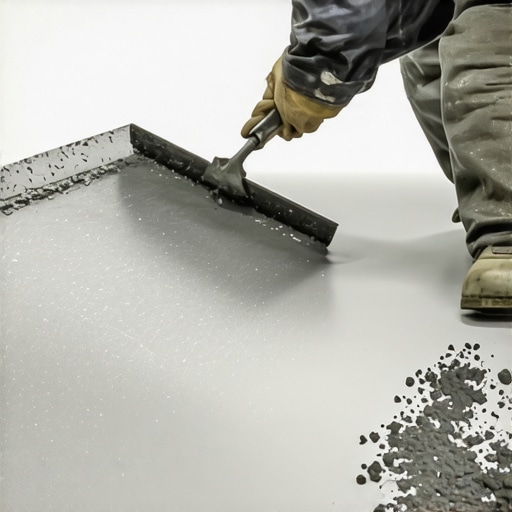
Subfloor flatness is different from subfloor levelness and ignoring the 1/8 inch deviation over a ten foot radius will result in joint failure, hollow sounds, and structural fatigue in LVP, laminate, and hardwood. You walk across a room and it feels solid. You look at it and it looks flat. It is lying to you. Gravity and the settling of a house create micro-dips that the naked eye cannot see. When you install a modern click-lock floor over these dips, the floor flexes. That flex creates air movement, which sounds like a ticking or clicking. Over time, that repetitive stress fatigues the plastic or wood locking tongue. It eventually shears off. To fix this, you must master the feather edge. This involves using a high-grade, polymer-modified cementitious patch to bridge the gap between two different heights or to smooth out a valley in the concrete. We are talking about taking a 1/4 inch offset and stretching it over three to four feet so the transition is imperceptible to the human foot.
“A floor is only as good as the subfloor beneath it; deflection is the enemy of every joint.” – Master Flooring Axiom
The 1/8 inch that ruins everything
Floor leveling requires a straightedge and Portland cement patch to ensure substrate integrity before a carpet install or laminate application. If you have a dip deeper than 1/8 of an inch, your floor is at risk. This is especially true in transitions between rooms. Imagine moving from a thick 3/4 inch solid oak floor into a kitchen with new laminate. The height difference is massive. You cannot just put a bulky T-molding there and call it a day. That is the mark of a hack. A master uses a feather edge compound to build a ramp. This ramp must be long. If the height difference is 1/2 inch, your ramp should be at least 48 inches long. This creates a slope so gradual that the transition feels flat. The chemistry of these compounds is vital. You need a product with high polymer content that can bond to the subfloor at a thickness of literally zero. That is why it is called a feather edge. It tapers down to nothing without cracking or peeling away from the substrate.
| Substrate Type | Required Preparation | Maximum Deviation | Recommended Patch |
|---|---|---|---|
| Concrete Slab | Grinding and pH testing | 1/8 inch per 10 feet | Polymer-modified cement |
| Plywood / OSB | Sanding joints and screw check | 3/16 inch per 10 feet | Fiber-reinforced patch |
| Existing Tile | Deglossing and priming | 1/8 inch per 10 feet | High-bond feather finish |
The ghost in the expansion gap
Expansion gaps are the breathing room for floating floors and laminate to prevent buckling or peaking during humidity shifts. People think the floor is static. It is not. It is a living, moving entity. Wood and laminate expand when the humidity rises. If you shove a floor tight against a transition or a wall, it has nowhere to go. It will lift. It will hump up in the middle of the room. This is the ghost that haunts bad installations. When creating a feather edge transition, you must still respect the expansion gap. You are leveling the ground, not locking the floor in place. The feathering compound provides a smooth plane so the floor can slide back and forth as it breathes. If the subfloor is rough or uneven at the transition, the floor will catch on the bumps. This friction prevents movement and leads to the same buckling issues as a lack of expansion gaps. Use a siliconized transition strip if necessary, but keep that subfloor smooth as glass.
- Check subfloor moisture with a pinless meter before starting.
- Sweep and vacuum the substrate three times. Dust is the enemy of adhesion.
- Mix the feathering compound to a peanut butter consistency for vertical stability.
- Use a 12-inch or 24-inch steel trowel to pull the material thin.
- Sand the edges of the patch once dry to ensure no ridges remain.
The chemistry of the bond
The molecular reality of a feather edge transition is fascinating. Standard concrete mix has large aggregates. You cannot feather standard concrete because the rocks get in the way. Feathering compounds use micro-aggregates and advanced polymers like vinyl acetate-ethylene. These molecules create a bridge. They hook into the microscopic pores of the concrete or the cellulose fibers of the wood. This is why you cannot just use