Why Your Kitchen Refrigerator Is Crushing Your Laminate Edges
Homeowners always ask why their waterproof vinyl or laminate is buckling. Usually, it is because they locked it under a heavy kitchen island or a massive refrigerator, killing the floor’s ability to breathe. I once walked into a kitchen where the floor looked like a rolling mountain range. The owner had just installed a high-end French door fridge. The weight of that appliance, combined with a subfloor that was about as level as a gravel road, had literally sheared the locking mechanisms right off the planks. You could hear the floor clicking and groaning with every step. It was a classic case of ignoring the physics of floating floors. My boots were covered in white dust from the previous job, and the smell of WD-40 on my toolkit filled the room as I told them the hard truth. Their floor was toast because they treated a structural installation like a weekend craft project.
The physics of the heavy appliance lock
A floating floor must move as a single unit to accommodate changes in temperature and humidity. When a heavy kitchen refrigerator is placed on laminate, it creates a massive friction point that anchors the planks to the subfloor. This prevents necessary expansion, leading to joint failure and peaking. This anchoring effect is the primary cause of edge crushing. Think of the laminate as a large sheet of ice on a lake. If you bolt one corner of that ice to the bottom of the lake, the rest of the sheet will crack as the water levels shift. In your kitchen, the water level is the humidity. When the air gets damp, the wood fibers in the laminate core absorb moisture and want to grow. If the fridge is holding them down, that energy has nowhere to go but up. This results in the edges of the planks rubbing against each other until the decorative layer chips or the tongue snaps off entirely. This is not a product defect. It is an installation failure caused by a lack of understanding of static loads.
Why your subfloor is lying to you
Most subfloors have subtle dips and humps that are invisible to the naked eye but catastrophic for thin laminate planks. If there is a void under the plank where the refrigerator sits, the weight will force the material to deflect into the hole. This vertical movement destroys joints. I spent three days grinding concrete on a job last month just so the floor wouldn’t click like a castanet. People think they can just throw an underlayment down and it will smooth everything out. That is a lie. Underlayment is for sound dampening and moisture protection, not for structural support. If your floor has a 1/4 inch dip over a six foot span, that fridge is going to push the laminate into that dip every single time the compressor kicks on. This constant micro-flexing is what wears out the click-lock system. You need to use a high-quality floor leveling compound before the first plank ever touches the ground. If you skip the leveling, you are essentially building a house on a swamp. The chemical composition of modern leveling cements allows for a feather-edge transition that creates the perfectly flat plane required for heavy appliances.
“A floor is only as good as the subfloor beneath it; deflection is the enemy of every joint.” – Master Flooring Axiom
The ghost in the expansion gap
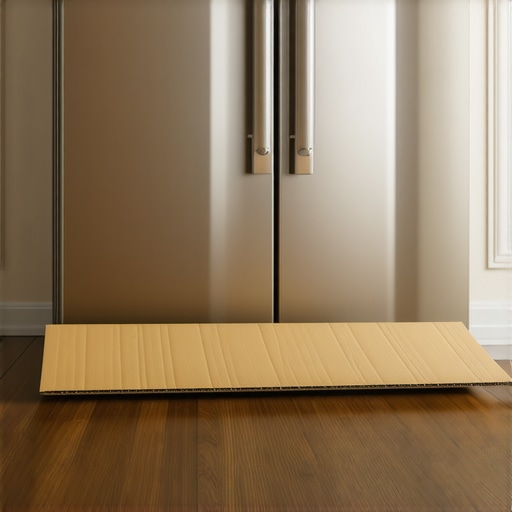
The expansion gap is the empty space left around the perimeter of a room to allow the floor to grow. If this gap is missing or blocked by heavy cabinetry, the floor will bind and buckle. Heavy refrigerators act as a secondary wall that traps the floor planks in place. I see it all the time. An installer leaves a gap at the wall but then puts a 500 pound fridge in the middle of a run. The floor is now pinched between the wall and the fridge. When the floor expands, it hits that fridge and has nowhere to go. This is why you often see the edges of the planks near the kitchen stove or fridge starting to lift. You must treat the area under the fridge with the same respect as the rest of the floor. In some cases, it is actually better to install the floor around the area where the fridge sits or to use a specialized glide plate to distribute the weight. Laminate is a composite of wood particles and melamine resin. These materials are incredibly strong under compression but very weak under shear stress. The fridge provides the shear stress that destroys the integrity of the HDF core.
The moisture trap under the compressor
Refrigerators generate heat and occasionally leak small amounts of moisture from condensation or defrost cycles. This creates a microclimate of high humidity directly under the appliance. This localized moisture causes the laminate edges to swell significantly faster than the rest of the floor. When wood fibers swell, they lose their structural density. The edges of the laminate are the most vulnerable part because the protective wear layer does not wrap around the tongue and groove. Once moisture gets into that joint, the HDF core expands like a sponge. This makes the edge higher than the surrounding floor, which makes it even more likely to get caught and chipped by shoes or the fridge wheels. If you are doing a carpet install in a bedroom, moisture is less of a concern for the structure, but in a kitchen or near showers, it is the number one enemy. You must seal the perimeter of the floor in these high-risk areas with a 100 percent silicone sealant to prevent water from reaching the subfloor. This is especially true in regions like Houston where the ambient humidity is already pushing the limits of what wood products can handle.
“Standard laminate flooring requires a minimum 1/4 inch expansion gap around all vertical obstructions to accommodate thermal movement.” – NWFA Technical Guidelines
Technical specifications for heavy load flooring
When you are dealing with heavy appliances, you need to look at the AC rating and the density of the core. An AC4 or AC5 rating is better for kitchens because it can handle more abrasive wear, but it does nothing for the weight. The density of the core, measured in kilograms per cubic meter, is what matters for static load. A high-density core will resist crushing better than a cheap, airy board from a big-box store. Also, pay attention to the mil thickness of the wear layer. While we often talk about mils in the context of LVP, the protective lacquer on laminate serves a similar purpose. Below is a comparison of how different materials handle the stresses of a kitchen environment.
| Material Type | Static Load Resistance | Moisture Sensitivity | Expansion Requirement |
|---|---|---|---|
| Laminate (HDF) | Moderate | High | High |
| SPC Vinyl Plank | High | Low | Low |
| Solid Hardwood | Very High | Moderate | Very High |
| Engineered Wood | High | Moderate | Moderate |
The 1/8 inch that ruins everything
Precision is the difference between a floor that lasts thirty years and one that fails in three months. Professional standards require subfloors to be flat within 1/8 inch over a 10 foot radius. Anything less is a gamble. Most people think a little dip doesn’t matter. They are wrong. When the fridge sits on a plank that is spanning a dip, the plank is under constant tension. This is called bridge loading. The moment someone walks past the fridge, that tension increases. Eventually, the clicking starts. That click is the sound of the tongue grinding against the groove. It is the sound of your investment dying. If you find a dip, you must fill it. If you find a hump, you must sand it down. There are no shortcuts. This is why I carry a 10 foot straightedge to every job. I don’t trust my eyes, and you shouldn’t either. Even in bathroom installs or near showers, the levelness of the floor dictates how well the water drains and how well the transition pieces sit. A flat floor is a happy floor.
Kitchen installation checklist
- Check subfloor for 1/8 inch flatness over a 10 foot span.
- Install a 6-mil poly vapor barrier over concrete slabs.
- Verify that the refrigerator has leveling legs to distribute weight.
- Leave a minimum 3/8 inch expansion gap around all cabinets and walls.
- Use 100 percent silicone in the expansion gap near water sources.
- Acclimate the flooring in the kitchen for at least 48 hours.
- Check the moisture content of the subfloor using a pinless meter.
Stop treating your floor like a rug. It is a piece of engineering. If you want to put a heavy fridge on a floating floor, you have to follow the rules of physics. Use a high-quality leveler, respect the expansion gaps, and for the love of all that is holy, stop buying the cheapest underlayment you can find. A floor is a system. If one part of that system fails, the whole thing goes. Keep your subfloor flat and your gaps wide, and your laminate might actually survive the kitchen. Fail to do that, and you will be calling someone like me to tear it all out in two years. I have seen it enough to know that the floor always wins the argument. Don’t let a heavy appliance turn your dream kitchen into a clicking, buckling nightmare. Check your levels and do it right the first time.