Why Your Laminate Flooring is Separating at the Short Ends
The Mechanical Reality of Short End Separation in Laminate Flooring
I spent three days grinding concrete on a job last month just so the floor wouldn’t click like a castanet. Most guys skip the leveling compound because it is messy, expensive, and takes time to dry. They think the underlayment will hide the dip. It won’t. I can still smell the oak dust and the faint hint of WD-40 on my knee pads from that job. I walked in and saw the short ends of the planks pulling apart like a bad divorce. The homeowner was blaming the product, but the product was fine. The subfloor was a mountain range of peaks and valleys. When you walk across a floor with a dip, the plank flexes. That flex puts a massive amount of torque on the smallest part of the plank, the short end locking mechanism. Eventually, that mechanical lock fails. It snaps. Or it just slides out because the friction can no longer hold the tension of the subfloor deflection.
The structural lie of the easy install
Separation at the short ends occurs because the subfloor fails to meet the flatness tolerance of 3/16 inch over a 10 foot radius. When a laminate plank spans a low spot, every step creates a lever effect that pulls the butt joints apart. This is not a product defect, it is an installation failure rooted in poor site preparation and a lack of floor leveling. Most installers treat laminate as a cosmetic cover, but it is a structural performance surface that requires a perfectly planar base. When the subfloor is uneven, the vertical movement of the planks during foot traffic converts into horizontal force. This force focuses entirely on the short ends of the boards. Because the short end has significantly less surface area and mechanical engagement than the long side, it is the first point of failure. You might not see it the first week, but after three months of seasonal humidity changes and thousands of footfalls, those gaps will appear. They start as a hairline and grow into a debris-trapping canyon.
“A floor is only as good as the subfloor beneath it; deflection is the enemy of every joint.” – Master Flooring Axiom
Mechanical failure of the butt joint locking system
The short end of a laminate plank relies on a drop-lock or click-lock geometry that lacks the surface area of the long edges. Without the long-edge friction to stabilize the plank, any vertical deflection causes the tongue to slide out of the groove or fracture the HDF core. The chemistry of the high-density fiberboard (HDF) is part of this equation. HDF is made of wood fibers bound with melamine-urea-formaldehyde resin. While this makes for a very hard core, it is not indestructible. When a plank is forced to bend over a subfloor dip, the resin bonds are stressed. In many cases, the installer used a tapping block too aggressively, causing micro-fractures in the tongue before the floor was even finished. These micro-fractures compromise the structural integrity of the joint. When the house settles or the humidity shifts, the damaged joint can no longer resist the tension, and the gap opens up.
Laminate Locking System Comparison
| Locking Type | Mechanical Strength | Tolerance for Deflection | Installation Difficulty |
|---|---|---|---|
| Angle-Angle | High | Low | Moderate |
| Drop-Lock | Moderate | Very Low | Easy |
| Uniclic Profile | Very High | Moderate | High |
Hidden subfloor topography and its destructive force
Subfloor topography refers to the dips, humps, and ridges in the concrete or plywood base that prevent the laminate from laying flat. If the subfloor is not leveled to within 1/8 inch over 6 feet, the laminate will bridge the gaps, creating air pockets that lead to joint separation. This is particularly common in areas near showers where moisture might have previously warped a plywood subfloor. Many people transition from a carpet install to laminate without realizing that carpet hides a multitude of sins. Carpet padding can absorb a half-inch dip without you ever feeling it. Laminate is unforgiving. It is a rigid product that expects a rigid, flat surface. When you remove that old carpet, you have to spend the time with a 10-foot straight edge. You have to mark every low spot with a pencil and fill it with a high-quality, polymer-modified leveling compound. If you skip this, the short ends of your laminate will eventually separate as the planks seek the lowest point of the floor.
Temperature shifts and the coefficient of expansion
Laminate flooring expands and contracts based on the temperature and humidity of the room, requiring a minimum 3/8 inch expansion gap. If the floor is pinned against a wall or a heavy kitchen island, it cannot move as a single unit, causing the weakest joints to pull apart. This is a matter of physics. The wood fibers in the HDF core are hygroscopic, meaning they absorb and release moisture from the air. Even in a climate-controlled room, there are shifts. If the floor is locked in place by a heavy object, the expansion force has nowhere to go. The pressure builds until the mechanical lock at the short end of a plank gives way. This is why we never install kitchen cabinets on top of a floating floor. The weight of the cabinets anchors the planks, preventing the natural movement required for the floor to stay intact. When the rest of the floor tries to shrink during a dry winter, the anchored section stays put, and the closest short-end joint is ripped open.
The microscopic reality of HDF core moisture absorption
Moisture vapor emission from a concrete slab can cause the HDF core to swell, distorting the locking mechanism and leading to gaps. Even if the surface of the laminate is waterproof, the underside is often vulnerable to the microscopic transmission of water vapor that moves through porous concrete. This is why a 6-mil poly film moisture barrier is not optional, it is a requirement. When moisture enters the HDF core from below, the fibers at the bottom of the plank expand more than the fibers at the top. This causes the plank to cup or bow. This distortion changes the angle of the locking mechanism. Once the tongue and groove are no longer perfectly aligned, the tension of the floor’s weight will cause the joint to disengage. We measure this using anhydrous calcium chloride tests or electronic moisture meters. If you are seeing short-end separation near a bathroom or shower, it is almost certain that moisture is the primary driver of the structural failure.
“Wood and laminate flooring will always seek an equilibrium with their environment; the installer’s job is to manage that transition.” – Master Flooring Axiom
Mistakes made during the initial carpet install transition
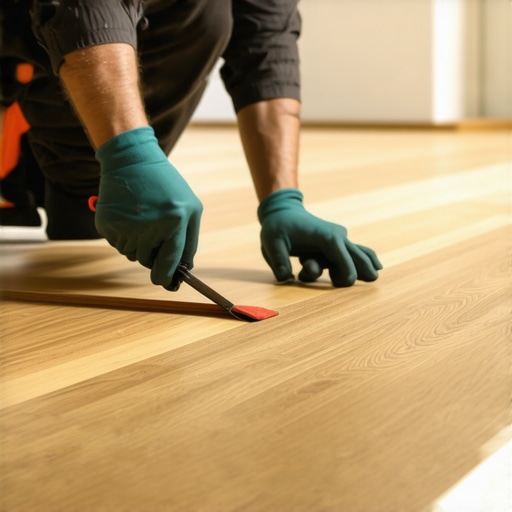
Problems often arise when a homeowner replaces a carpet install with laminate without adjusting the subfloor height or checking for levelness. Carpet installers often use tack strips and staples that can leave the subfloor scarred and uneven, requiring significant prep work before a floating floor can be laid. If you have just pulled up carpet, you are looking at a subfloor that has been hidden for years. There might be old adhesive, floor leveling compounds that have cracked, or plywood seams that have peaked. All of these high spots act as fulcrums. When a laminate plank sits on a high spot, it teeters. This teetering action puts constant upward pressure on the short ends of the neighboring planks. Over time, the locking system fatigues. You must scrape the floor clean, sand down high spots, and ensure the surface is pristine before the first plank of laminate touches the ground.
Short End Separation Checklist
- Check the perimeter expansion gap for obstructions like nails or tight baseboards.
- Use a moisture meter to verify the subfloor is within 2 percent of the laminate core.
- Inspect the locking mechanism for broken tongues or debris in the groove.
- Verify subfloor flatness using a 10-foot straight edge across the room.
- Assess the weight of furniture to ensure the floor is not pinned in one corner.
Solving the gap with suction and adhesive
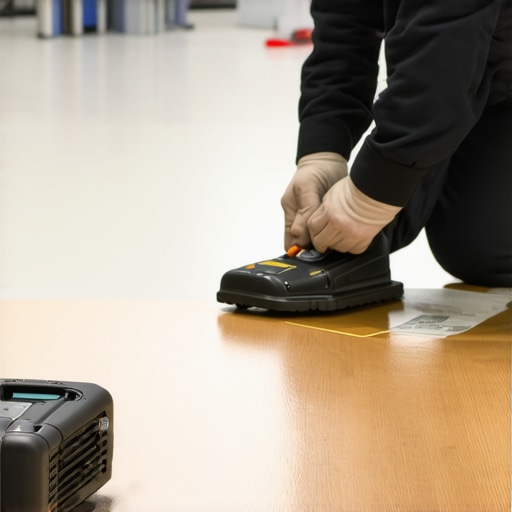
You can often fix a separated short end by using a floor gap fixer tool, which is a suction block that allows you to kick the planks back together. Before doing this, you must clean the debris out of the gap and apply a small amount of PVA wood glue to the tongue to prevent it from sliding out again. This is a surgical repair. First, you vacuum the gap to ensure no grit or dust will prevent a tight fit. Then, you attach the suction block to the plank that has moved. With a rubber mallet, you strike the block toward the gap. The goal is to slide the plank back into its original position. If the locking mechanism is not broken, it should click back into place. The glue provides a chemical bond that helps the weakened mechanical lock hold. However, this is a temporary fix if the underlying cause, such as an unlevel subfloor, is not addressed. The floor will eventually try to move again because the physics of the dip remain.
Why floor leveling is the only permanent cure
Permanent stability for laminate flooring requires a subfloor that is flat to the manufacturer’s specifications, usually achieved through self-leveling underlayments. If the separation is widespread across the room, the only real solution is to pull up the floor, level the subfloor, and reinstall the planks. I know that is not what people want to hear. They want a quick fix. But you cannot fight the physics of a moving floor. If you have a 1/4 inch dip in the middle of your living room, every time you walk across it, you are testing the tensile strength of that HDF core. Eventually, the core will fail. By using a high-flow self-leveling compound, you create a flat plane that supports the entire surface of the plank. This eliminates the lever effect and allows the locking mechanisms to do their job without being under constant stress. It is the difference between a floor that lasts twenty years and one that fails in twenty months. Do the work on the subfloor first, and you will never have to worry about your short ends opening up again.