How to Patch a Cigarette Burn in a Plush Carpet Without Leaving a Trace
A cigarette burn in a high-quality plush carpet is more than a cosmetic blemish. It is a structural failure of the synthetic fibers. Most homeowners look at that blackened pit and see a ruined room. They think about the cost of a full carpet install. They worry about the subfloor underneath. But as a master installer with twenty-five years on my knees, I see a surgical opportunity. You do not need to replace the room. You do not even need to call a professional if you have a steady hand and an understanding of fiber physics. This process is about precision, chemistry, and the invisible logic of the nap. If you follow these steps, that burn will vanish into the pile, leaving no ghost behind. We are talking about molecular alignment and adhesive bonding that rivals the original factory construction.
The anatomy of a ruined carpet fiber
Plush carpet fibers are usually synthetic, often made from nylon or polyester. A cigarette burn causes immediate melting, which fuses these plastic strands into a hard and blackened globule of ruined polymer. You cannot clean or brush this out. You must physically remove the damaged area and replace it with a donor piece. This is not just about looks. It is about the integrity of the secondary backing. When a cigarette hits the floor, the heat can penetrate through the primary backing and hit the latex layer. If that latex melts, the structural tension of the carpet is compromised. You are no longer just fixing a spot. You are reinforcing a localized structural failure. This is why we treat a patch like an organ transplant. You need a perfect match, a clean incision, and a bond that will not fail under the friction of a vacuum or the weight of a heavy dresser.
The subfloor secret that ruins every patch
Most guys skip the leveling compound. They think the underlayment will hide the dip. It won’t. I spent three days grinding concrete on a job last month just so the floor wouldn’t click like a castanet. That experience applies to carpet more than people realize. If your subfloor is uneven, your carpet patch will eventually show. When you cut into a carpet to fix a burn, you are exposing the subfloor. If there is a dip or a crack in the concrete or plywood underneath, that patch will settle differently than the surrounding area. I have seen patches that looked perfect on day one but turned into visible craters by month six because the installer ignored the substrate. Always inspect the floor leveling situation before you glue down your donor piece. If the subfloor is dusty or crumbling, your adhesive will stick to the dust, not the floor. That patch will kick loose the first time someone walks on it in heavy boots.
“A floor is only as good as the subfloor beneath it, and deflection is the enemy of every joint.” – Master Flooring Axiom
The donor site scavenge
Finding the right donor carpet is the most critical phase of the repair process. You need a piece of carpet that has the same dye lot, the same wear pattern, and the same sun exposure as the damaged area. Usually, the best place to find this is inside a closet or behind a baseboard. You cannot just go to the store and buy a remnant of the same brand. The UV rays in your living room have likely faded your carpet by a fraction of a shade. If you take a brand new piece from the roll and drop it into the middle of a five year old floor, it will look like a bright neon sign. I always go to the back of the master closet. I cut a small square from the corner, making sure I am not near the tack strip. If I have to, I will even perform a small floor leveling operation in the closet to make sure the donor site stays flat after I replace that piece with a scrap. This ensures the nap matches the traffic pattern as closely as possible.
The scalpel and the structural incision
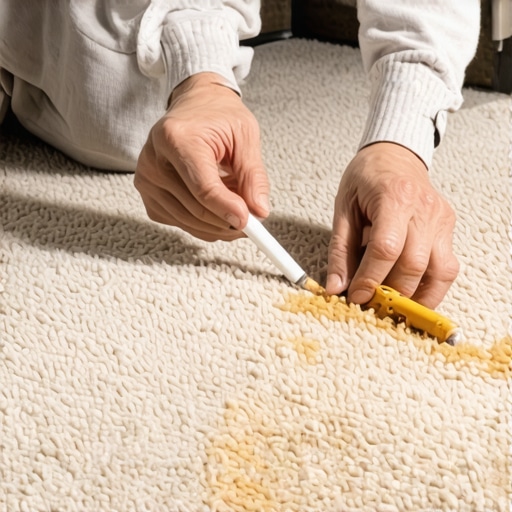
Cutting the carpet requires a surgical grade utility knife with a fresh blade. You must cut through the primary and secondary backing without slicing into the subfloor or the padding. The goal is to create a clean void that the donor piece can fill with zero tolerance. You should use a