The Dollar Bill Trick for Checking Laminate Expansion Space
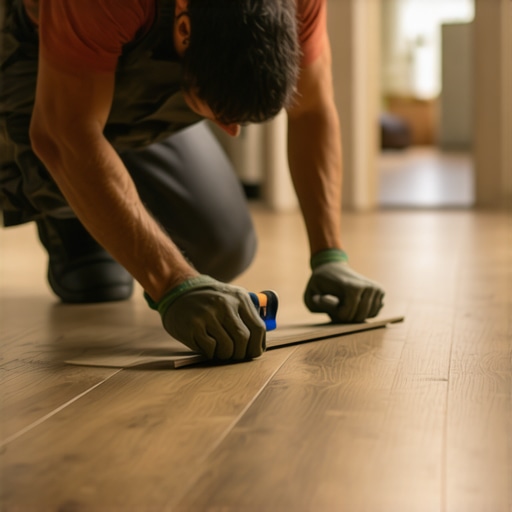
The dollar bill trick is a fundamental field test used by professional flooring installers to verify that a floating floor has the necessary room to breathe against a vertical obstruction. By sliding a crisp bill into the gap between the laminate plank and the drywall or baseboard, you can confirm a minimum clearance of roughly 0.004 inches, though industry standards usually require a full quarter to half inch. This simple check identifies if the floor is pinched, which prevents the inevitable buckling that occurs during seasonal humidity shifts.
I remember a job back in ninety-eight where a homeowner called me out because their kitchen floor was literally lifting off the joists like a tectonic plate. They had installed a beautiful high-pressure laminate but then bolted a massive granite-topped kitchen island right through the planks into the subfloor. They effectively locked the floor in place. When the summer humidity hit, that floor had nowhere to go but up. It is the classic mistake of treating a floating floor like a permanent structural element rather than a living, moving organism that reacts to every drop of moisture in the air. I spent three days dismantling that island just to give the floor the three-eighths of an inch it was screaming for. You smell the oak dust and the machine oil on my clothes and you realize I have seen this tragedy a hundred times. A floor is a machine, and like any machine, it needs tolerances to function.
The mechanics of the dollar bill gap test
The dollar bill test ensures a floating floor has not been installed too tight against walls or transitions to allow for expansion. If you cannot slide a bill into the gap, the floor is at risk of peaking or joint failure. This test is a baseline diagnostic tool for any professional flooring inspection. When we talk about the dollar bill trick, we are talking about the margin of error between a successful long-term installation and a total failure. Laminate is essentially a photograph of wood glued to a core of high-density fiberboard. That core is hygroscopic, meaning it drinks moisture from the air. When those fibers absorb water, they expand. If you have not left a gap at the perimeter, those expanding planks will push against the wall. Since the wall will not move, the floor must. It will bow upward at the weakest joint, creating a soft spot or a visible peak. The dollar bill is your first line of defense. It is thin, but it represents the presence of a void. If that void is gone, your floor is a ticking time bomb.
“A floor is only as good as the subfloor beneath it; deflection is the enemy of every joint.” – Master Flooring Axiom
The physics of thermal expansion in laminate cores
Laminate flooring is a composite material dominated by the behavior of its HDF core. Under a microscope, HDF is a matrix of wood fibers compressed with resin. These fibers are incredibly sensitive to the partial pressure of water vapor in the room. As the relative humidity rises from thirty percent to sixty percent, the linear expansion of a twenty foot run of laminate can be as much as half an inch. This is not a suggestion. It is physics. The force exerted by expanding wood fibers is enough to crack grout lines and snap the plastic locking tongues on modern click-lock systems. We use the dollar bill trick to ensure that the initial gap was at least maintained during the molding installation. If the trim carpenter nailed the baseboard too tight against the floor or through the floor, the dollar bill will snag. That snag tells you that the floor is no longer floating. It is anchored. An anchored floating floor will always fail. I have seen guys use heavy-duty t-moldings that were screwed down so tight they acted like a clamp. You need that gap to be clean and clear of any debris or nails.
| Material Type | Expansion Rate (per 10ft) | Acclimation Time | Core Density |
|---|---|---|---|
| Laminate (HDF) | 0.25 inches | 48 Hours | 850 kg/m3 |
| Engineered Hardwood | 0.15 inches | 72 Hours | 700 kg/m3 |
| Solid White Oak | 0.40 inches | 7+ Days | 750 kg/m3 |
| SPC Vinyl (Stone Core) | 0.05 inches | 24 Hours | 2000 kg/m3 |
Why heavy furniture creates a floor lockdown
A floating floor is designed to move as a single monolithic slab. When you place a heavy refrigerator or a pool table on one end and a heavy bookshelf on the other, you are effectively pinning the floor. This is why we insist on the dollar bill trick at the perimeters where these heavy loads are closest. If the floor is pinned by weight, the expansion will be forced toward the side with the least resistance. If that side is also tight against a wall, the floor will buckle in the center. I once saw a carpet install where the transition strip to the laminate was nailed directly into the laminate plank. It was a disaster. The installer thought he was being helpful by making it sturdy. Instead, he created a pivot point. Every time the furnace kicked on and the air dried out, the floor would pull away from that transition, leaving a gap. When the humidity returned, the floor would push against the nail and hump up three inches high. It looked like a mole was tunneling under the house.
The structural reality of subfloor leveling
Floor leveling is the stage where most amateurs fail. You cannot hide a dip with extra padding. If your subfloor has a deviation of more than three-sixteenths of an inch over a ten-foot span, the locking mechanisms will be under constant vertical stress. Imagine the tongue and groove joint as a tiny bridge. Every time you walk over a low spot, that bridge flexes. Eventually, the HDF will fatigue and the joint will snap. No amount of dollar bill testing will save a floor that is installed on a roller coaster of a subfloor. I spend more time with a straightedge and self-leveling compound than I do actually laying planks. You have to grind down the high spots on the concrete and fill the low spots. If you are working over a crawlspace, you must check the moisture levels. High moisture from below will swell the bottom of the plank while the top stays dry, leading to cupping. I have seen beautiful laminate floors look like potato chips because the installer skipped the six-mil poly vapor barrier on a concrete slab.
- Check subfloor flatness using a ten-foot straightedge.
- Ensure a minimum of six-mil polyethylene vapor barrier on concrete.
- Maintain a quarter-inch expansion gap around all vertical obstructions.
- Acclimate the flooring in the room for at least forty-eight hours.
- Verify that baseboards are nailed to the wall, not the floor.
The ghost in the expansion gap
Most homeowners hate the look of a wide expansion gap. They want the floor to run tight against the stone of a fireplace or the tile of a shower. But the physics of the material do not care about your aesthetic preferences. Near showers, the risk is even higher. The high localized humidity from steam will cause the edges of the laminate to swell faster than the rest of the floor. If you do not have a proper transition and a waterproof silicone seal that remains flexible, you will see edge peaking within six months. The dollar bill trick near a shower door or a bathroom transition is vital. You need to ensure that the floor can move under the transition strip. If the transition is glued to the floor instead of the subfloor, you have a problem. I always use a high-quality flexible sealant in these areas, but the physical gap must remain. You are managing the movement of molecules. It is a chemical and mechanical battle that you will lose if you do not respect the math of the expansion.
“Deflection is a silent killer; if the subfloor moves, the finish floor will eventually follow.” – Master Flooring Axiom
Regional humidity and the threat to your planks
If you are in a swampy environment like Houston or a coastal area, your expansion gaps need to be even more generous. The air is heavy with water. A standard quarter-inch gap might not be enough for a wide-room installation. Conversely, in the bone-dry heat of Phoenix, the floor will shrink. If you do not acclimate the floor to that dry environment, you will end up with gaps between the planks as they contract. The dollar bill trick is most useful after the floor has been down for a few weeks. Go around and check the gaps. If you find sections where the bill will not fit, you need to pull the baseboard and trim the planks. It is a pain in the neck, but it beats replacing the whole floor. Laminate is a fantastic product when installed with respect for its limitations. It is durable and beautiful, but it is not a rigid board. It is a dynamic system. Treat it with the precision of an engineer and it will last thirty years. Treat it like a rug and you will be tearing it out in two. Keep your moisture meter calibrated and your spacers handy. The physics of the floor will always win the argument.